
One guide per application, written from the interface up.
Each guide says what the application governs, the governed flow it runs on, and shows the application’s own screens rather than an illustration of them.
Four things every guide has to answer.
Including the last one, which is usually the fastest way to judge whether an application is honest about its own limits.
What it governs
The class of record the application owns end to end, and the part of the operation that keeps it.
The flow it runs on
The governed sequence the application actually enforces, stage by stage, in the application’s own terms.
The interface itself
The application’s own screens, shown complete and at their own proportions rather than illustrated.
What it will not do
The figures it declines to compute and the claims it does not make; stated as plainly as the capabilities.
CCMS: Completion, Commissioning & Handover Management System
ITRs, punch lists, certificate sequence and turnover packages.
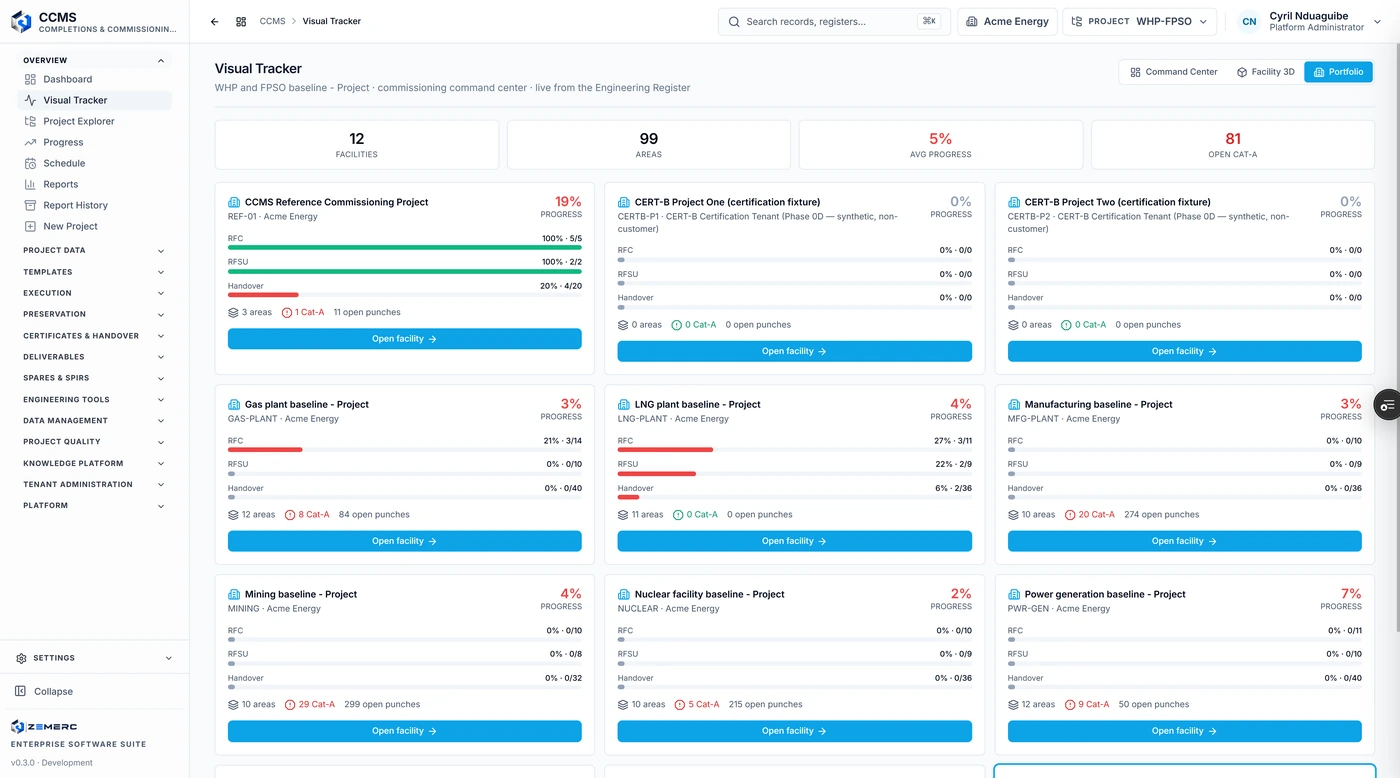
Every facility in the programme with its readiness position shown as completed against total rather than as a percentage alone, with its areas and open punch.
27 applications, grouped by the stage they serve.
Four stages of an industrial operation, eight operating areas, and one guide for every application inside them.
- PDMS
PDMS: Project Delivery Management System
Portfolio → Project workspace → Stage gate → Delivery governance
Open the guide - BCMS
BCMS: Budget & Cost Management System
Estimate → Budget → Commitment → Actual → Forecast
Open the guide - IFMS
IFMS: Interface Management System
Interface identified → Agreed → Decision recorded → Closed
Open the guide
- CVMS
CVMS: Contractor / Vendor Management System
Qualification → Computed compliance → Supplier portal → Scorecard
Open the guide - PMS
PMS: Procurement Management System
Requisition → Sealed tender → Award → Purchase order → Receipt
Open the guide - CMS
CMS: Contracts Management System
Contract → Obligation → Claim → Payment certification
Open the guide - LGMS
LGMS: Logistics Management System
Movement plan → Scenario comparison → Marine & berth check → Execution
Open the guide
- CCMS
CCMS: Completion, Commissioning & Handover Management System
ITR → Punch list → Certificate chain → Turnover package
Open the guide - QMS
QMS: Quality Management System
ITP → Inspection → NCR / CAPA → Quality dossier
Open the guide - SPIR
SPIR: Spare Parts Interchangeability Record Management System
Vendor data → SPIR register → Transmittal → Digital handover
Open the guide
- OPEP
OPEP: Offshore Projects Execution Platform
Project record → Readiness gate → Offshore execution → Field update
Open the guide - OPMS
OPMS: Offshore Projects Management System
Daily field input → PT / NPT productivity → Portfolio consolidation → Management bulletin
Open the guide - VMT
VMT: Vessel Management Tracker
Vessel & charter → Campaign → Daily operations → Downtime & off-hire
Open the guide
- AIRMS
AIRMS: Asset Integrity & Reliability Management System
Asset 360 → Inspection → Integrity record → Barrier assurance
Open the guide - RAMS
RAMS: Reliability, Availability & Maintainability Management System
Reliability model → Analysis → Availability → Maintainability
Open the guide - EAMS
EAMS: Enterprise Asset Management System
Asset → Condition → Work order → Preventive maintenance
Open the guide - OMS
OMS: Obsolescence Management System
Lifecycle risk → Where-used impact → Mitigation case → Lifetime buy
Open the guide
- HSE
HSE: Health, Safety & Environment Management System
Permit → Field report → Incident → Emergency response
Open the guide - PSM
PSM: Process Safety Management System
PHA → Barrier & SIF → Management of change → Proof test
Open the guide - TSM
TSM: Technical Safety Management System
Hazard register → ALARP → Safety case → SCE assurance
Open the guide - RMS
RMS: Risk Management System
Risk register → Workshop → BowTie → Control effectiveness
Open the guide
- IMS
IMS: Integrated Management System
Understand → Build → Operate
Open the guide - ESG
ESG: Environmental, Social & Governance Management System
Data → Materiality → Framework → Report
Open the guide - EDMS
EDMS: Enterprise Document Management System
Registered → Revised → Reviewed & approved → Published & distributed
Open the guide - LLMS
LLMS: Lessons Learned Management System
Captured → Reviewed → Approved → Retained & reused
Open the guide

Start at what it will not tell you.
Every guide states the figures its application declines to compute and the claims it does not make. On industrial software that section is more informative than the capability list, because it is the part nobody writes unless it is true.
- The governed flow is the application’s own, not a generic lifecycle
- Screens are shown complete, at the application’s own proportions
- Where a capability is not yet real, it is not described as live
Read a guide, then see it running.
The guides show the interface. A working session shows it against your own register, which is the part that settles anything.