
Asset Integrity & Reliability Management System
Engineering judgement, recorded and auditable.
The enterprise system of record for asset integrity, from concept and design through operation and life extension to decommissioning; holding inspection, corrosion, risk-based inspection, fitness-for-service, defects, barriers and reliability as governed registers an auditor can read back.
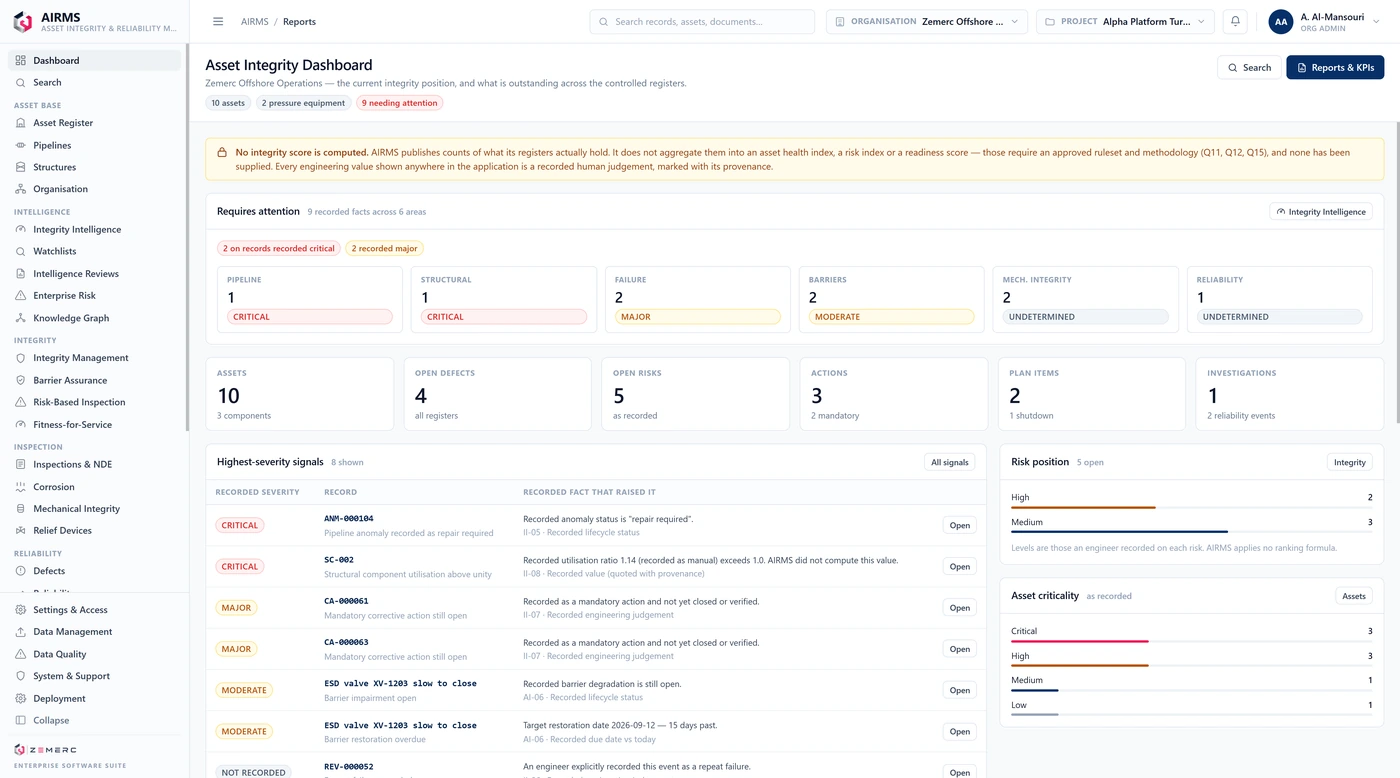
AIRMS publishes what its registers hold. It does not invent the rest.
Most integrity tools will give you a health index. AIRMS will not, because an index needs an approved ruleset and methodology that belongs to your organisation, not to a vendor. What it gives instead is every count, every recorded judgement and the provenance behind them.
No integrity score
No asset health index, no risk index, no readiness score. Criticality and risk levels are the ones an engineer recorded against each asset, and AIRMS applies no ranking formula over them.
No derived reliability metric
Mean time between failures, mean time to repair and availability are recorded, imported or deferred; never inferred from missing timestamps. An unrecorded value shows as unknown, not as zero.
No fabricated assessment
Risk-based inspection and fitness-for-service are governed, revisioned registers of assessments that engineers made. They are records of judgement, not calculators pretending to it.
Eight module groups, one asset record beneath them.
The application's own navigation, from the asset base through integrity, inspection, reliability and planning to the records layer. Every chip is a page.
The asset base
One register for the assets themselves, with pipelines, structures and the operating organisation held beside them, so every integrity record has somewhere definite to hang.
- Asset Register
- Pipelines
- Structures
- Organisation
- Search
Integrity management
Integrity strategy, barrier assurance with performance standards, risk-based inspection and fitness-for-service, all held as governed, revisioned registers of assessments rather than as calculators.
- Integrity Management
- Barrier Assurance
- Risk-Based Inspection
- Fitness-for-Service
Inspection and condition
Inspections and non-destructive examination, corrosion with immutable thickness readings, mechanical integrity and relief devices; the measured condition behind every judgement.
- Inspections & NDE
- Corrosion
- Mechanical Integrity
- Relief Devices
Defects and reliability
A defect lifecycle that will not close without evidence, reliability programmes with their recorded exposure, and failure investigations that establish cause rather than assert it.
- Defects
- Reliability
- Failure Investigations
Planning and shutdowns
Inspection planning and shutdown scope built from what the registers actually hold, so a campaign is planned against recorded condition and not against an assumption.
- Inspection Planning
- Shutdowns
Intelligence and records
Deterministic surveillance with watchlists and reviews, an enterprise risk view, a knowledge graph and library, and the documents, reports, workflow, notifications and audit trail beneath them.
- Integrity Intelligence
- Watchlists
- Intelligence Reviews
- Enterprise Risk
- Knowledge Graph
- Documents
- Reports
- Audit Trail
A barrier is assured by activity that actually happened, not by a policy that says it should.
Performance standards carry their governing standard and assurance frequency. Each assurance activity records what was performed and what was found, and verification is refused where the activity was not actually performed. Degradations and impairments are tracked to restoration.
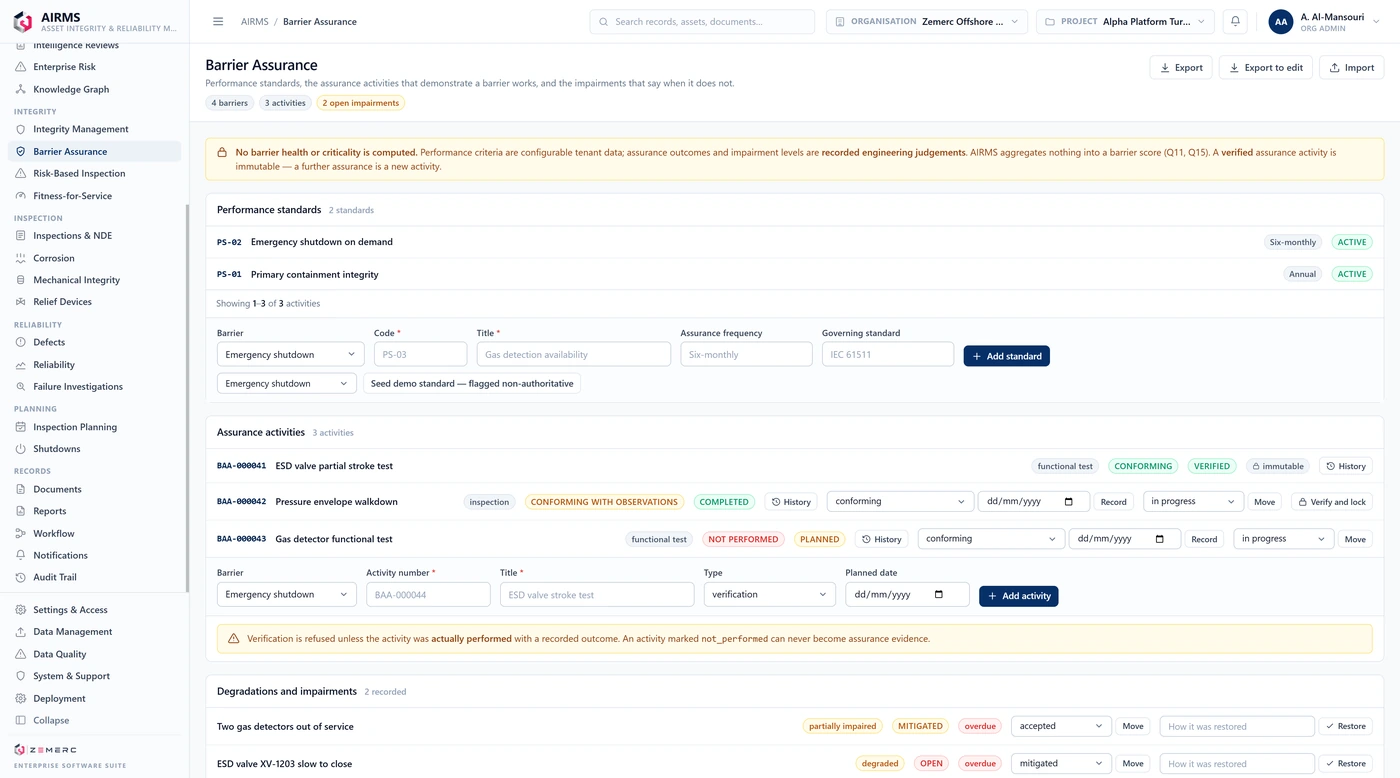
No barrier health or criticality is computed. Performance criteria are tenant data, and assurance outcomes are recorded engineering judgements.
- Immutable once assuredA verified assurance activity cannot be edited afterwards. A further assurance is a new activity with its own record.
- Impairment has a positionA degraded or impaired barrier carries its mitigation and its restoration state, so nothing sits impaired without a route back.
- Standards are namedEach performance standard records the governing standard it answers to, rather than asserting conformance in general terms.
Every integrity record hangs on something definite.
Assets, pipelines and structures sit under the operating organisation, so an inspection, a thickness reading or a defect always has an unambiguous owner.
A defect closes against evidence, or it does not close.
Five states, and the last one is gated. Corrective actions carry an owner and a date, and the defect cannot be closed while the evidence that justifies closing it is missing.
Exposure is recorded, so the rate means something.
A reliability programme carries its taxonomy reference and its operating and exposure periods. Failure events record the class, the mode, the downtime and the repair hours as they were observed.
- Operating hours left blank where they are unknown, never assumed
- Failure investigations establish cause rather than assert it
- Repeat failures are marked as repeats against the same equipment
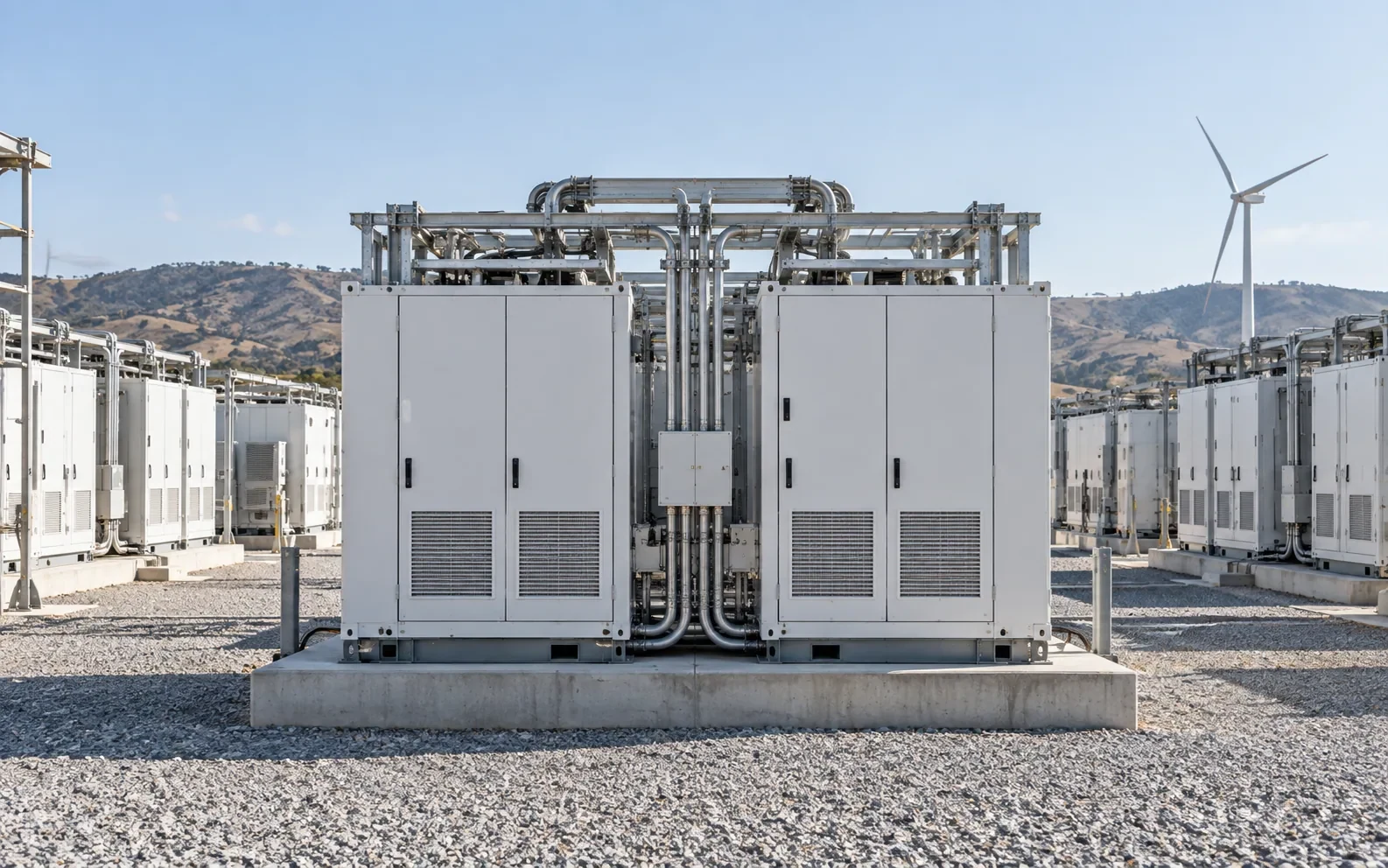
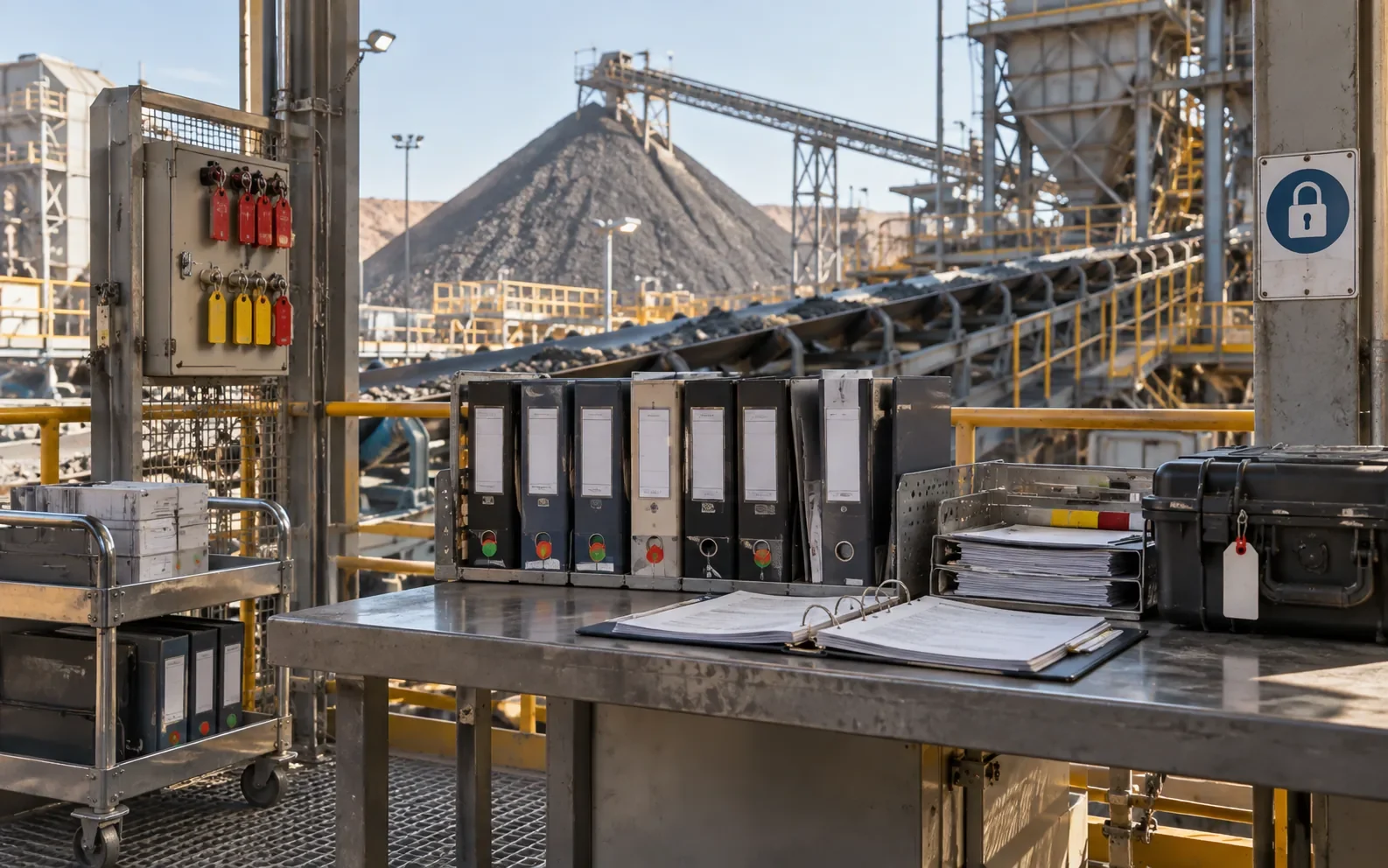
Written for the technical authority who has to sign.
Integrity engineers, inspectors, corrosion engineers and the technical authority work the same registers. The separation that matters is between the engineering timeline; what was found and decided; and the audit history of who changed what, and AIRMS keeps them apart.
- Asset 360 brings identity, criticality, strategy and history into one view
- The engineering timeline is kept separate from the audit history
- Six roles, with tenant isolation enforced beneath them
Twenty-one formal reports, and every figure a count.
Each report states the columns and the scope it prints before it is generated. Data quality is evaluated by deterministic checks that say what is wrong, why it matters and what a corrected record looks like.

A failed check tells an engineer exactly what to correct.
Each check states what is wrong, why it matters downstream, worked examples of a corrected record, and a route straight to the register that holds the offending entry.
A blank field means unknown
An unrecorded value is never treated as zero. Where a figure has no recorded basis the application shows that it has none, and says what would have to be recorded for it to appear.
Immutable where it matters
Thickness readings and approved assessment revisions cannot be edited after the fact. A correction is a new revision with its own provenance, and the earlier one stays readable.
Evidence-gated closure
A defect, an assurance activity and an action each close only against the evidence that justifies it. Verification is refused where the activity was not actually performed.
Deterministic checks, not scores
Data quality is evaluated by explicit checks with stated reasons and worked examples, so a failure tells an engineer exactly what to correct.
More of what the application covers.
- Asset 360: identity, criticality, strategy and history in one view
- Immutable corrosion thickness readings with provenance
- Pipeline and structural integrity registers
- Shutdown scope built from recorded condition
- Watchlists and intelligence reviews
- Knowledge graph and knowledge library
- Documents with optical character recognition and full-text search
- Governed import, export, bulk update and historical migration
Integrity judgement, beside the systems that act on it.
- RAMSRAMS: Reliability, Availability & Maintainability Management SystemQuantitative reliability, availability and maintainability analysis; AIRMS holds the failure and integrity record behind it.
- EAMSEAMS: Enterprise Asset Management SystemMaintenance execution and work orders; AIRMS holds the integrity judgement that drives the work.
- SPIRSPIR: Spare Parts Interchangeability Record Management SystemSpares and interchangeability; AIRMS names the equipment whose supportability matters.
- OMSOMS: Obsolescence Management SystemObsolescence and lifetime-buy decisions for the equipment AIRMS keeps in service.
See AIRMS with one of your integrity registers.
Bring one asset’s inspection history and one open defect. We will show the registers they land in, the assessment record they produce and the evidence closure would require.