
The yard, the vessel and the platform, on one project record.
Offshore projects often span different systems across fabrication, marine execution and completions. The critical risk lies at the hand-offs, where incomplete readiness can result in vessel standby, missed load-out or unconfirmed system availability.
- 0
- Applications serving this industry
- 0
- Operating areas
- 0
- Stages in the lifecycle

What this industry is actually like to run.
Offshore execution, marine spreads and campaign logistics, run from a daily operational record that both the vessel and the shore organisation work from.
The execution window is constrained and costly.
Weather, vessel availability and crew rotations may align for only a limited period, so work that is not ready can defer until the next viable window.
Everything reaches the work front through a constrained logistics chain.
Berths, manifests, persons on board, cargo and vessel capacity all affect whether planned work can proceed.
Readiness has to be provable
Nobody sails on an opinion. Whether a system is ready has to be derived from check sheets, certificates and punch rather than declared at the morning meeting.
Every one of these is a failure a governed record prevents.
Not a list of features. Each row is something that goes wrong in this industry, and the specific control in a Zemerc application that stops it happening.
- Progress reported from a spreadsheet that the deck would not recognise
Every reported figure is derived from the governed records beneath it. Where the required basis is unavailable, the position is reported as not measurable rather than as zero.
OPEPOffshore Projects Execution Platform- The same vessel or crane promised to two movements at once
Double allocation is prevented through database-level constraints rather than relying only on interface validation.
LGMSLogistics Management System- A berth check that quietly passes because a limit was never stated
An undeclared limit is reported as not checkable, never as a pass.
LGMSLogistics Management System- Readiness declared rather than assessed, and load-out short as a result
Gate status is derived from the governing registers, with cannot-be-determined kept distinct from not-ready.
OPEPOffshore Projects Execution Platform
5 stages, and who owns each of them.
The sequence this industry is genuinely run along, with the applications that govern each stage. Every one of them runs on its own; none of them needs the others to be useful.
- Yard
Onshore
Fabrication in the yard: work packs, work fronts, materials and labour against the project record.
- Yard
Load-out
Cargo, load lists and manifests; the gate that decides whether the vessel sails with everything it needs.
- Offshore
Installation
Campaigns, lifts and sequence, read against weather windows and vessel availability.
- Offshore
Commissioning
Systems, tests and packs through to start-up, with readiness assessed from records.
- Handover
Handover
Turnover, controlled documents and the signed certificates the operator actually receives.
OPEP: Offshore Projects Execution Platform
The offshore project lifecycle from fabrication to commissioning, with execution intelligence.
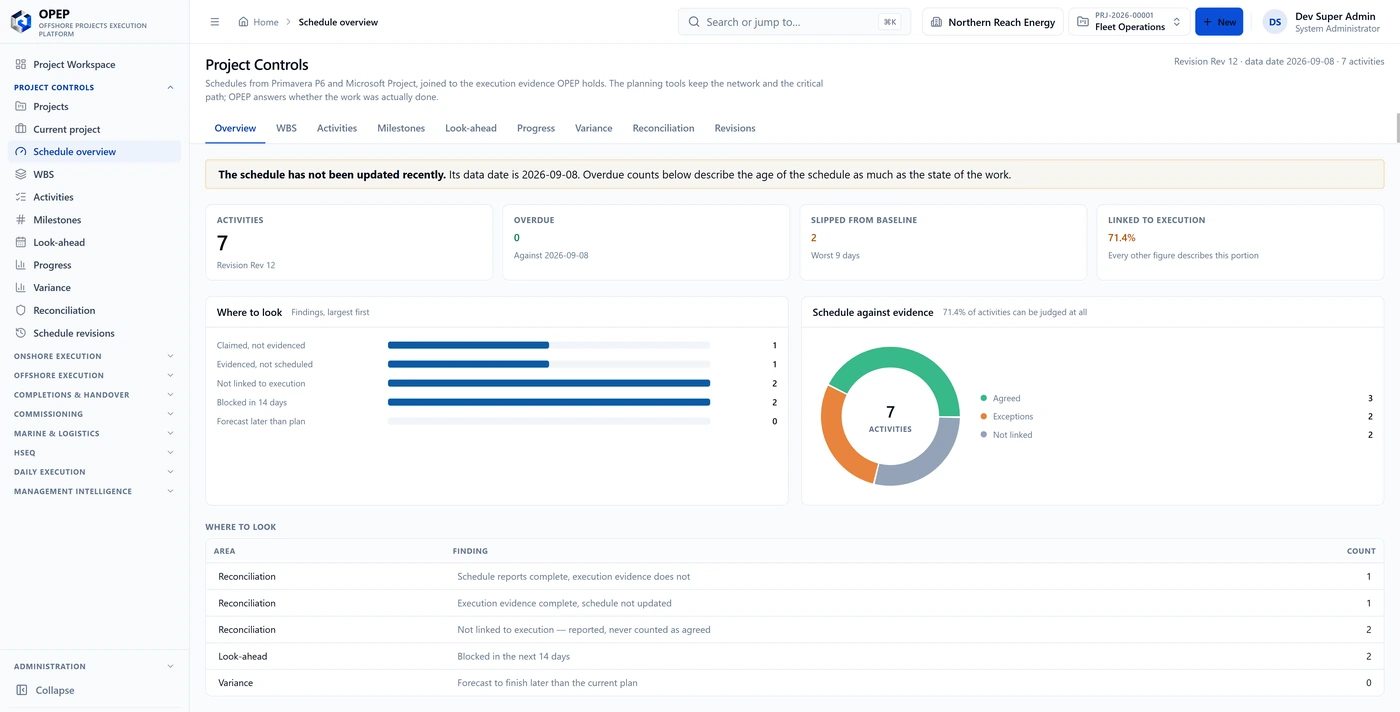
The schedule is reconciled against the execution evidence the platform holds, so claimed-but-not-evidenced and evidenced-but-not-scheduled are both positions you can open.

The day is entered once, where the work is.
The daily field record is the authoritative operational record. Project-office and management views are derived from it rather than recreated through separate transcription.
- One governed daily record per project, location, date and shift
- Amendments keep their history rather than replacing what was said
- Constraints and exceptions carry a target date and an age
One picture of the movement, and one owner for every record.
Planning, logistics, asset and port teams work from the same governed movement record, with each completed stage leaving the evidence required by the next.
- Shipment lifecycle with every shipment shown by the state it is in
- Fleet assets and operators allocated once, enforced by the database
- No route optimisation, demand forecasting or pricing is claimed, and no generative component makes the operational decision.

7 applications across 2 operating areas.
Adopt a single application and it works on its own. Adopt an operating area and the records line up across it.
Execute offshore projects and marine spreads from yard to offshore to handover.
- OPEPOPEP: Offshore Projects Execution Platform
- OPMSOPMS: Offshore Projects Management System
- VMTVMT: Vessel Management Tracker
Qualify suppliers, buy, contract and move materials with governed commercial records.
- CVMSCVMS: Contractor / Vendor Management System
- PMSPMS: Procurement Management System
- CMSCMS: Contracts Management System
- LGMSLGMS: Logistics Management System
The position you can defend when you are asked to.
Every control on this page exists because the underlying decision may need to be demonstrated later to a regulator, auditor, partner or board.
One register per thing
Equipment, personnel, companies and vessels exist once and are shared across every module, so the same vessel is the same vessel everywhere.
Blocked work, fourteen days out
Blocked work within the fourteen-day look-ahead is identified while there is still time to intervene before the offshore execution window closes.
Acknowledged, not merely sent
A transmittal issued and never acknowledged is an open exposure at handover, and the register treats it as one.
Bring one offshore campaign with its load list.
We will show the schedule reconciled against the evidence, the allocations the database will not double-promise, and the readiness the records actually support.