
Every external party, governed end to end.
Qualify suppliers, buy with sealed bids, contract on obligations and move materials with checked plans.
- 4
- Applications
- 4
- Stages in the flow

Assurance is computed
Qualify suppliers, buy with sealed bids, contract on obligations and move materials with checked plans.
Assurance is computed
Supplier and contractor compliance is derived from the evidence they hold, not from a self-declared form.
Sealed bids, exact money
Tenders stay sealed until opening; orders carry exact money through to receipt.
Certified before paid
Contract obligations, claims and payment certification are recorded before a budget and cost system pays.
4 stages, each owned by an application.
Every stage is a working part of a Zemerc application today, and each application runs on its own. An operating area is how they are bought, not a bundle they have to be bought in.
Supplier assurance with computed compliance.
Assurance and transaction are not the same question.
Supplier qualification and procurement are deliberately governed separately. An organisation may exist in the supplier register without being eligible for award or purchase, preventing commercial transactions from bypassing assurance requirements.
- Contractor assuranceProcurement
Only a qualified, compliant organisation reaches an award decision
- ProcurementContracts
An award becomes a contract with obligations, notices and certification
- ContractsLogistics
A committed order becomes a movement with its own checks and allocations
CVMS: Contractor / Vendor Management System
Supplier and contractor assurance with computed compliance and a supplier portal.
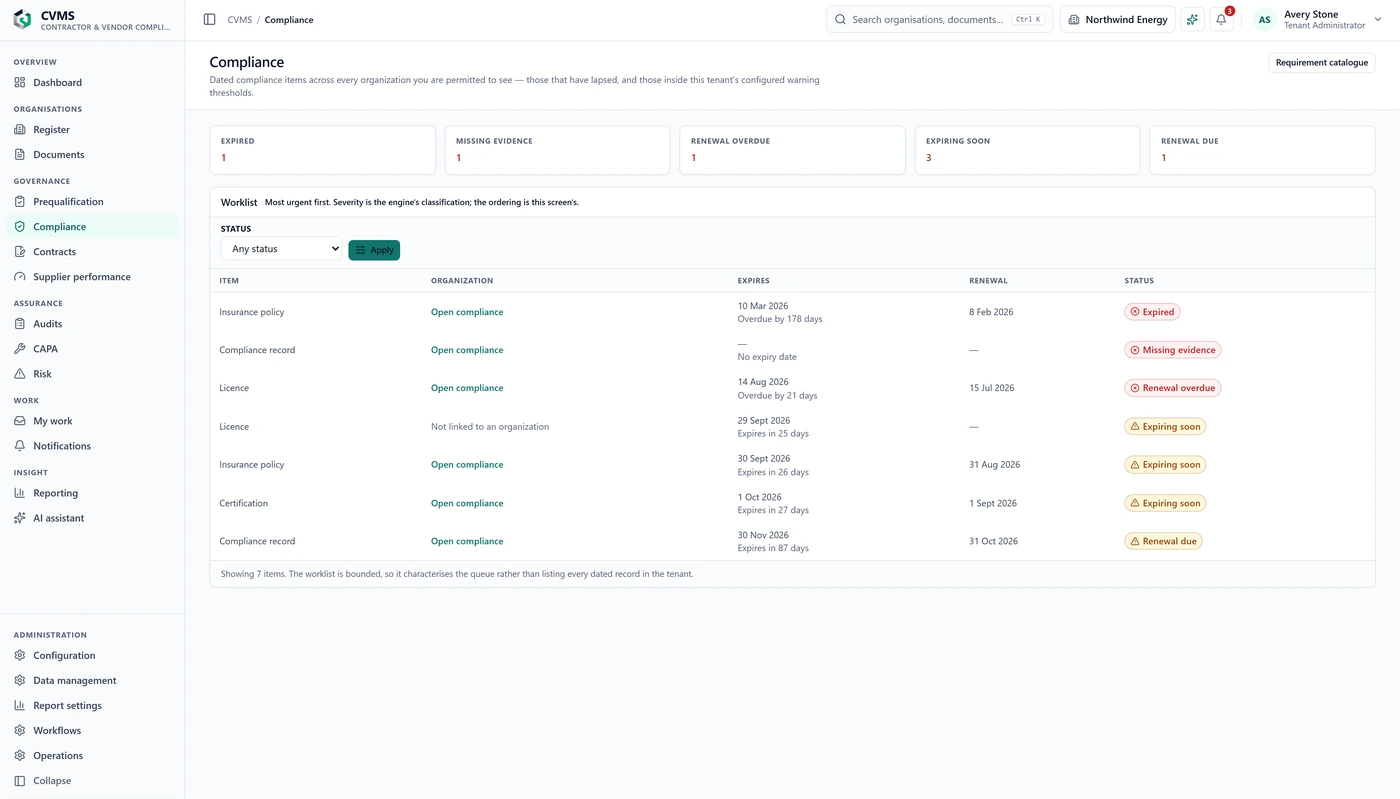
Expired, missing evidence, renewal overdue and expiring soon are classifications the engine produces from requirements, evidence and dates. Nobody types a compliance status.
- Exposure by date, not by feelingCompliance exposure is expressed as expired, renewal overdue and expiring soon, with the days involved carried alongside.
- Closure that cannot be gamedCorrective action closure is measured as a share of all non-cancelled actions, so cancelling is not a route to a better figure.
- Observed prices, not inferred onesMarket intelligence records what was published and observed with its source, and computes no average, index or trend.

Bring one supplier register or one tender.
Each movement is checked against the route revision in force and the limits declared by the relevant port. Where a required limit has not been stated, the result is reported as not checkable rather than assumed acceptable.
- Supplier portal; Suppliers keep their own records current; CVMS computes the result.
- Sealed tender; PMS holds bids sealed until opening and records the criteria used.
- Lifecycle contracts; CMS follows a contract through obligations and claims to certification.

One global identity, isolated customer relationships.
A supplier may exist in the register before becoming eligible for purchasing. Each lifecycle transition is governed, records who made the decision and why, and prevents conditional approval unless the required conditions have been explicitly recorded.
- Six lifecycle states from prospective through qualified to active
- Standing held separately from approval, because a supplier can be both active and no longer preferred
- Sealed tenders with no administrative route to read a bid early
4 applications, each operable on its own.
Adopt one and it works. Adopt the area and the records line up. No application here depends on another to run.
- CVMS
CVMS: Contractor / Vendor Management System
Supplier and contractor assurance with computed compliance and a supplier portal.
See the interface - PMS
PMS: Procurement Management System
Source-to-pay procurement with sealed tenders and supplier access.
See the interface - CMS
CMS: Contracts Management System
The contract lifecycle through obligations, claims and payment certification.
See the interface - LGMS
LGMS: Logistics Management System
Movement planning, scenario comparison and marine or berth checks.
See the interface

Where this area is actually worked.
What a supplier submits through the portal is a proposal until somebody on the customer side verifies it. Participation without authority is the whole design.
- Scenario comparison; LGMS compares movement scenarios on impact before a plan runs.
Before the first working session.
Which applications belong here?
CVMS (supplier assurance), PMS (procurement), CMS (contracts), LGMS (logistics).
What is the difference between CVMS and PMS?
CVMS is assurance: who is qualified and compliant. PMS is transactions: what is bought and paid.
Where do receipts go?
PMS hands goods receipt to LGMS for movement.
Supplier portal
Suppliers keep their own records current; CVMS computes the result.
Sealed tender
PMS holds bids sealed until opening and records the criteria used.
Lifecycle contracts
CMS follows a contract through obligations and claims to certification.
Scenario comparison
LGMS compares movement scenarios on impact before a plan runs.
Bring one supplier register or one tender
We will show the assurance and procurement records side by side.