
Contracts Management System
What does this contract oblige us to do this month?
Contract lifecycle management built for the operating years, not the signature: obligations with evidence, deliverables and milestones, notices with deadlines, variations that become controlled amendments, a twelve-stage claim lifecycle, and payment certification that checks the approver actually held authority.
- 0
- Functional areas
- 0
- Claim stages
- 0
- Governed datasets
- 0
- User types

Signing is the easy part. The obligations run for years.
Most contract systems are registers: they tell you a contract exists. CMS runs the operational registers of a contract that is already live, so the question a commercial manager actually has can be answered from records rather than from a mailbox.
Obligations with evidence
Each obligation carries an owner, a due date and the evidence that discharged it. What is overdue is derived from the contract’s own dates, not from somebody’s status field.
Notices with deadlines
A served notice starts a response window. The dashboard shows which notices are past their response deadline and which contractual windows have already lapsed.
Claims that run a lifecycle
A claim moves through twelve recorded stages with a settlement position at each. Nothing jumps from raised to agreed without the steps between being recorded.
One contract, eight registers that answer for it.
A contract is not a document in this application. It is the thing every one of these registers hangs from, which is why a question about obligations, claims or certification has a single answer.
Value carried in its own currency, because nobody approved a conversion.
Active contracts, portfolio value, contracts approaching expiry, overdue obligations and high or critical risks, with the attention list ordered by the issues most likely to constrain delivery.
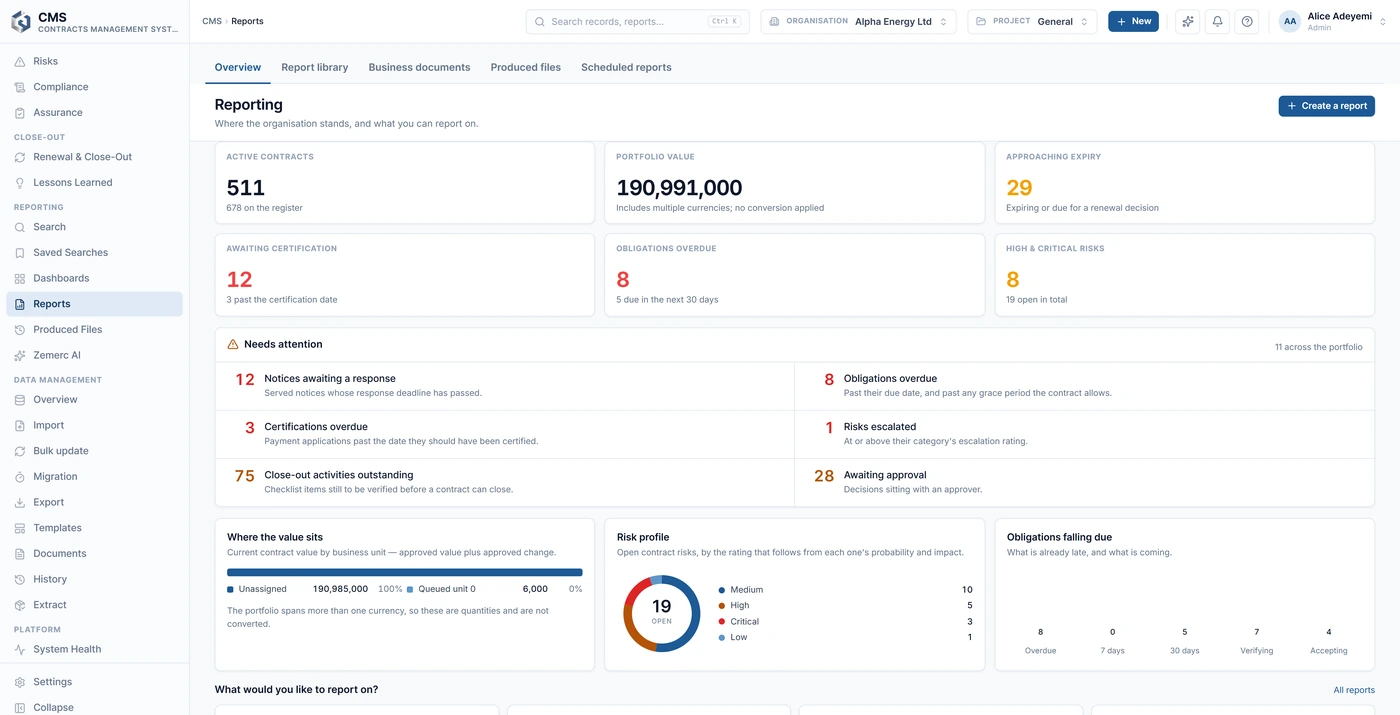
Where a portfolio spans more than one currency the application says so, rather than applying a rate that was never agreed.
- Authority per currencyDelegated financial authority is evaluated in the contract’s own currency, so a limit is never silently converted.
- Escalation is a ratingA risk escalates at or above its category’s escalation rating, which is a contract setting rather than a judgement made at the time.
- Close-out has a checklistOutstanding close-out activities must be verified before a contract can close; the count is carried, not waived.
CMS certifies. The cost system pays.
Budgets and commitments on one side, payment applications and certification on the other, with retention held and released against them. The boundary is deliberate: certification is a contractual act, and payment is a financial one.
Differences between headline and underlying contract positions are explained by governed records such as applications awaiting certification, retained amounts and approved variations not yet incorporated into the current commercial position.
Thirteen functional areas, from intake to archive.
The application's own navigation. Every chip is a page.
Origination and authoring
A request enters through a permission-guarded intake workflow, is planned, and is drafted from a governed clause and template library rather than from the last contract somebody happened to have.
- Requests
- Planning
- Clauses
- Knowledge
- Templates
- Authoring
- Review
- Approval
The live contract
The executed contract with its relationships and counterparties, the notices and records served against it, and the obligations and deliverables it actually commits the organisation to.
- Contracts
- Relationships
- Relationship Reviews
- Notices & Records
- Obligations
- Deliverables
Commercial
Budgets and commitments, payment applications and certification with retention, each checked against delegated financial authority in the currency the contract is actually denominated in.
- Payment Applications
- Commitments & Budget
- Certification
- Retention
Performance
Key performance indicators and service levels measured against the contract, performance reviews recorded, and corrective actions raised where the measurement says they are needed.
- KPIs
- Service Levels
- Performance Reviews
- Corrective Actions
Change and claims
Variations that generate controlled amendments rather than side letters, a twelve-stage claim lifecycle, and the risk, compliance and assurance registers that sit across both.
- Variations
- Claims
- Risks
- Compliance
- Assurance
Close-out and reporting
Renewal and close-out with its outstanding checklist, lessons learned, and the search, dashboards, reports and produced files the organisation reports from.
- Renewal & Close-Out
- Lessons Learned
- Search
- Saved Searches
- Dashboards
- Reports
- Produced Files
Every transition is explicit, and every transition is guarded.
A request carries its own intake lifecycle from draft to approved. Each action is driven by the workflow engine as an explicit, permission-guarded transition, with the approver and the due date recorded on the step rather than implied by a status.
- Kind, category, contract type, priority and source recorded at intake
- Record version carried so an earlier state can be read back
- Approve, reject and return are distinct outcomes with distinct records


Templates carry your own allowed values.
A generated template is populated with the organisation's own reference values, so an import is validated against what the organisation actually recognises. Approvals, certificates, settlements and audit records are deliberately not importable: creating the evidence without the decision is not permitted.
Authority checked in the currency
Delegated financial authority is evaluated per currency, so an approver authorised to a limit in one currency is not silently treated as authorised to the equivalent in another.
Value carried, not converted
Portfolio value spans more than one currency and the application says so rather than applying a conversion that nobody approved.
Obligations carry evidence
An obligation is discharged against evidence and a verification, not against somebody ticking it. What is late, and how late, is derived from the contract’s own dates.
Append-only history
Tenant isolation is enforced in the database and the record history is append-only, so who approved what, and whether they could, is reproducible.
More of what the application covers.
- Clause and template library with approved language
- Notices with deadlines and acknowledgement
- Variations generating controlled amendments
- Retention held and released against certification
- Counterparty access narrowed to their own contracts
- Enterprise search with saved searches
- Scheduled execution of recurring checks
- Governed import, bulk update, migration and organisation extract
Contract governance, beside procurement and cost.
- PMSPMS: Procurement Management SystemPMS governs source-to-pay procurement and sealed tendering; CMS governs the contract created by the award.
- CVMSCVMS: Contractor / Vendor Management SystemCVMS governs contractor and vendor assurance; CMS governs the contractual obligations against which that relationship is administered.
- BCMSBCMS: Budget & Cost Management SystemBCMS governs budget, commitment, actual and forecast; CMS governs contractual certification and commercial entitlement.
- RMSRMS: Risk Management SystemEnterprise risk; contract risks raised in CMS reference the same control model.
See CMS with one of your live contracts.
Bring one contract in its operating years. We will show the obligations falling due, the notices running, the claim position and the authority check behind its last certification.