

From the well to the export line, every figure traceable to a record.
Upstream and midstream operations convert physical measurements into commercial quantities and engineering judgements into safety and integrity decisions. Both require traceability back to the governed evidence from which the reported position was derived.
- 0
- Applications serving this industry
- 0
- Operating areas
- 0
- Stages in the lifecycle
What this industry is actually like to run.
Production operations from the reservoir to the export point: flow assurance, hydrocarbon accounting, asset integrity and the safety case, each held in its own controlled record.
The measurement is the money
At custody transfer a quantity leaves one party’s books and arrives on another’s. An estimate becomes a liability, and the question that follows is always whether the figure can be reproduced two years later.
The barrier supports continued operation.
Operating a major-hazard facility depends on demonstrating that engineered safeguards reduce risk to the approved tolerability basis and on retaining evidence that those safeguards continue to perform as intended.
The asset outlives the project
Equipment installed for a twenty-five-year design life is operated well past it. Integrity, reliability and supportability become the whole conversation long after the project team has gone.
Every one of these is a failure a governed record prevents.
Not a list of features. Each row is something that goes wrong in this industry, and the specific control in a Zemerc application that stops it happening.
- Quantities that cannot be reproduced because a raw reading was corrected in place
Immutable readings with governed substitution and effective-dated calculations that reproduce a historical period using the method in force at the time.
HAMSHydrocarbon Accounting Management System- Flow assurance studies built on a fluid definition nobody agreed
Governed engineering records in which draft information is unavailable for downstream use and the author cannot approve their own work.
FAMSFlow Assurance Management System- Integrity judgements that cannot be audited, and defects closed without evidence
Governed, revision-controlled assessment registers with evidence-gated closure and no unsupported health index.
AIRMSAsset Integrity & Reliability Management System- Barriers assumed effective because a policy says they should be
Barrier-assurance activities recorded against each barrier, with verification refused where the required activity was not actually performed.
PSMProcess Safety Management System
HAMS: Hydrocarbon Accounting Management System
Meter to validated, allocated, reconciled, closed and reported.
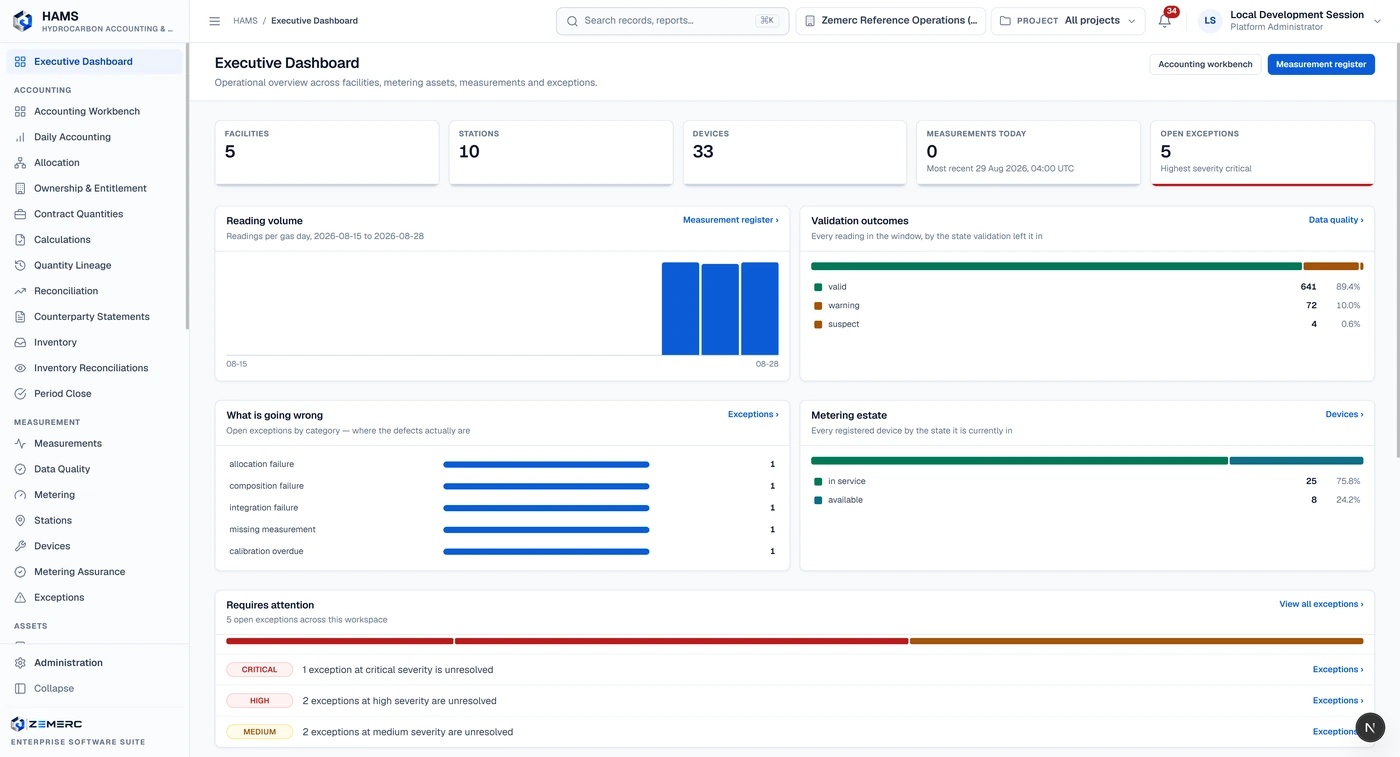
Every reading in the window is classified by the state validation left it in; valid, warning or suspect; rather than silently accepted.
5 stages, and who owns each of them.
The sequence this industry is genuinely run along, with the applications that govern each stage. Every one of them runs on its own; none of them needs the others to be useful.
Reservoir and wells
The production network held as one structural model from business unit down to the individual well.
Flow assurance
Fluids, envelopes, hydraulics and the four solids threats that decide how a line may actually be operated.
Process and integrity
Inspection, corrosion, barriers and safety-critical elements, recorded as engineering judgement rather than scored.
Metering
Raw readings validated and classified, with metering assurance behind the confidence in each one.
Allocation and close
Quantities allocated to counterparties, reconciled against their statements, and closed with the lineage intact.

The technical authority who will be asked to explain it.
These records exist so a reported quantity, engineering judgement or barrier position can be traced back to the evidence and decisions that produced it. The applications are designed to support that scrutiny directly.
- Segregation of duties enforced on identity, not on working practice
- Append-only audit behind every controlled change
- Where no approved method exists, the application says so instead of producing a number

A barrier is assured by activity that happened, not by a policy that says it should.
Performance standards carry their governing standard and assurance frequency. Each assurance activity records what was performed and what was found, and degradations are tracked through to restoration.
- No integrity score, health index or readiness score is computed
- Thickness readings and approved assessment revisions are immutable
- A defect cannot close until the evidence that justifies closing it is attached
10 applications across 3 operating areas.
Adopt a single application and it works on its own. Adopt an operating area and the records line up across it.
Engineer production flow and account for every measured hydrocarbon.
Keep operating assets available, maintained, inspected and supportable.
- AIRMSAIRMS: Asset Integrity & Reliability Management System
- RAMSRAMS: Reliability, Availability & Maintainability Management System
- EAMSEAMS: Enterprise Asset Management System
- OMSOMS: Obsolescence Management System
Prevent harm and major accidents, and govern enterprise risk.
- HSEHSE: Health, Safety & Environment Management System
- PSMPSM: Process Safety Management System
- TSMTSM: Technical Safety Management System
- RMSRMS: Risk Management System
The position you can defend when you are asked to.
Every control on this page exists because the underlying decision may need to be demonstrated later to a regulator, auditor, partner or board.
Reproducible on demand
From a closed quantity back to the reading that produced it, and from a barrier position back to the activity that assured it.
Regulatory frameworks named
Obligations and the regimes they answer to are recorded against the facility they apply to rather than held centrally and assumed.
Disclosure from the same record
Emissions reporting draws on the measured production record, so the sustainability figure and the operating figure have one source.
Bring one accounting period and one integrity register.
We will show the validation outcome, the allocated quantities, the reconciliation difference, and the assurance position behind the barriers on the same asset.