
Engineer the flow. Account for every barrel.
Flow assurance on the production network and hydrocarbon accounting from meter to report.
- 2
- Applications
- 5
- Stages in the flow

Validated before allocated
Flow assurance on the production network and hydrocarbon accounting from meter to report.
Validated before allocated
Every reading is validated and its state recorded before allocation, reconciliation and close.
The network, solved
Hydraulic and thermal solves, envelope evaluation and pigging planning on the schematic itself.
Period close on readiness
Close proceeds when the readiness checks pass, not when the calendar says.
5 stages, each owned by an application.
Every stage is a working part of a Zemerc application today, and each application runs on its own. An operating area is how they are bought, not a bundle they have to be bought in.
The production schematic.
How it is operated, and what it produced.
Flow assurance decides how the network is run. Hydrocarbon accounting establishes what came out of it. Both are engineering disciplines, and both are ruined by an edited number.
- Flow assuranceOperations
Operating envelopes and solids studies set how the line may actually be run
- MeteringAccounting
A raw reading is validated, substituted where necessary, and never edited
- AccountingReporting
Allocated quantities reconcile against the counterparty statement before the period closes
HAMS: Hydrocarbon Accounting Management System
Meter to validated, allocated, reconciled, closed and reported.
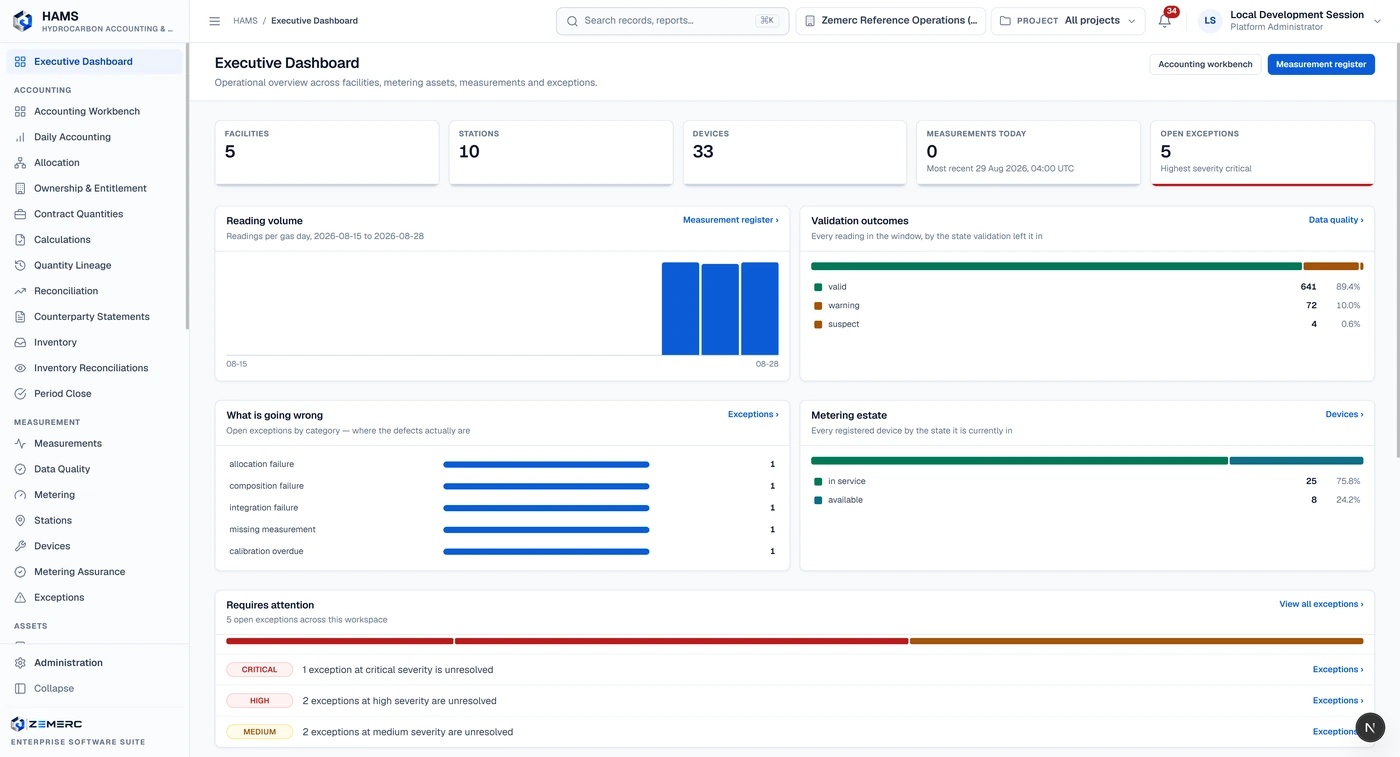
Every reading in the window is classified by the state validation left it in; valid, warning or suspect; rather than silently accepted.
- Reproducible two years laterEffective-dated calculations mean re-running a historical period uses the method that was in force then, not the one in force now.
- Difference with a nameUnaccounted quantity is expressed with its exceptions attached rather than absorbed into a tolerance.
- Segregation where it countsAllocation and reconciliation carry review and approval as distinct acts, because that is exactly where one pair of hands is a weakness.

Bring one production month.
Custody transfer is the point at which an engineering quantity becomes a commercial quantity attributable to a counterparty. The accounting chain therefore preserves the engineering basis as well as the commercial allocation.
- Validation outcomes; HAMS shows every reading in the window by the state validation left it in.
- Quantity lineage; From meter to reported quantity, the chain is kept.
- Envelope evaluation; FAMS evaluates wax, hydrate, scale and asphaltene envelopes on the solved network.
Only approved engineering records may be used downstream.
Unapproved engineering records cannot be used downstream. A hydraulic study, for example, cannot rely on a fluid definition that has not been approved, and preparation and approval remain segregated by role.
- One structural model from business unit down to the individual well
- Wax, hydrate, scale and asphaltene held as four separate threats, not one risk score
- Values stored canonically and shown in each engineer’s own units

2 applications, each operable on its own.
Adopt one and it works. Adopt the area and the records line up. No application here depends on another to run.

Where this area is actually worked.
A metering-assurance programme covering calibration, proving, uncertainty and downtime provides the evidence required to defend a reported quantity.
- Period-close readiness; Close readiness is computed from the checks, and shown as such.
Before the first working session.
Which applications belong here?
FAMS (flow assurance) and HAMS (hydrocarbon accounting).
Does FAMS replace a simulator?
No broader claim is made than the implemented engineering capability supports. FAMS provides governed network solves, operating-envelope analysis and pigging-planning functions within its defined scope.
Where does allocation data come from?
From validated meter readings held in HAMS.
Validation outcomes
HAMS shows every reading in the window by the state validation left it in.
Quantity lineage
From meter to reported quantity, the chain is kept.
Envelope evaluation
FAMS evaluates wax, hydrate, scale and asphaltene envelopes on the solved network.
Period-close readiness
Close readiness is computed from the checks, and shown as such.
Bring one production month
We will show validation, allocation and close on it.