
Hydrocarbon Accounting Management System
Preserve the reading. Govern every correction.
A governed hydrocarbon-accounting chain from meter reading to approved reporting: immutable raw readings, controlled substitution, effective-dated deterministic calculations, allocation to counterparties, inventory, reconciliation against counterparty statements, managed exceptions and period close.
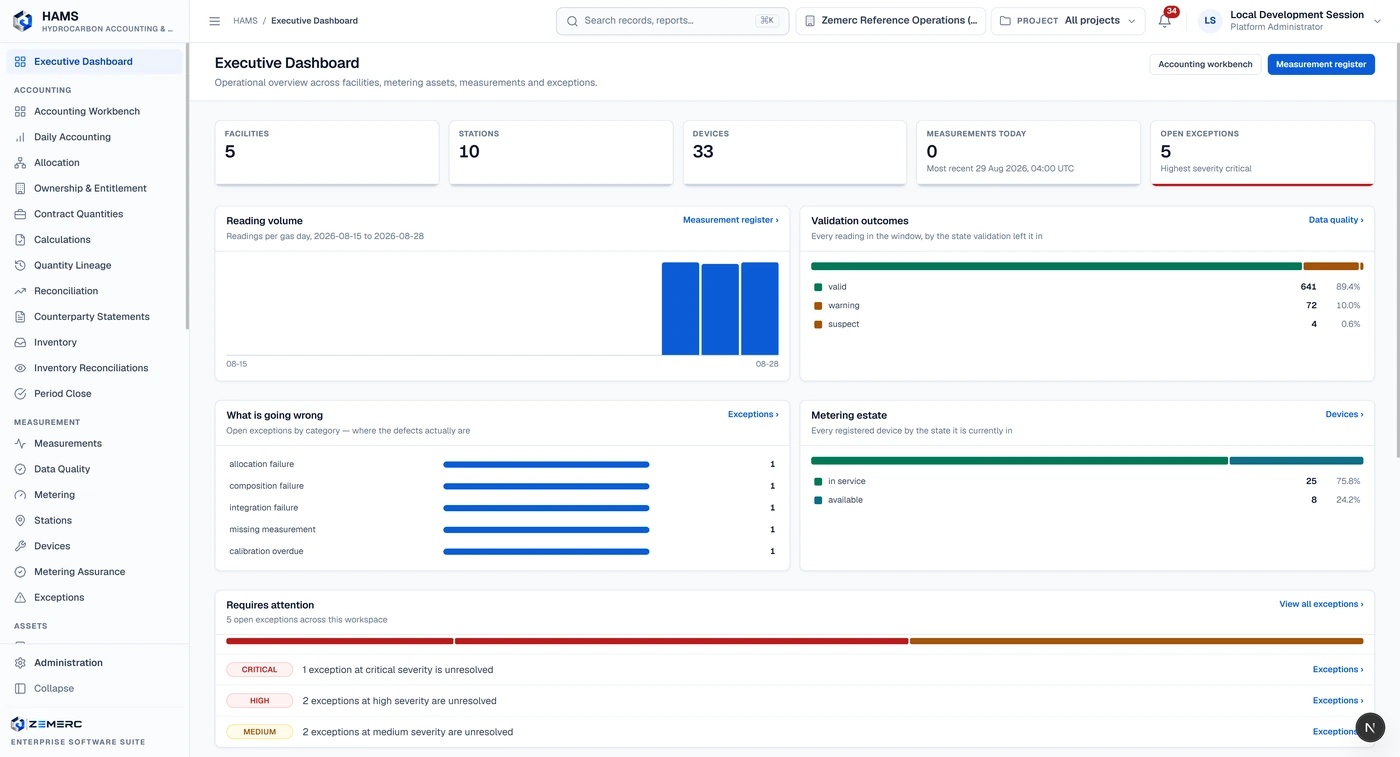
Seven stages, and every one of them is reproducible.
The value of hydrocarbon accounting is reproducibility. A reported quantity must be traceable back to the reading, substitution, calculation method and approval that produced it, including when the period is revisited years later.
Read. A raw reading arrives from the meter and is stored immutably. It is never edited afterwards.
Most accounting problems start with a corrected spreadsheet.
HAMS prevents uncontrolled correction of accounting values by preserving the original record and requiring any replacement value to be introduced through a governed substitution with its reason and approval trail.
Readings are immutable
A raw reading is stored once and never edited. Where it cannot be used, a governed substitution supersedes it, records the reason and remains traceable alongside the original.
Methods are effective-dated
A calculation carries the dates it applies from, so re-running a historical period uses the method that was in force then rather than the one in force now.
Duties are segregated
Allocation and reconciliation carry review and approval as distinct acts, because that is exactly where one pair of hands is a control weakness.
Book against measured, and the difference has a name.
Inventory is compared as book against measured, and the organisation's figures against the counterparty's statement. A difference is not absorbed into a tolerance; it becomes a dispute with a record.
Where the two sides do not meet, the gap is expressed as unaccounted quantity with its exceptions attached; allocation failure, composition failure, missing measurement or calibration overdue; rather than as a rounding adjustment.
Eleven report families, each written for a named accountant.
Daily, weekly, monthly and quarterly hydrocarbon accounting reports, each stating what it reads from, the periods it covers, the commentary sections it carries, and the point in the period at which it may be published.
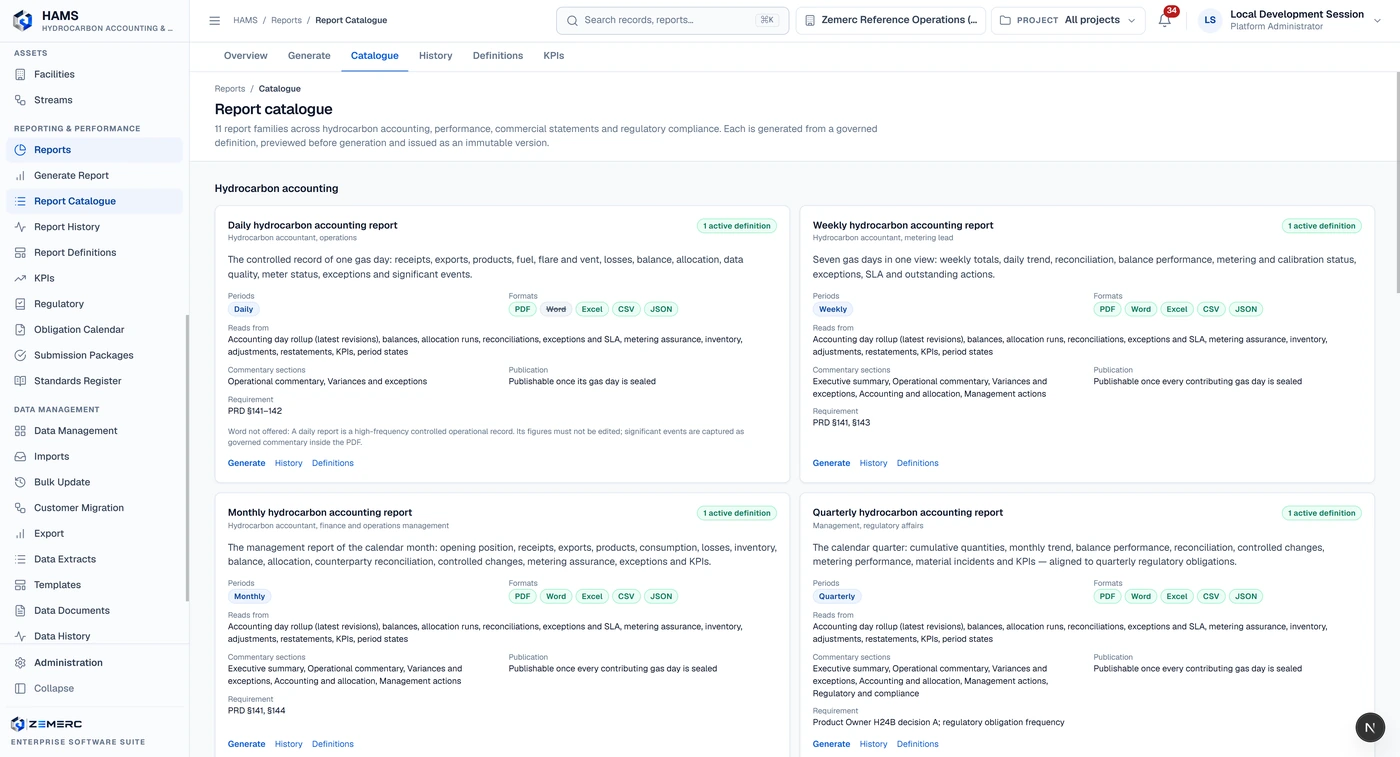
Each definition is generated from a governed statement and previewed before generation, so an issued report is an immutable version.
- Publication has a ruleA report states when it may be published; once gas day is sealed, once contributing days are sealed; rather than leaving it to the calendar.
- Commentary is structuredOperational, executive and regulatory commentary sections are part of the definition, so a report is not half narrative and half table by accident.
- Requirements are namedEach definition records the requirement it answers, including the regulatory obligation where one applies.
Fourteen functional areas, from the device to the disclosure.
The application's own navigation, grouped from measurement through metering, accounting and balance to exceptions and reporting. Every chip is a page.
Measurement
Raw readings held immutably with governed substitution where a reading is bad, data quality applied on the way in, and every reading classified as valid, warning or suspect by the state validation left it in.
- Measurements
- Data Quality
- Quantity Lineage
The metering estate
Stations, runs and devices with an assurance programme behind them: calibration, proving, uncertainty and downtime, so the confidence in a figure is traceable to the device that produced it.
- Metering
- Stations
- Devices
- Metering Assurance
Accounting
Effective-dated deterministic calculations, the accounting workbench, allocation, ownership and entitlement, contract quantities, period close and the lineage that ties every figure to its source.
- Accounting Workbench
- Daily Accounting
- Calculations
- Allocation
- Ownership & Entitlement
- Contract Quantities
- Period Close
- Quantity Lineage
Inventory and reconciliation
Inventory with book against measured comparison, counterparty statements reconciled against the organisation’s own figures, and disputes held as records rather than as email threads.
- Inventory
- Inventory Reconciliations
- Reconciliation
- Counterparty Statements
Exceptions
Allocation, composition, integration, missing-measurement and calibration failures raised as exceptions with a severity and a service level, so a period cannot quietly close over them.
- Exceptions
- Performance
Reporting and regulatory
Eleven report families across daily, weekly, monthly and quarterly accounting, with regulatory obligations, submission packages, the obligation calendar and the standards register.
- Reports
- Report Catalogue
- Report Definitions
- KPIs
- Regulatory
- Obligation Calendar
- Submission Packages
- Standards Register

Custody transfer is where an estimate becomes a liability.
Gas processing plants, gathering systems, pipelines, production facilities, floating production units, terminals and tank farms all reach the same point: a quantity leaves one party's books and arrives on another's. HAMS exists to make that number defensible on both sides.
- Metering assurance: calibration, proving, uncertainty and downtime
- Exceptions carry a severity and a service level
- Counterparty disputes held as governed records

Paste a record identifier, and see where it came from.
Every movement of data into or out of the application is recorded with its direction, its files and what remains downloadable. From any record you can trace back to the import, the row and the template version that created or changed it.
- Inbound and outbound movements counted separately
- Retained files held with what is capped or restricted
- Timeline of every movement with who made it and when
Each dataset states what may be done to it, and whether it is audited.
Import, bulk update, historical migration and export are declared per dataset, with prohibited stated as clearly as permitted. Where a dataset cannot be imported, that is a control decision, and the register says so.

Immutable at the source
A raw reading is never corrected in place. A governed substitution supersedes it and both remain, which is what makes a historical figure reproducible.
Effective-dated calculations
A calculation carries the dates it applies from. Re-running last quarter uses last quarter’s method, not this quarter’s.
Segregation in allocation
Allocation and reconciliation carry review and approval as distinct acts, because this is precisely where a single pair of hands is a control weakness.
Recorded, not transmitted
Regulatory submissions are assembled and recorded as packages. The application does not claim to file them on the organisation’s behalf.
More of what the application covers.
- Metering assurance: calibration, proving, uncertainty and downtime
- Book against measured inventory comparison
- Counterparty disputes as governed records
- Exceptions with service levels and severity
- Obligation calendar and standards register
- Quantity lineage from closed figure to raw reading
- File drop, REST and webhook integration points
- Module licensing with an explicit tenant position
Accounting, beside the systems that produce and consume the quantity.
- FAMSFAMS: Flow Assurance Management SystemFlow assurance decides how the network is operated; HAMS accounts for what it produced.
- CMSCMS: Contracts Management SystemContract quantities and entitlement sit against the contract CMS governs.
- ESGESG: Environmental, Social & Governance Management SystemEmissions reporting draws on the same measured production record.
- AIRMSAIRMS: Asset Integrity & Reliability Management SystemIntegrity of the metering and pipeline assets the accounting depends on.
See HAMS with one of your accounting periods.
Bring one period of meter readings and one counterparty statement. We will show the validation outcome, the allocated quantities, the reconciliation difference and the lineage back to the reading.