
27 applications. Start with the industrial record you need to govern.
Zemerc is a portfolio of independently operable applications. Each one governs a defined class of industrial record and can be adopted on its own. Start with the record or workflow that needs control, then add other applications only where the operation requires them.
Capital projects: controls, supply, completions and offshore execution.
Producing assets: integrity, maintenance, flow and hydrocarbon accounting.
People and major-accident risk, in design and in operation.
Management systems, sustainability reporting, documents and knowledge.
A portfolio of independently operable applications, not dependent modules in a single platform.
The distinction matters commercially and operationally. Clients can purchase and operate one application without buying the wider portfolio or depending on another Zemerc product.
Every application stands on its own
Each application has its own users, data, controls and release lifecycle. It remains fully operable as a standalone product.
Adopt one and stop there
A customer can take a single application for a single team and never take another. Widening is a decision, never a dependency.
Connected only where records genuinely relate
Applications exchange defined records only where the underlying work crosses a real operational boundary.
Narrow the portfolio to the application that fits your requirement.
Filter by operating stage and operating area, or search using the record or workflow you manage, such as a punch list, sealed tender, barrier or meter reading.
Search matches application names, governed records and lifecycle stages.
27 applications in the portfolio
- PDMSProjects
PDMS: Project Delivery Management System
Integrated delivery governance: portfolio, project workspaces and stage gates.
Portfolio → Project workspace → Stage gate → Delivery governanceSee the application - BCMSProjects
BCMS: Budget & Cost Management System
Estimate, budget, commitment, actual and forecast in one financial chain.
Estimate → Budget → Commitment → Actual → ForecastSee the application - IFMSProjects
IFMS: Interface Management System
Governed interfaces between parties on capital projects.
Interface identified → Agreed → Decision recorded → ClosedSee the application - CVMSSupply chain
CVMS: Contractor / Vendor Management System
Supplier and contractor assurance with computed compliance and a supplier portal.
Qualification → Computed compliance → Supplier portal → ScorecardSee the application - PMSSupply chain
PMS: Procurement Management System
Source-to-pay procurement with sealed tenders and supplier access.
Requisition → Sealed tender → Award → Purchase order → ReceiptSee the application - CMSSupply chain
CMS: Contracts Management System
The contract lifecycle through obligations, claims and payment certification.
Contract → Obligation → Claim → Payment certificationSee the application - LGMSSupply chain
LGMS: Logistics Management System
Movement planning, scenario comparison and marine or berth checks.
Movement plan → Scenario comparison → Marine & berth check → ExecutionSee the application - CCMSCompletions
CCMS: Completion, Commissioning & Handover Management System
ITRs, punch lists, certificate sequence and turnover packages.
ITR → Punch list → Certificate chain → Turnover packageSee the application - QMSCompletions
QMS: Quality Management System
ITPs, inspections, NCR and CAPA, traceability and quality dossiers.
ITP → Inspection → NCR / CAPA → Quality dossierSee the application - SPIRCompletions
SPIR: Spare Parts Interchangeability Record Management System
Spares, transmittals, vendor portal and digital handover records.
Vendor data → SPIR register → Transmittal → Digital handoverSee the application - OPEPOffshore
OPEP: Offshore Projects Execution Platform
The offshore project lifecycle from fabrication to commissioning, with execution intelligence.
Project record → Readiness gate → Offshore execution → Field updateSee the application - OPMSOffshore
OPMS: Offshore Projects Management System
Daily field input to productivity analysis and portfolio consolidation.
Daily field input → PT / NPT productivity → Portfolio consolidation → Management bulletinSee the application - VMTOffshore
VMT: Vessel Management Tracker
Fleet, charters, campaigns, daily operations, downtime and off-hire.
Vessel & charter → Campaign → Daily operations → Downtime & off-hireSee the application - AIRMSAssets
AIRMS: Asset Integrity & Reliability Management System
Integrity, inspection, corrosion and barrier records with an Asset 360 view.
Asset 360 → Inspection → Integrity record → Barrier assuranceSee the application - RAMSAssets
RAMS: Reliability, Availability & Maintainability Management System
Quantitative reliability analysis for operating assets.
Reliability model → Analysis → Availability → MaintainabilitySee the application - EAMSAssets
EAMS: Enterprise Asset Management System
Maintenance execution: work orders, preventive maintenance, inventory and calibration.
Asset → Condition → Work order → Preventive maintenanceSee the application - OMSAssets
OMS: Obsolescence Management System
Lifecycle supportability risk and lifetime-buy decisions.
Lifecycle risk → Where-used impact → Mitigation case → Lifetime buySee the application - FAMSProduction
FAMS: Flow Assurance Management System
Network hydraulics, thermal behaviour, envelopes and pigging.
Network → Hydraulic & thermal solve → Envelope evaluation → PiggingSee the application - HAMSProduction
HAMS: Hydrocarbon Accounting Management System
Meter to validated, allocated, reconciled, closed and reported.
Metered → Validated → Allocated → Reconciled → Closed → ReportedSee the application - HSESafety & risk
HSE: Health, Safety & Environment Management System
Occupational and operational safety, field reporting, permits and emergencies.
Permit → Field report → Incident → Emergency responseSee the application - PSMSafety & risk
PSM: Process Safety Management System
Process safety in operation: hazards, barriers, change and proof tests.
PHA → Barrier & SIF → Management of change → Proof testSee the application - TSMSafety & risk
TSM: Technical Safety Management System
Technical safety in design: safety case, hazard register and safety-critical elements.
Hazard register → ALARP → Safety case → SCE assuranceSee the application - RMSSafety & risk
RMS: Risk Management System
One enterprise risk register with workshops, BowTies and control effectiveness.
Risk register → Workshop → BowTie → Control effectivenessSee the application - IMSGovernance
IMS: Integrated Management System
Multi-standard management-system builder: understand, build, operate.
Understand → Build → OperateSee the application - ESGGovernance
ESG: Environmental, Social & Governance Management System
Carbon, disclosure frameworks, materiality and reporting.
Data → Materiality → Framework → ReportSee the application - EDMSGovernance
EDMS: Enterprise Document Management System
Controlled documents, revisions, transmittals and records.
Registered → Revised → Reviewed & approved → Published & distributedSee the application - LLMSGovernance
LLMS: Lessons Learned Management System
Lessons learned and the knowledge chain from capture to reuse.
Captured → Reviewed → Approved → Retained & reusedSee the application
PDMS: Project Delivery Management System
Integrated delivery governance: portfolio, project workspaces and stage gates.
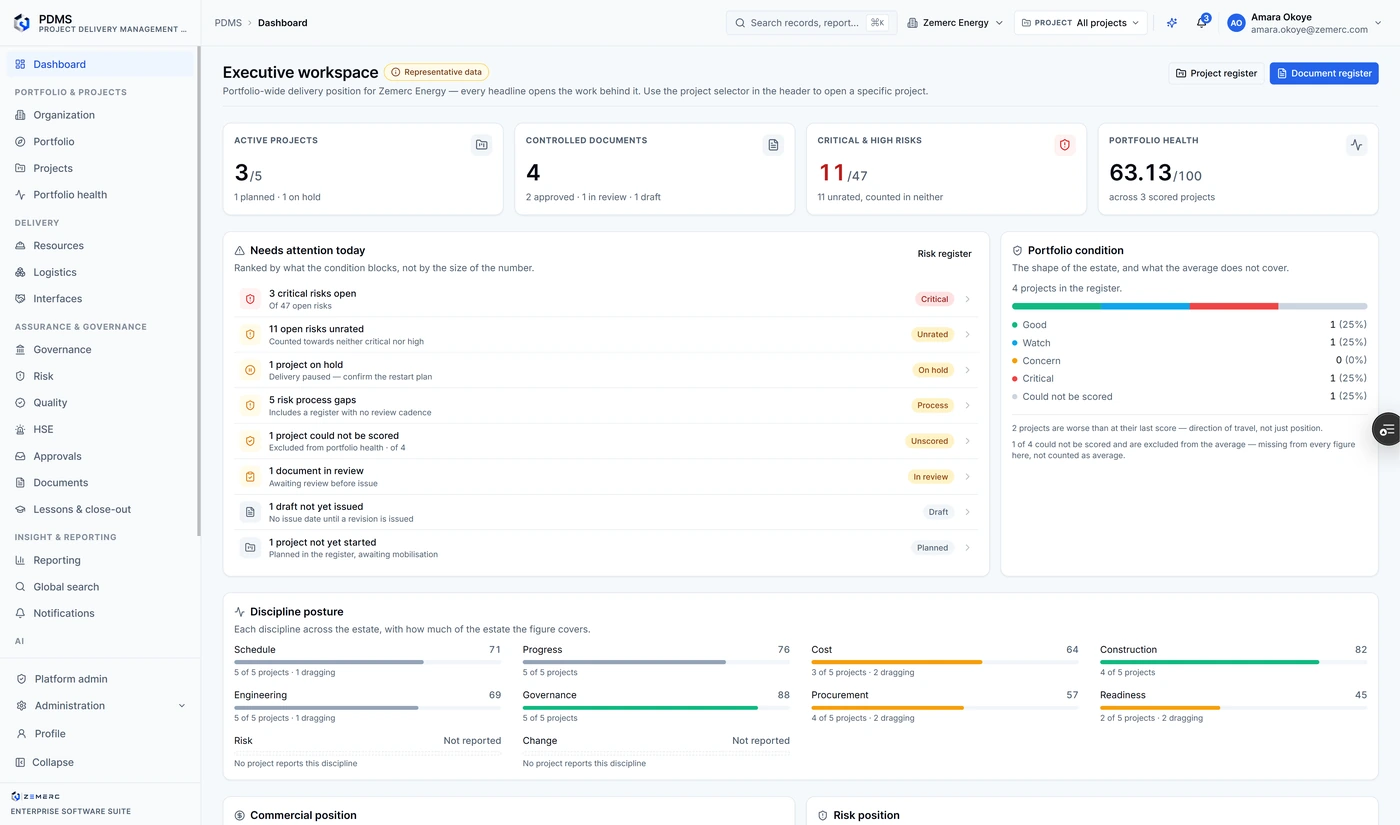
Portfolio, programme and project in one governed structure, with stage gates that read the workspace registers rather than a status field. Where the history will not support a completion forecast, the platform declines to produce one.
- 0
- Applications in the portfolio
- 0
- Operating areas
- 0
- Stages of the operation
A barrier is assured by activity that happened, not by a policy that says it should.
Performance standards carry their governing standard and assurance frequency. Each assurance activity records what was performed and what was found, and degradations are tracked through to restoration.
- No integrity score, health index or readiness score is computed anywhere
- Thickness readings and approved assessment revisions are immutable
- A defect cannot close until the evidence that justifies closing it is attached


Every quantity traceable back to the reading that produced it.
Readings are held immutably with governed substitution, and every reading in the window is classified by the state validation left it in; valid, warning or suspect; rather than silently accepted.
- Effective-dated calculations re-run a historical period on the method in force then
- Allocated quantities reconcile against counterparty statements
- The lineage survives the close, which is when it is actually needed
22 problems, and the application that answers each.
Most organisations arrive with a requirement rather than an application in mind. These are the ones we are asked about, set against the application whose job it already is.
- BCMS“Our cost reporting and our commitments never agree”Estimate, budget, commitment, actual and forecast held as one financial chain rather than five spreadsheets
- IFMS“Nobody owns the boundary between us and the other contractor”Every interface numbered, owned on both sides, with a required-by date the register measures against
- CVMS“We cannot show a supplier was compliant at the time we used them”Compliance computed from the evidence actually held, with suppliers keeping their own records current through a portal
- PMS“A tender could be read before the opening”Tender submissions remain sealed without an administrative read path and are opened through a formal recorded action.
- CCMS“Certificates are issued on a percentage rather than on finished work”A lockable certificate sequence where a gate opens on completed deliverables, and the percentage is derived afterwards
- QMS“Non-conformances get closed by whoever raised them”Disposition by a technical authority, with an effectiveness review and a signed closure
- OPEP“Offshore progress is reported from a spreadsheet the deck would not recognise”Every figure derived from the records beneath it, and a figure that cannot be derived shown as not measurable rather than zero
- LGMS“The same vessel gets promised to two movements”Double allocation is prevented through database-level constraints rather than relying only on interface validation.
- AIRMS“Our integrity position is a score nobody can reproduce”Governed, revisioned assessment registers with evidence-gated closure; and no health index computed at all
- EAMS“Maintenance compliance includes work nobody independently checked”Work completion and independent verification are held as separate governed actions.
- OMS“A critical spare turns out to be obsolete the week we need it”Lifecycle position derived from verified manufacturer evidence, with lifetime-buy decisions taken while there is still a window
- RAMS“Reliability studies sit in consultant reports nobody re-runs”Versioned models with a deterministic engine over an immutable failure register coded to a standard taxonomy
- FAMS“Flow assurance work is built on a fluid definition nobody agreed”Governed engineering records in which draft information is unavailable for downstream use and the author cannot approve their own work.
- HAMS“A corrected meter reading has overwritten the original”Immutable readings with governed substitution, and effective-dated calculations that can re-run a closed period
- HSE“Incidents are reported days late because the form is on a desktop”Anyone reports in seconds, from the field and offline, with a permanent document number
- PSM“We publish a process safety index we cannot defend”The application states that no certified engineering method exists for it and reports the components individually instead
- TSM“Safety-critical element definitions are re-typed once the plant is operating”Barriers, safety-critical elements and performance standards are defined in design and published as governed requirements for operation.
- RMS“Every function keeps its own risk register”One enterprise register with workshops, bow-ties and control effectiveness recorded against the control
- IMS“Our management system lives in a document nobody opens”A multi-standard management system built as a working structure: understand, build, then operate it
- ESG“Sustainability figures are assembled by hand each reporting cycle”Disclosure drawn from the measured operating record, so the sustainability figure and the operating figure have one source
- LLMS“The same lesson is learned on every project”The knowledge chain from capture to reuse, so a lesson reaches the next project rather than the archive
- SPIR“Handover arrives as a hard drive nobody can audit”Spares, vendor data and transmittals as governed records, with handover completeness computed from the registers
One record crosses, and only where the work joins.
This is the whole of the integration story. Applications do not share a database because they are sold together; they share a named record because the work genuinely passes from one team to the next.
- PMSLGMS
The receipt: what was bought becomes something that has to be moved
- LGMSCCMS
The delivered item: what arrived becomes what can be installed and tested
- CCMSSPIR
The completed system: what was proven becomes what is handed over
- QMSCCMS
The inspection and test record: quality evidence becomes completion evidence
- IFMSPDMS
The open interface: a boundary nobody has closed becomes a delivery exposure
- TSMPSM
The safety-critical element: a design definition becomes an operating obligation
- PSMAIRMS
The barrier: an assurance obligation becomes an inspection and integrity activity
- AIRMSEAMS
The defect: an integrity finding becomes maintenance work with a verification step

The first application is chosen by the team that keeps the record.
Not by a procurement committee comparing suites. The team that already maintains the register, the gate log or the meter file knows which one it is, and they are the ones who will prove it works.
- Each application is operable on its own, so a first adoption commits you to nothing else
- Cross-area relevance is shown honestly: one home, and the areas it also serves
- Every application page shows the application’s own screens, not an illustration of them
All 27 applications, by stage and operating area.
Every application in the portfolio, with the area it belongs to and the areas it is also relevant in.
See the applications working with your own records.
A working session built around one of your own registers, projects or assets, showing the application in the context of your actual record structure.