
From yard to offshore, one execution record.
Offshore projects, vessel fleets and campaigns run on daily records that the office and the deck both trust.
- 3
- Applications
- 5
- Stages in the flow

Counted, never blended
Offshore projects, vessel fleets and campaigns run on daily records that the office and the deck both trust.
Counted, never blended
Outstanding work is counted per register and per age; a gate is ready, not ready, or cannot be determined.
Weather hold is not other delay
Hours lost are recorded against lifts on separate columns because a day-rate conversation turns on which one it was.
Field entry, office view
Daily data is entered on the phone against the vessel and the month, into the record the office reads.
5 stages, each owned by an application.
Every stage is a working part of a Zemerc application today, and each application runs on its own. An operating area is how they are bought, not a bundle they have to be bought in.
Fabrication to commissioning in one place.
OPEP: Offshore Projects Execution Platform
The offshore project lifecycle from fabrication to commissioning, with execution intelligence.
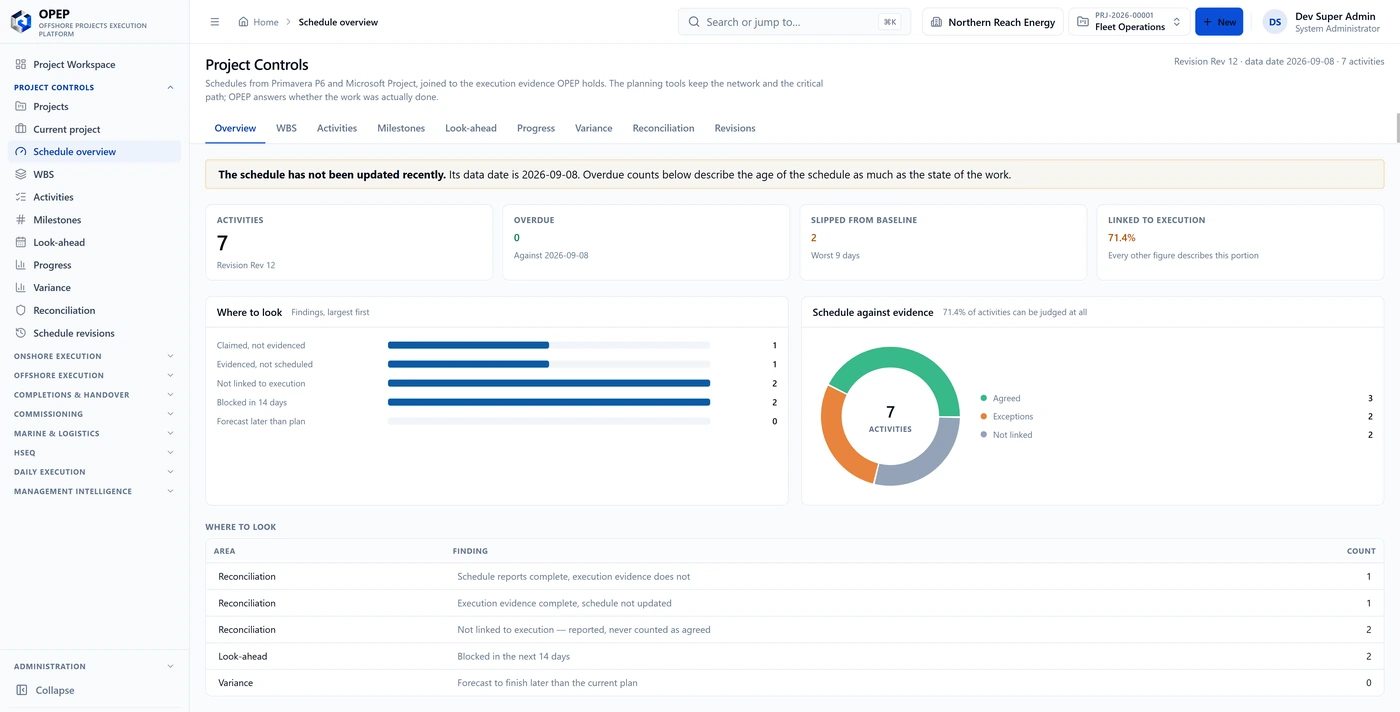
The schedule is reconciled against the execution evidence the platform holds, so claimed-but-not-evidenced and evidenced-but-not-scheduled are both positions you can open.
- Counted, not typedEvery figure is derived from the records beneath it, and a figure that cannot be derived is shown as not measurable rather than as zero.
- One register per thingEquipment, personnel, companies and vessels exist once and are shared across every module, so the same vessel is the same vessel everywhere.
- Blocked work, fourteen days outThe look-ahead reports what is blocked in the next fortnight, which is the window in which an offshore problem is still solvable.
The yard, the vessel and the platform, on one record.
Offshore projects normally run on one system in the fabrication yard, another offshore and a third for completions. The handovers between them are where the cost lands.
- Onshore executionMarine and logistics
Work packs and cargo become a load list against a sailing date
- Marine and logisticsOffshore installation
A campaign is read against weather windows and vessel availability
- Offshore installationCommissioning
Systems, check sheets and certificates carry through to start-up

Bring one campaign or one vessel month.
The day is entered where the work is, once. Every figure the project office and the centre read afterwards is derived from that entry rather than transcribed from it.
- Execution intelligence; Seven registers counted from one view, with ageing and gate readiness beside them.
- Separate applications, one area; OPEP, OPMS and VMT are distinct applications; none replaces another.
- Offline field capture; VMT captures daily operations as a PWA when the vessel has no connection.
A non-conformance blocks the scope it was raised against, and nothing else.
Blocking readiness, overdue work, failed inspections and verification outstanding are separate governed states derived from the underlying registers. A failed inspection represents a technical outcome; a late inspection represents a schedule condition, and the application keeps those positions distinct.
- Open non-conformances counted in age bands rather than averaged
- A blocking record settled by the responsible party, not closed by the raiser
- Readiness assessed from records, with cannot-be-determined kept apart from not-ready

3 applications, each operable on its own.
Adopt one and it works. Adopt the area and the records line up. No application here depends on another to run.
- OPEP
OPEP: Offshore Projects Execution Platform
The offshore project lifecycle from fabrication to commissioning, with execution intelligence.
See the interface - OPMS
OPMS: Offshore Projects Management System
Daily field input to productivity analysis and portfolio consolidation.
- VMT
VMT: Vessel Management Tracker
Fleet, charters, campaigns, daily operations, downtime and off-hire.
See the interface

Where this area is actually worked.
Vessels, charters, crew and persons on board sit inside the project record, so a weather window and a lift plan are read against each other rather than in separate meetings.
- Overrides on evidence; A gate override is recorded against the evidence it overrides.
Before the first working session.
Which applications belong here?
OPEP (offshore project execution), OPMS (portfolio consolidation), VMT (fleet).
Are OPEP and VMT the same application?
No. OPEP is project-rooted; VMT is vessel-rooted. They are adopted separately.
What does the field team use?
The mobile daily data entry shown on this page: the same record, entered on the phone.
Execution intelligence
Seven registers counted from one view, with ageing and gate readiness beside them.
Separate applications, one area
OPEP, OPMS and VMT are distinct applications; none replaces another.
Offline field capture
VMT captures daily operations as a PWA when the vessel has no connection.
Overrides on evidence
A gate override is recorded against the evidence it overrides.
Bring one campaign or one vessel month
We will show the execution record from the deck to the office.