
One version of project truth, from sanction to handover.
Capital projects are delivered across multiple organisations, each with its own responsibilities and records. Effective governance requires cost, interfaces, procurement, contracts, quality and completion positions to reconcile against controlled source records rather than competing spreadsheets.
- 0
- Applications serving this industry
- 0
- Operating areas
- 0
- Stages in the lifecycle

What this industry is actually like to run.
Capital project delivery under control: cost and change, interfaces, procurement and contracts, and the completions chain through to handover.
The boundary is where it fails
Engineering clashes, lost actions and contract disputes almost never start inside one company. They start where two parties each assumed the other owned something.
Completion is a chain, not a date
Systemisation, inspection records, punch clearance and certification form a sequence. A date in a plan is a prediction about that sequence, not a substitute for it.
The operator inherits the transferred record.
The quality and completeness of handover information affect the asset for its operating life, so readiness should be evidenced from the underlying records rather than accepted as an unsupported declaration.
Every one of these is a failure a governed record prevents.
Not a list of features. Each row is something that goes wrong in this industry, and the specific control in a Zemerc application that stops it happening.
- Portfolio health that quietly excludes the projects it cannot score
Projects that cannot be scored are identified and excluded explicitly, and a completion forecast is not produced where the available history does not support one.
PDMSProject Delivery Management System- Interfaces tracked in email and a shared spreadsheet nobody owns
Every interface is numbered, has accountable parties on both sides and carries a required-by date against which performance is measured.
IFMSInterface Management System- Certificates issued on a percentage rather than on completed deliverables
A controlled certificate sequence in which gate release depends on the required records being achieved; completion percentage is derived afterwards for reporting.
CCMSCompletion, Commissioning & Handover Management System- A tender that somebody could read early
Tender submissions remain sealed without an administrative read path and are opened through a formal recorded action.
PMSProcurement Management System
PDMS: Project Delivery Management System
Integrated delivery governance: portfolio, project workspaces and stage gates.
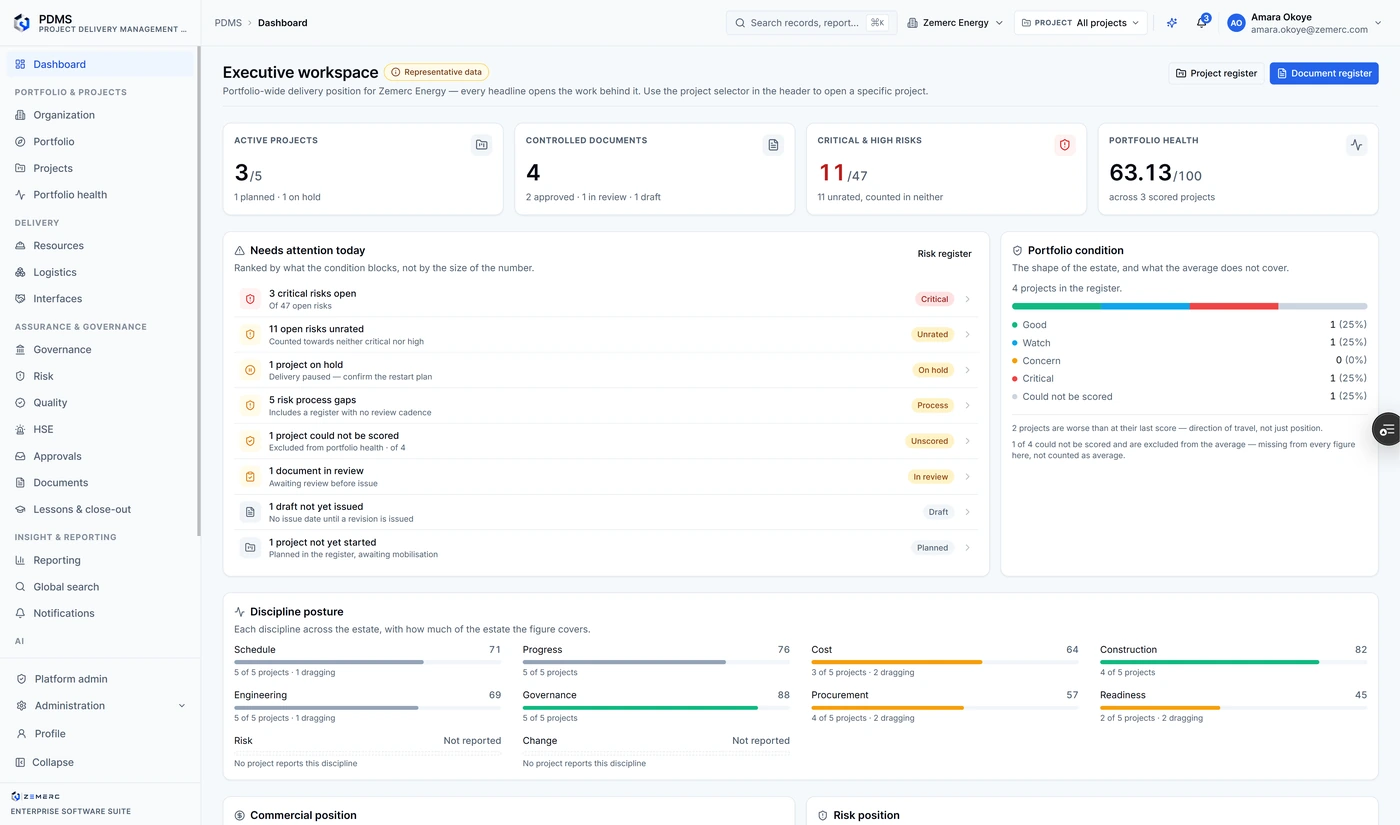
Attention is ranked by the condition behind it rather than by the size of the number, and discipline posture reports how much of the estate each figure actually covers.
6 stages, and who owns each of them.
The sequence this industry is genuinely run along, with the applications that govern each stage. Every one of them runs on its own; none of them needs the others to be useful.
Sanction
Portfolio, programme and project established, with the governance workspace that holds the evidence a gate is taken on.
Engineer
Deliverables, technical queries and the interfaces between every party delivering the work.
Procure
Qualification, sealed tendering, award, orders, expediting and inspection before acceptance.
Contract
Obligations, notices, variations, claims and payment certification through the operating years.
Complete
Systemisation, inspection and test records, punch clearance and the certificate sequence.
Hand over
Turnover packages, engineering information, spares and the transmittals the operator acknowledges.

The record is made where the work happens.
Project-board reporting should resolve to the records created in engineering, procurement, construction, completion and commissioning. Maintaining that lineage reduces the gap between field reality and management reporting.
- Barcode and QR scanning so records are raised where the equipment is
- Dual-party signatures on certificates, with the approval parties recorded
- Handover completeness computed from the registers rather than declared
A gate opens on completed deliverables, not on a number.
Each facility is reported against ready-for-commissioning, ready-for-start-up and handover criteria using completed-versus-total records, together with area status and open punch positions.
- The certificate sequence is configured once per project and then locked
- An executed record keeps the exact template revision it was signed against
- Category A punch is counted against the system it belongs to

10 applications across 3 operating areas.
Adopt a single application and it works on its own. Adopt an operating area and the records line up across it.
Govern capital-project cost, schedule, interfaces and delivery performance.
- PDMSPDMS: Project Delivery Management System
- BCMSBCMS: Budget & Cost Management System
- IFMSIFMS: Interface Management System
Qualify suppliers, buy, contract and move materials with governed commercial records.
- CVMSCVMS: Contractor / Vendor Management System
- PMSPMS: Procurement Management System
- CMSCMS: Contracts Management System
- LGMSLGMS: Logistics Management System
Prove the asset is built right and hand it over with complete engineering information.
- CCMSCCMS: Completion, Commissioning & Handover Management System
- QMSQMS: Quality Management System
- SPIRSPIR: Spare Parts Interchangeability Record Management System
The position you can defend when you are asked to.
Every control on this page exists because the underlying decision may need to be demonstrated later to a regulator, auditor, partner or board.
Deliverable-driven, never percentage-driven
A certificate is issued against completed deliverables. A percentage is something derived afterwards for reporting; it is never what opens a gate.
Two owners on every boundary
An interface carries a responsible organisation and an owner on each side, so there is no single accountable party to hide behind.
Decisions stay human and recorded
Gate outcomes are recorded human judgements with their evidence and audit trail. The platform computes support for a decision; it does not take one.
Bring one project and one system.
We will show the portfolio position it produces, the interfaces it is waiting on, and how its completion chain reads from the records rather than from the plan.