
Project Delivery Management System
Decision support you can reproduce by hand.
Capital-project delivery, project controls and portfolio governance in one application, covering portfolios, programmes and projects; governance workspaces across risk, quality, safety and approvals; and completion forecasting derived from the underlying project records.
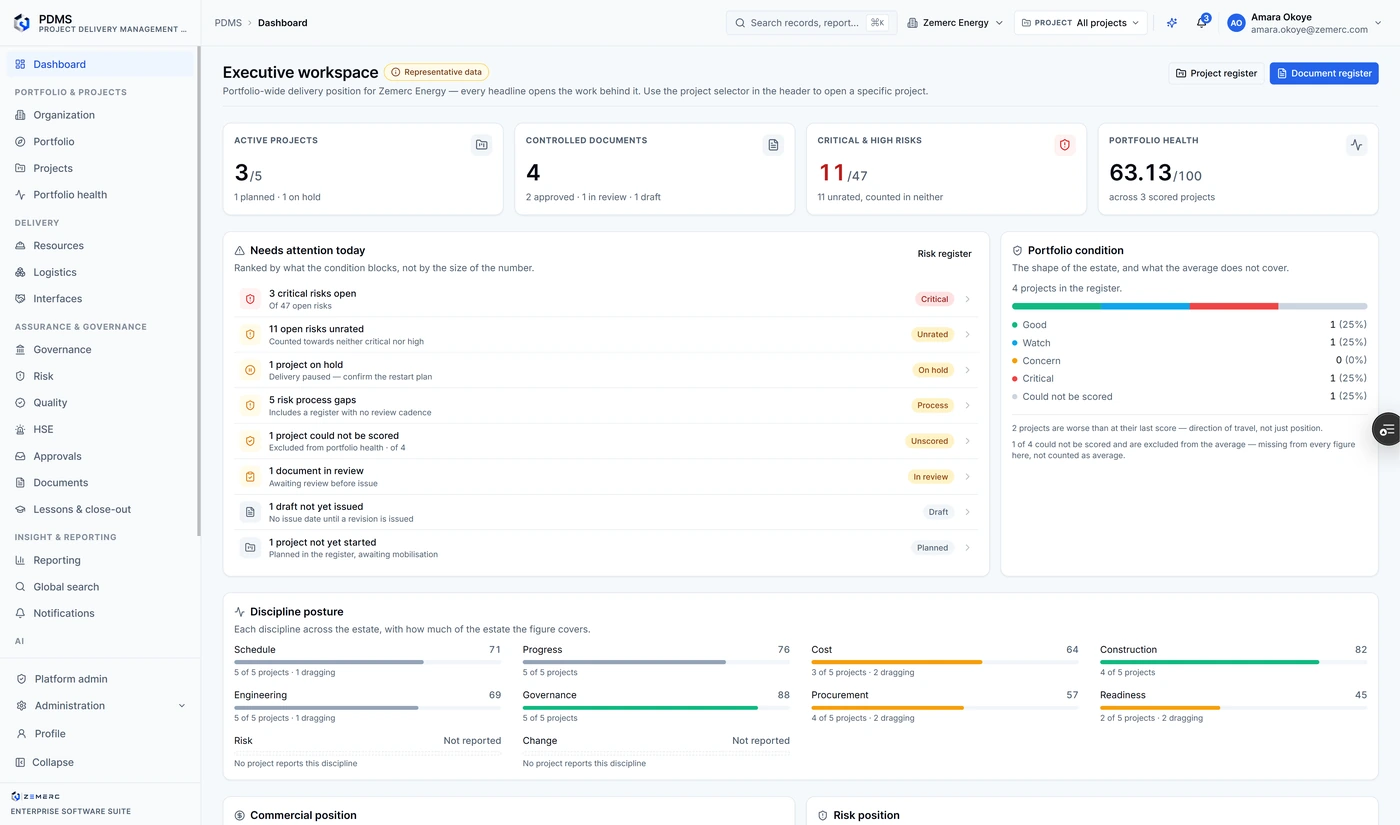
It will tell you it cannot say. That is the feature.
A delivery platform that always produces a forecast is producing a number somebody will be held to. PDMS projects a completion range from observed run-rate, states the day spread, refuses when the history will not support one, and reports that a project does not finish rather than extrapolating a date nobody believes.
A forecast you can check
Best, mean and worst finish, projected from run-rate with a countable spread. Every figure is reproducible by hand, which is what makes it defensible in a governance meeting.
Answers made of register figures
Ask a question and the answer is composed from the registers, each figure traceable to the workspace page it came from. Where nothing matches, it refuses rather than improvises.
Decisions stay human
Gate outcomes are recorded human judgements with their evidence and their audit trail. The platform computes support for a decision and records who took it.
Whether the register is being looked after is a separate question from what is in it.
Risks nobody rated count towards no severity band, so every figure above them describes a smaller register than the one that exists. Risks with no owner are nobody's problem by definition. Registers with no review cadence will never prompt anybody. PDMS reports all three.
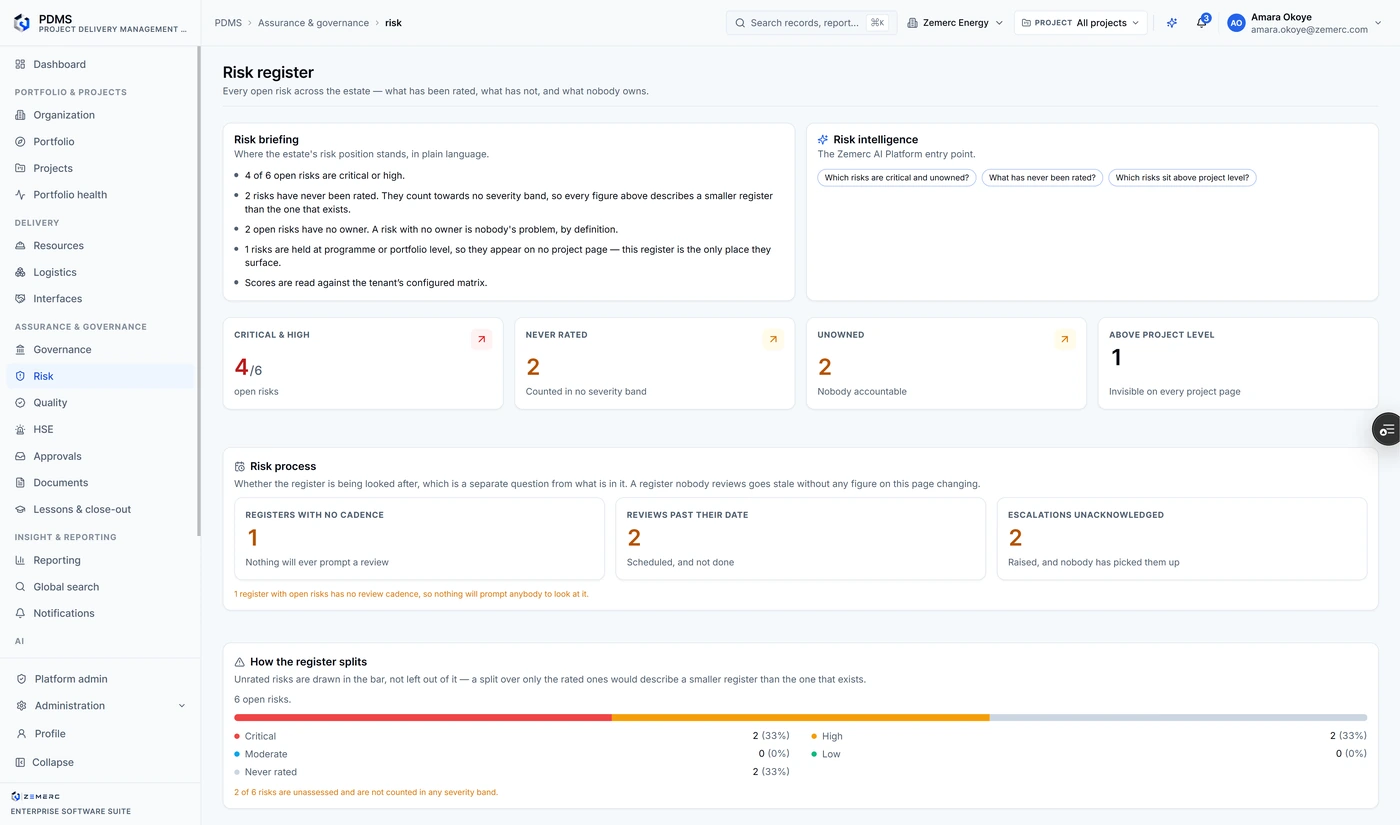
Unrated risks are drawn in the bar rather than left out of it, because a chart of only the rated ones describes a smaller register than the real one.
- Never rated is countedA risk that has never been rated is shown as its own band rather than omitted, so the severity split describes the whole register.
- Unowned is namedA risk with no owner is reported as unaccountable, because that is exactly what it is.
- Above project levelRisks held at programme or portfolio level remain visible in the governing register even when they do not appear on an individual project page.
Organisation, portfolio, programme, project, facility.
Every figure is aggregated along this structure, which is why a risk held at programme level has to be surfaced deliberately and why an unscoreable project is named rather than dropped from the average.
The gate decision is a judgement. The evidence for it is not.
Thirteen governance workspaces per project hold the evidence supporting delivery decisions across engineering, procurement, contracts, cost, schedule, controls, construction, readiness and related disciplines. Each gate records who made the decision and the evidence considered.
- Concept and selection
- Portfolio fit
- Options assessed
- Approval recorded
The gate outcome is a recorded human judgement with its evidence attached, not a computed verdict.
- Definition
- Engineering scope
- Cost basis
- Schedule baseline
Discipline posture reports how much of the estate each figure actually covers, rather than implying full coverage.
- Execution
- Progress against baseline
- Risk position
- Interface obligations
A project placed on hold is reported as on hold, with its restart plan identified for confirmation, rather than being misclassified as simply behind schedule.
- Readiness and handover
- Completions position
- Documents issued
- Close-out actions
Where a project cannot be scored, it is named as unscoreable and excluded from the average explicitly.
Supplied is not the same as accepted.
An interface supplied but not accepted has been sent on the provider's word, and the receiver may never agree with it. An interface past its date with both parties agreeing is fine. The register keeps those apart, because the second is a plan and the first is an exposure.
- Every transition records who moved it and why
- A slipped interface does not create a cost value on this page. Financial exposure remains governed by cost control.
- Obligations that cannot be named from the supplier or discipline registers are flagged as broken references

Seven licensed modules, three editions, enforced on the server.
The application's own navigation. Module and seat entitlement is enforced server-side rather than by hiding a menu, so what an organisation holds is what it can actually reach.
Portfolio and projects
Organisation, portfolios, programmes, projects and facilities with portfolio health assessed across the estate. Projects that cannot be assessed are reported explicitly rather than silently excluded.
- Organisation
- Portfolio
- Projects
- Portfolio health
The governance workspace
Thirteen governed workspaces per project cover engineering, procurement, contracts, cost, schedule, planning, controls, construction, readiness and handover, stage gates, actions, issues and decisions. Each workspace retains the evidence used for the relevant decision.
- Governance
- Stage gates
- Cost
- Schedule
- Controls
- Construction
- Readiness & handover
- Actions & decisions
Delivery
Resources, logistics and the interfaces between the parties delivering the work, held against the project rather than in the coordination meeting that discusses them.
- Resources
- Logistics
- Interfaces
Assurance
Risk, quality, health and safety, approvals, documents, and lessons and close-out, each reported on whether the register is actually being maintained rather than only on what it contains.
- Risk
- Quality
- HSE
- Approvals
- Documents
- Lessons & close-out
Insight and reporting
Governed, metadata-driven reports produced from live operational data, with global search across the estate and notifications when something crosses a line.
- Reporting
- Report library
- Schedules
- Global search
- Notifications
Administration
Configuration and audit, access reviews, data protection, control posture, licensed capabilities and data management, with module and seat entitlements enforced by the application rather than by presentation logic alone.
- Configuration & audit
- Access reviews
- Data protection
- Control posture
- Licensed capabilities
- Data Management

Seventeen roles reading one delivery estate.
Portfolio directors and executive sponsors, project directors and engineering managers, planning and cost engineers, procurement and contracts managers, construction and commissioning managers, risk, quality, safety and document control. The problem they share is that the portfolio view and the project view are usually different numbers.
- Per-project governance workspaces rather than a single project record
- Portfolio health scored across the estate, with exclusions named
- Access reviews, control posture and data protection as first-class areas
More of what the application covers.
- Stage gates with the evidence each decision was taken on
- Portfolio health with unscoreable projects named
- Risk registers reported on their own review cadence
- Readiness and handover as a project workspace
- Resources and logistics against the delivery plan
- Lessons and close-out held with the project
- Seven licensed modules across three editions, enforced server-side
- Queued field writes replay safely on reconnection without duplication
Reproducible by hand
The completion forecast projects best, mean and worst finish from observed run-rate with a countable day spread. It refuses on insufficient history and reports that a project does not finish rather than extrapolating.
Answers built from registers
The copilot routes a question to registered domain topics and composes its answer strictly from register figures, each traceable to the workspace page it came from. It refuses when nothing matches, and there is no model in the path.
Decisions are human and recorded
Gate outcomes are recorded human judgements with their evidence and their audit trail. The platform computes support for a decision; it does not take one.
Isolation enforced in the database
Row-level security is enabled and forced on every tenant-scoped table, verified by an automated completeness test against the live catalogue, with a runtime role that cannot bypass it.
The integrated delivery suite, beside the specialists.
- IFMSIFMS: Interface Management SystemInterface management in depth, where boundaries between parties require their own governed register and lifecycle.
- BCMSBCMS: Budget & Cost Management SystemBudget, commitment, actual and forecast for organisations that require dedicated cost-control governance.
- CCMSCCMS: Completion, Commissioning & Handover Management SystemCompletion and commissioning in depth, with governed certificate libraries, inspection and test records, punch control and handover evidence.
- LLMSLLMS: Lessons Learned Management SystemLessons learned maintained as an enterprise knowledge record rather than treated only as a project close-out activity.
See PDMS with one of your portfolios.
Bring one portfolio and its project history. We will show the health it scores, the projects it declines to score, and the completion forecast it will and will not produce.