
Completion, Commissioning & Handover Management System
Certificates are controlled gates supported by completion evidence.
The completion and commissioning lifecycle is governed within one project record, covering systemisation, inspection and test records, punch control, certificate progression and the evidence required for handover.
- 0
- Work areas
- 0
- Controlled registers
- 0
- Report definitions
- 0
- Certificate types

Gate release depends on completed deliverables, not a percentage alone.
Six controlled certificate types are configured in a project sequence and then locked. Whether mechanical completion or ready-for-pre-commissioning comes first is project-specific, but the approved sequence does not drift during execution.
Systemisation. Plant is divided into systems and subsystems, with each engineering item registered against one before completion status can be assessed.
Every plant object is registered against the controlled templates that govern it
Opening a system shows its plant-hierarchy position, applicable controlled certificate templates, inspection-and-test categories and outstanding punch affecting the next gate.
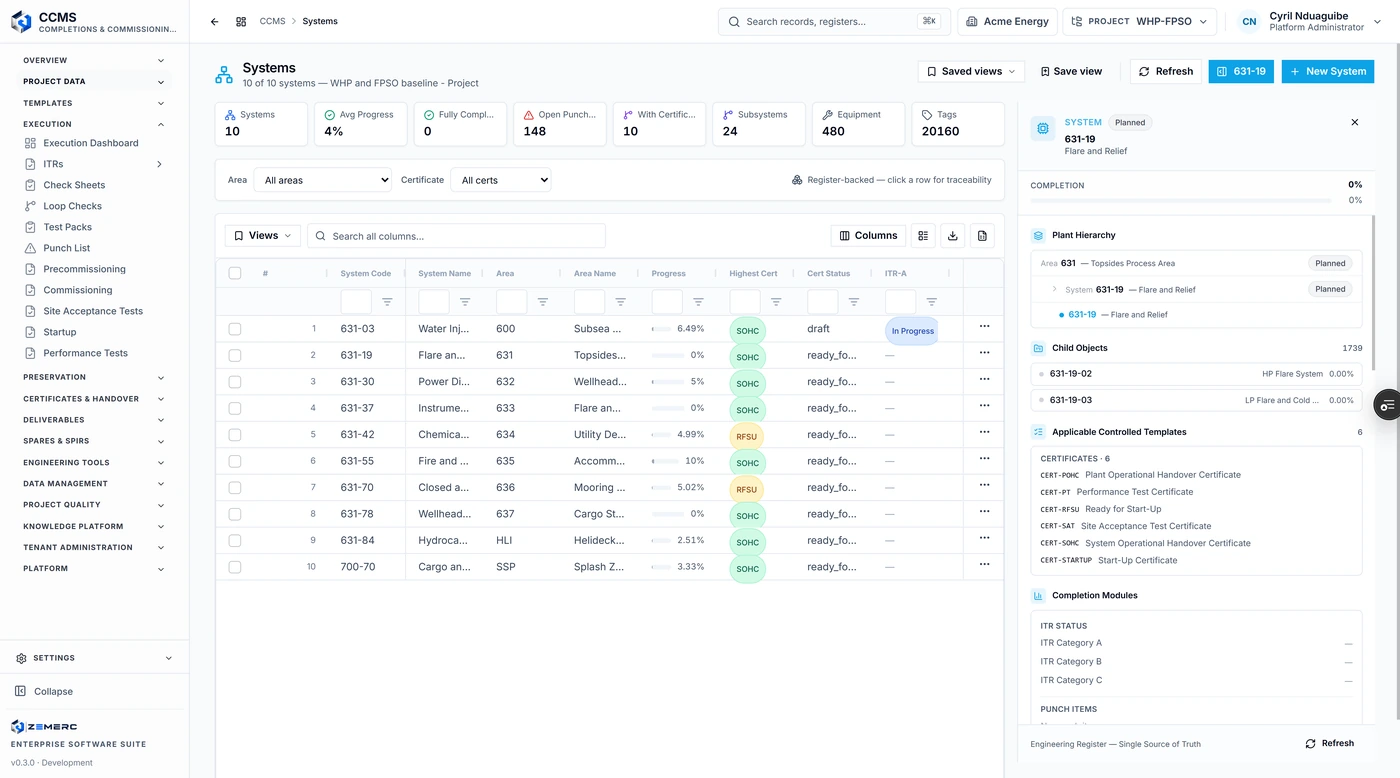
Completion is calculated as records achieved against records required, allowing the result to be traced back to its components.
- Traceable to the applicable revisionExecuted records retain the exact template revision against which they were signed.
- Category A blocks the applicable gatePunch items are counted by category against the system to which they belong rather than aggregated into a single clearance percentage.
- Dual-party signatureContractor and client signatories are recorded on the certificate together with the relevant approval parties.
Outstanding scope reduces at each controlled gate
Each stage reduces outstanding scope, and each reduction is supported by a signed record. Progression is based on evidence rather than planned dates alone.
Plant is divided into systems and subsystems, with each engineering item registered against one before completion status can be assessed.
Category A, B and C inspection and test records are executed against approved template revisions, with check sheets, loop checks and test packs behind them.
Punch items are raised and cleared by category. Category A items must be cleared before the gate they block, and counts remain associated with the relevant system.
The first certificate gate is issued against completed deliverables. Project configuration may place ready-for-pre-commissioning first where required.
Commissioning proceeds on the systems whose evidence supports it, through site acceptance testing and start-up.
Pre-start-up safety review, ready for start-up and the final handover certificate, with turnover packages and dossiers assembled from the records that produced them.
Fourteen work areas supported by one governed engineering register
CCMS navigation is organised around the way completions teams work, from engineering registers through execution and handover.
Systemisation
The engineering register provides the authoritative project hierarchy from plant through tag level, supported by line, valve, instrument, cable and loop lists.
- Areas
- Systems
- Subsystems
- Packages
- Equipment
- Tags
- Line Lists
- Loops
- Engineering Register
Controlled templates
Inspection and test records, check sheets and certificate templates are maintained in an approved revision-controlled library so executed records remain traceable to the exact revision used.
- Template library
- Approval Workspace
- Revision management
Execution
Inspection and test records in categories A, B and C, check sheets, loop checks, test packs and the punch list, through pre-commissioning, commissioning, site acceptance testing, start-up and performance tests.
- ITRs
- Check sheets
- Loop Checks
- Test packs
- Punch list
- Precommissioning
- Commissioning
- Site acceptance tests
- Startup
- Performance Tests
Certificates and handover
A configurable, lockable certificate sequence supports dual-party signatures, phase and area handover certificates, turnover packages and the governing event matrix.
- Certificate Workspace
- Stage sequence
- Phase Handover
- Area Handover
- Turnover packages
- Event Matrix
Deliverables and spares
Documents, drawings, single-line diagrams, piping and instrumentation diagrams, isometrics, vendor documents, calibration certificates, inspection and test plans and as-builts, with spares and interchangeability records beside them.
- Documents
- Drawings
- SLDs
- P&IDs
- Isometrics
- Vendor documents
- Calibration Certificates
- Inspection and test plans
- As-Builts
- Spares & SPIRs
Quality and knowledge
Technical queries, non-conformance reports, management of change and lessons learned, with preservation, the knowledge platform and the data management workspace supporting them.
- Technical queries
- NCRs
- Management of Change
- Lessons Learned
- Preservation
- Knowledge platform
- Data management

Twenty thousand plant objects linked to applicable controlled templates
Lines, valves, instruments, cables and loops are governed within one engineering register with discipline, area, system and subsystem context. Applicable controlled templates are listed by inspection-and-test category and project revision.
- Plant, area, system, subsystem, package, equipment and tag within one governed hierarchy
- Register-backed traceability from each record
- Temporary systems are maintained separately from permanent systems

Signatories are recorded against the work they verified
Commissioning engineers, inspectors and authorised signatories work from the same governed records. Certificates retain the people who executed and approved them together with the template revision in force at the time.
- Project roles for general users, super users and administrators
- Execution signatories and approval parties recorded on the certificate
- Barcode and QR scanning so records can be raised where the equipment is located
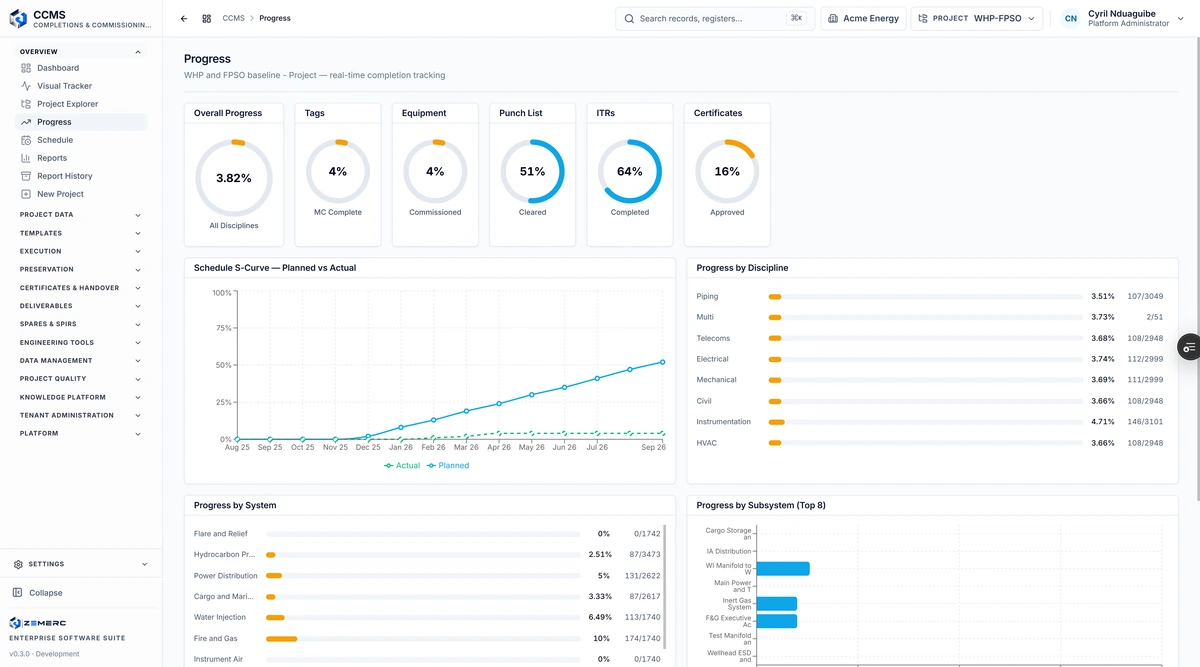
Progress percentages are meaningful because they are derived from governed records
Overall progress, mechanical completion, commissioned equipment, punch clearance and certificate approval are calculated from the underlying records, with planned and actual positions visible together.
Deliverable-driven rather than percentage-driven
Certificates are issued against completed deliverables. Completion percentage is derived afterwards for reporting and does not itself release a gate.
Signed against the applicable revision
Executed records retain the exact template revision against which they were signed, preserving the applicable rules for later review.
Dual-party signature
Certificates record contractor and client signatories together with the execution and approval parties associated with the certificate.
Certificate sequence configured and locked for each project
The approved order of mechanical completion and ready-for-pre-commissioning is configured once per project and then locked.
More of what the application covers
- Visual progress tracker and three-dimensional facility view
- Schedule curve comparing planned and actual progress
- Barcode and QR scanning on site
- Print and document packs
- Guided imports and a migration workspace
- Preservation registers with due dates
- Eighty-nine governed report definitions
- Tenant administration with project-specific role controls
Completion and handover supported by the registers from which status is derived
- QMSQMS: Quality Management SystemQMS governs inspection and test plans, non-conformance and corrective action, while CCMS applies the relevant controls to completion scope.
- SPIRSPIR: Spare parts Interchangeability Record Management SystemSPIR governs spares interchangeability and engineering information for handover, while CCMS governs completion status against the relevant equipment and systems.
- EDMSEDMS: Enterprise Document Management SystemEDMS governs controlled documents and transmittals, while CCMS assembles completion and handover evidence required for turnover.
- OPMSOPMS: Offshore Projects Management SystemOPMS governs portfolio-level execution and reporting, while CCMS governs system-level completion, tag status and commissioning evidence.
Review CCMS using one of your systems
Bring one system and its inspection and test records. The demonstration will follow it from systemisation through punch clearance to certificate release, including the applicable template revisions.