
Spare Parts Interchangeability Record Management System
We sent it is not the same as they have it.
The engineering information backbone from concept to decommissioning: a nine-level hierarchy with equipment and tags, spare parts with recorded interchangeability and alternates, documents and transmittals acknowledged rather than assumed, a vendor collaboration portal, technical records, and a digital handover centre where completeness is computed rather than asserted.
- 0
- Hierarchy levels
- 0
- Report definitions
- 0
- Transmittal states
- 0
- Module groups

Issued is where most systems stop. It is where the exposure starts.
A transmittal that was sent and never acknowledged means the organisation has despatched something and cannot demonstrate anybody received it. On a handover that is the difference between a closed obligation and an open one.
So acknowledgement is a state of its own, and closure needs it. The same discipline runs through the application: what has been done is held apart from what has been claimed.
Nine levels, atomic numbering, one identity per thing.
Questions such as which spare supports an item, which controlled documents apply to a tag and whether a handover package is complete can be answered only when each governed object has a unique, traceable identity.
Twelve reports, each phrased as a question.
Which spare-parts records are incomplete and which are ready for review. Which critical equipment has no approved spares. Which parts have recorded alternates and which obsolete parts still have none. What have vendors delivered and what is late. Which handover packages are ready, and what is blocking the rest.
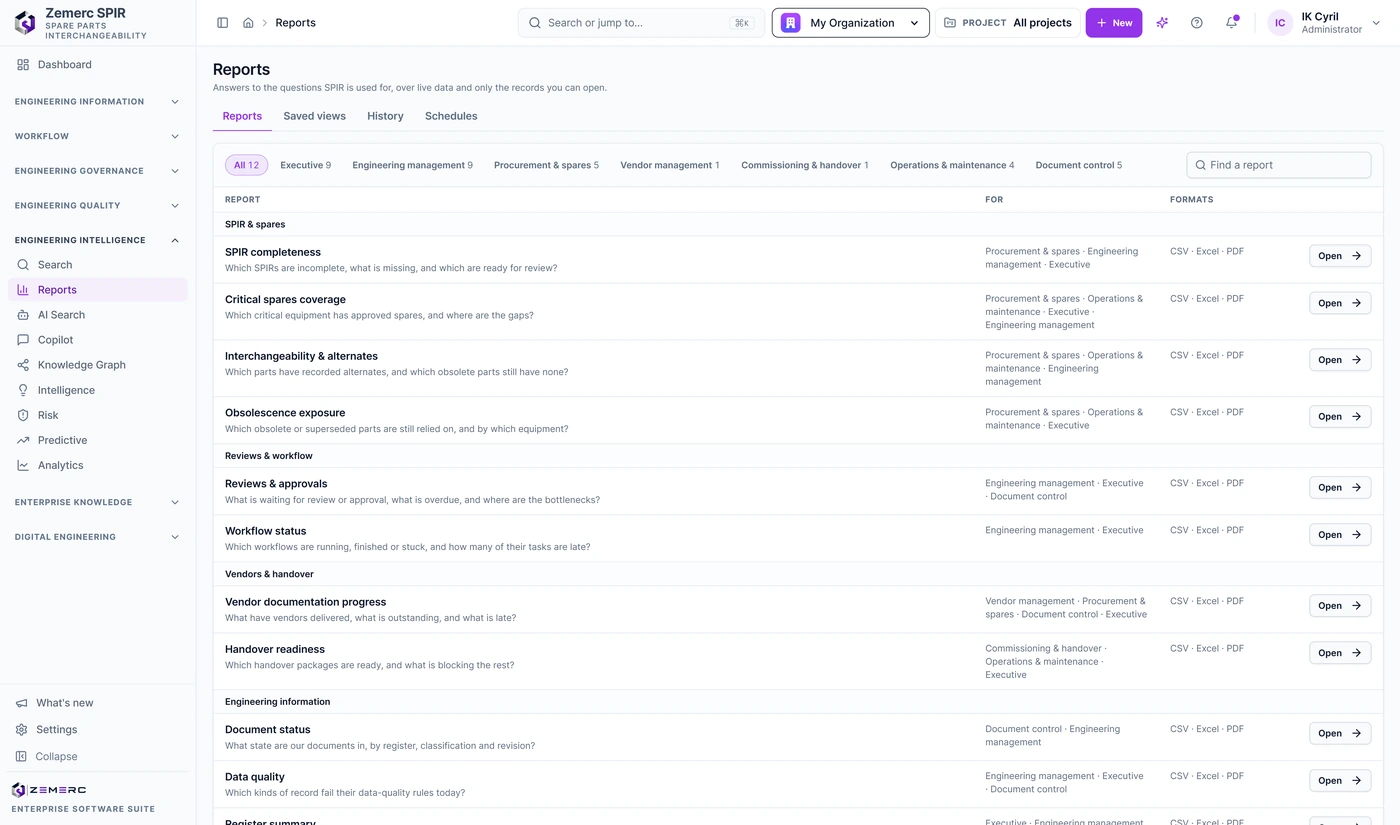
A report runs over live data and only the records the reader is permitted to open, so a figure is never inflated by rows they could not see.
- A question, not a tableEach report states the question it answers, so the right one can be chosen without opening six.
- Interchangeability is measured as coverageThe proportion of parts with recorded alternates and the number of obsolete parts for which no approved alternate has yet been established.
- Readiness before acceptanceHandover readiness is computed from the registers, so operations accept against evidence rather than against a date.
Eight module groups, concept to decommissioning.
The application's own navigation, from the hierarchy through spares, documents and vendor collaboration to technical records, handover and governance. Every chip is a page.
Engineering information
A nine-level hierarchy with atomic numbering, equipment and tags beneath it, so every document, spare and record has one identity to hang on rather than several.
- Hierarchy
- Equipment
- Tags
Spares and interchangeability
Records govern spare parts, approved alternates and procurement-relevant interchangeability decisions so engineering judgement is captured as an auditable record rather than retained only as personal knowledge.
- SPIR
- Spare Parts
- Procurement
Controlled documents and transmittals
Move through defined issue, acknowledgement and closure states so an unacknowledged transmission remains visible as an outstanding control point.
- Documents
- Transmittals
Vendor collaboration
Records data requirements, supplier submissions, review cycles, clarifications and scorecard measures so documentation progress is evidenced rather than inferred.
- Vendor Portal
- Data requirements
- Submissions
- Clarifications
- Scorecard
Technical records and handover
Factory and site acceptance tests, calibration and certificates verified, certified and archived, and a digital handover centre that computes completeness and readiness before operations accept.
- Technical Records
- Digital Handover
- Completeness validation
- Operations acceptance
Governance and quality
Master-data stewardship, configuration baselines and design freeze, reference data and metadata, data quality rules with a completeness scorecard, and the workflow and tasks across all of it.
- Governance
- Configuration
- Reference Data
- Metadata
- Data Quality
- Workflows
- Tasks

Lifecycle state on the equipment, not on a spreadsheet beside it.
Design, commissioned and operational are states the equipment itself carries, so a spare-parts question and a handover question are asked against the same record. Categories separate rotating, static and electrical equipment, because their spares behave differently.
- Bulk import and export for the whole register
- Filter by category and by lifecycle state
- Every item carries its number, name and place in the hierarchy
Interchangeability is recorded
Whether one part can stand in for another is an engineering judgement. SPIR holds it as a recorded relationship with its basis, rather than as something the storeman knew until they retired.
Handover readiness is calculated
From the records actually present, including documents, certificates, completion evidence and spares, rather than declared complete without supporting evidence.
One identity per thing
Atomic numbering across a nine-level hierarchy means an asset, a tag and a document each have one identity, which is what makes a where-used question answerable.
Only what you may open
A report runs over live data and only the records the user is permitted to see, so a figure is never inflated by rows the reader could not open.

The handover that arrives with everything it claimed.
Engineering and materials teams, document control, quality and certification, handover and commissioning personnel, and the receiving operator all depend on the quality and completeness of the engineering information transferred.
- Vendor data requirements issued, submitted, reviewed and scored
- Factory and site acceptance tests verified, certified and archived
- Operations acceptance against a computed readiness position
More of what the application covers.
- Nine-level hierarchy with atomic numbering
- Alternates and interchangeability with their basis
- Critical spares coverage against approved equipment
- Vendor scorecard from recorded submission outcomes
- Verify, certify and archive for technical records
- Configuration baselines and design freeze
- Mobile lookup by barcode or code at the equipment
- Governed import, export and master-data stewardship
The engineering information, beside the systems that consume it.
- CCMSCCMS: Completion, Commissioning & Handover Management SystemCCMS governs completion and commissioning execution; SPIR governs the engineering information and handover package associated with the equipment.
- OMSOMS: Obsolescence Management SystemOMS governs obsolescence and lifetime-buy decisions affecting the same equipment and spare-parts population.
- EAMSEAMS: Enterprise Asset Management SystemEAMS governs maintenance execution and asset work; SPIR supplies the governed spares and interchangeability information used by those activities.
- EDMSEDMS: Enterprise Document Management SystemEDMS governs enterprise document control; SPIR governs equipment-linked engineering deliverables and transmittals.
See SPIR with one of your handover packages.
Bring one equipment package with its vendor deliverables. We will show the interchangeability record it produces, the transmittals still unacknowledged and the handover completeness the registers actually support.