
Enterprise Asset Management System
Prioritise blocking work. Then manage the remaining backlog.
A governed system of record for the asset lifecycle, including the asset register, work management, preventive maintenance, inventory and spares, inspection, calibration and reliability. Work queues are prioritised by operational constraint and required action rather than by simple arrival order.
- 0
- Module groups
- 0
- Kinds of record
- 0
- Action types ranked
- 0
- Roles
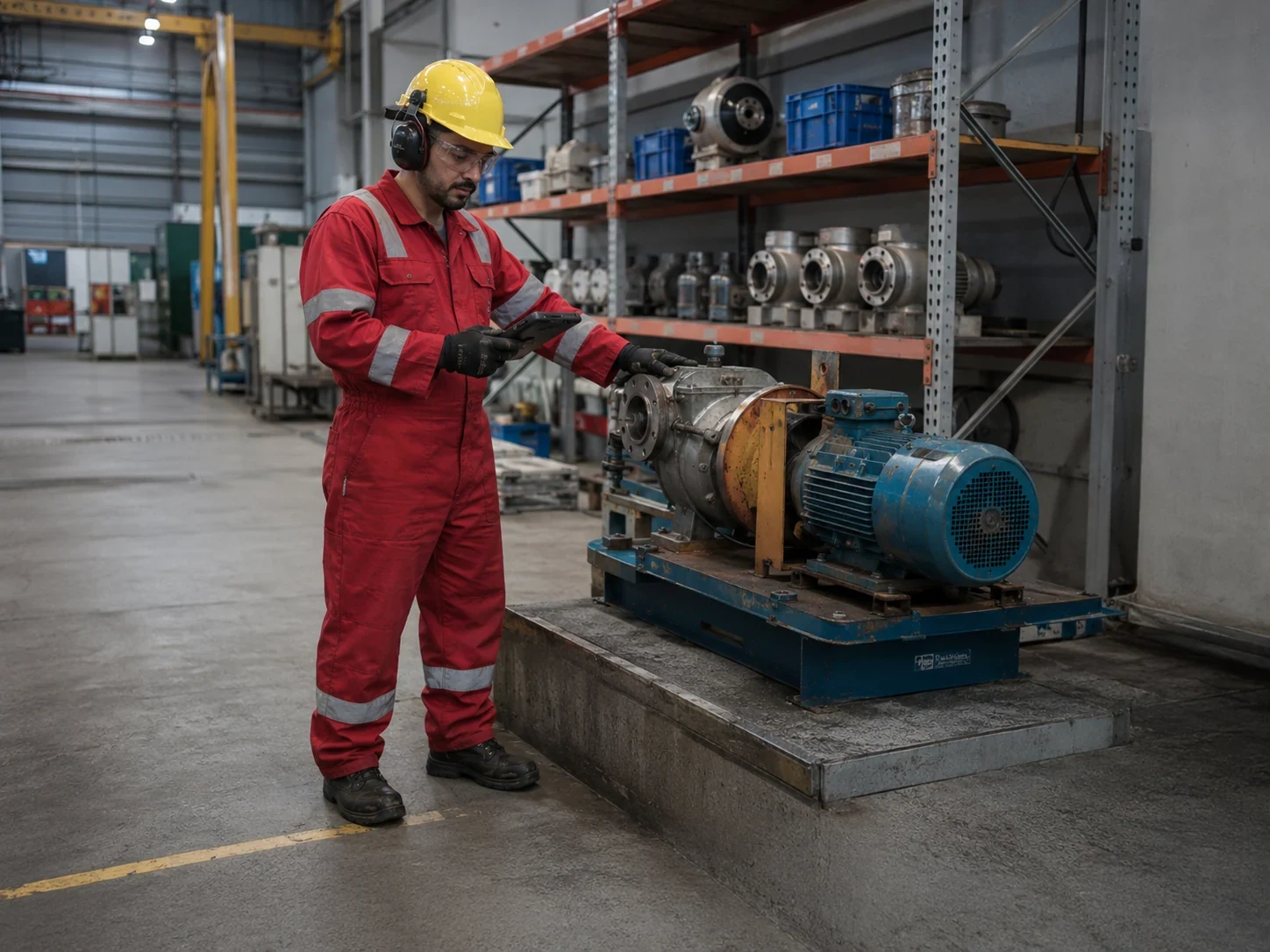
Controlled hand-offs connect each stage of the maintenance workflow.
An observation on an asset becomes planned work, scheduled work, completed execution with materials recorded against it, and finally an independently verified maintenance record. Each stage produces a defined input to the next.
Reports what was observed on the unit; a leak, a noise, a reading out of range; against the asset itself rather than as a message to a person.
Hands onA work request with the asset and the observation on it
Completed and closed are two different acts.
A technician completes the work and an authorised verifier closes it. EAMS keeps completion and verification as separate governed actions so closure cannot become a matter of informal practice.
The consequence shows up in the numbers: a maintenance-compliance figure means work that was done and checked, and an asset’s history contains verified records rather than self-reported ones.
Every asset carries its criticality, its state and what it is waiting on.
Lifecycle state and operational state are held separately, because an asset can be operating and planned for replacement, or in service and on standby. Attention is expressed as overdue work, overdue inspection or analysis outstanding, against the asset itself.
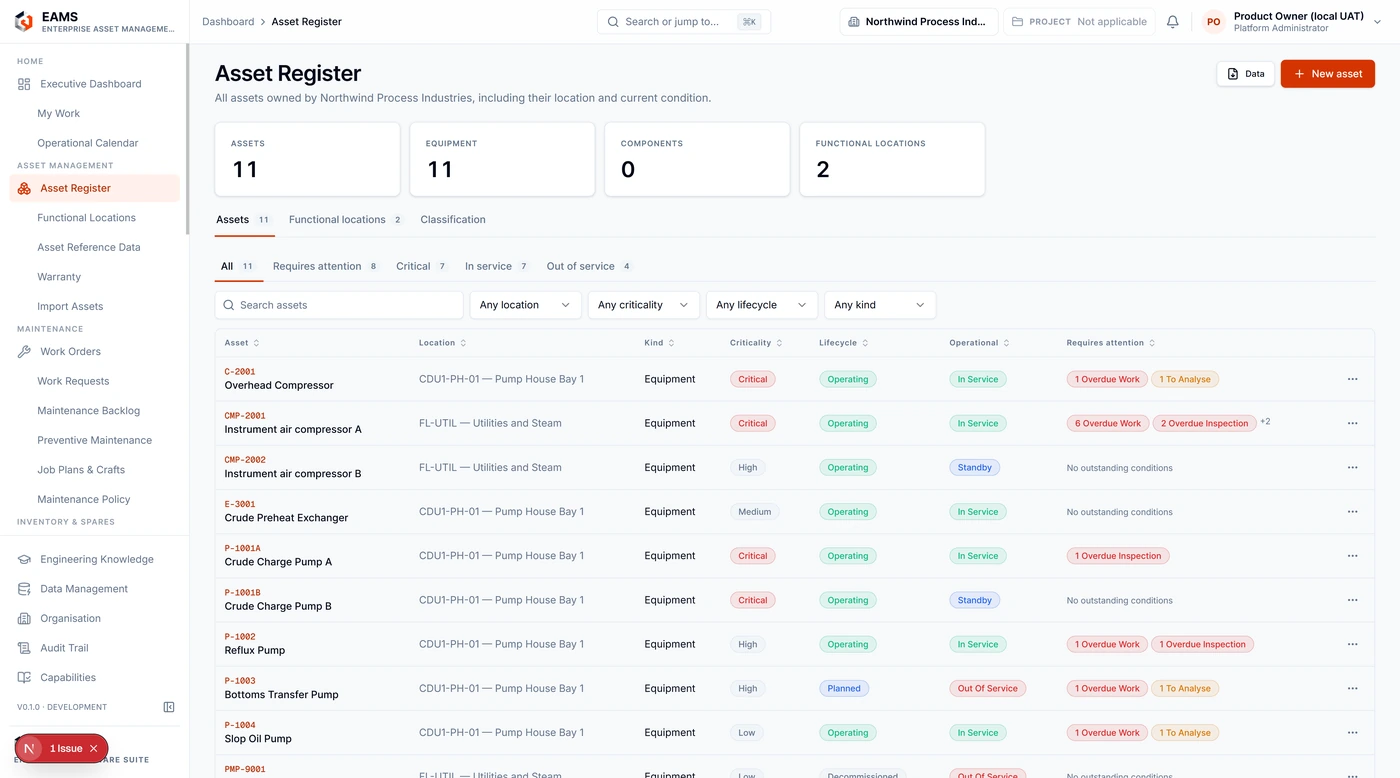
Where no supporting operational data exists a measure is shown as unavailable rather than as zero.
- Two states, kept apartLifecycle and operational state are separate fields, so decommissioned-but-running and in-service-but-standby are both expressible.
- Criticality is recordedCriticality is an engineering judgement held against the asset, and the queue uses it rather than recalculating it.
- Attention is specificAn asset does not show a warning; it shows the overdue work, overdue inspection or outstanding analysis behind it.
Ten module groups, grouped the way an EAM is bought.
The application is organised around the asset register, work management, inventory, condition, evidence and the operational work queue.
Asset management
The asset register with its relations, functional locations, classes, manufacturers and models as governed reference data, and warranty tracked against the asset rather than in a separate spreadsheet.
- Asset Register
- Functional Locations
- Asset Reference Data
- Warranty
- Import Assets
Work management
Work requests become work orders that move through a defined lifecycle, with the backlog visible by stage, crafts and contractors assigned, and approval rules that decide what needs authorising before it proceeds.
- Work Orders
- Work Requests
- Maintenance Backlog
- Preventive Maintenance
- Job Plans & Crafts
- Maintenance Policy
Inventory and spares
Stock and spare parts across stores and locations, an immutable stock-movement ledger, replenishment driven by reorder levels, and stocktake that reconciles what is held against what is recorded.
- Stock
- Spare Parts
- Stores & Locations
- Stock Movements
- Replenishment
- Stocktake
Inspection and calibration
Inspections with their due dates, a calibration programme carrying actual readings so an out-of-tolerance result is a recorded measurement, and failure events with analysis and a failure taxonomy.
- Inspections
- Calibration Programme
- Failure Events
- Analysis & Assessments
- Failure Taxonomy
Documents and evidence
Document control with a review and approval trail, the evidence held against the record that needs it, and certificates kept with the asset they belong to.
- Document Control
- Evidence
- Certificates
Work queue and reporting
A personal queue that ranks sixteen kinds of pending action with blocking items first, an operational calendar, and the report library, history, dashboards and notification rules behind them.
- My Work
- Operational Calendar
- Reports
- Report Library
- Dashboards
- Inbox
- Rules & Channels

Plans generate work. Meters decide when.
A maintenance plan identifies the asset, maintenance basis, frequency and next due point. Where maintenance is usage-based, governed meter readings drive the due position so work becomes due from actual equipment use rather than elapsed calendar time alone.
- Overdue plans are shown as cycles not generated, which is a different fault from work not done
- Job plans and crafts held separately from the plans that call them
- Maintenance policy governs what needs approval before it proceeds

Eleven roles, and one of them is always waiting.
Operators, planners, schedulers, technicians, supervisors, storemen, inspectors, calibration technicians, asset managers, document controllers and administrators all work the same records. The queue exists because the expensive delay in maintenance is almost never the work itself.
- Sixteen kinds of pending action, ranked with blocking items first
- An operational calendar across crafts and contractors
- Approval rules that decide what needs authorising before it proceeds
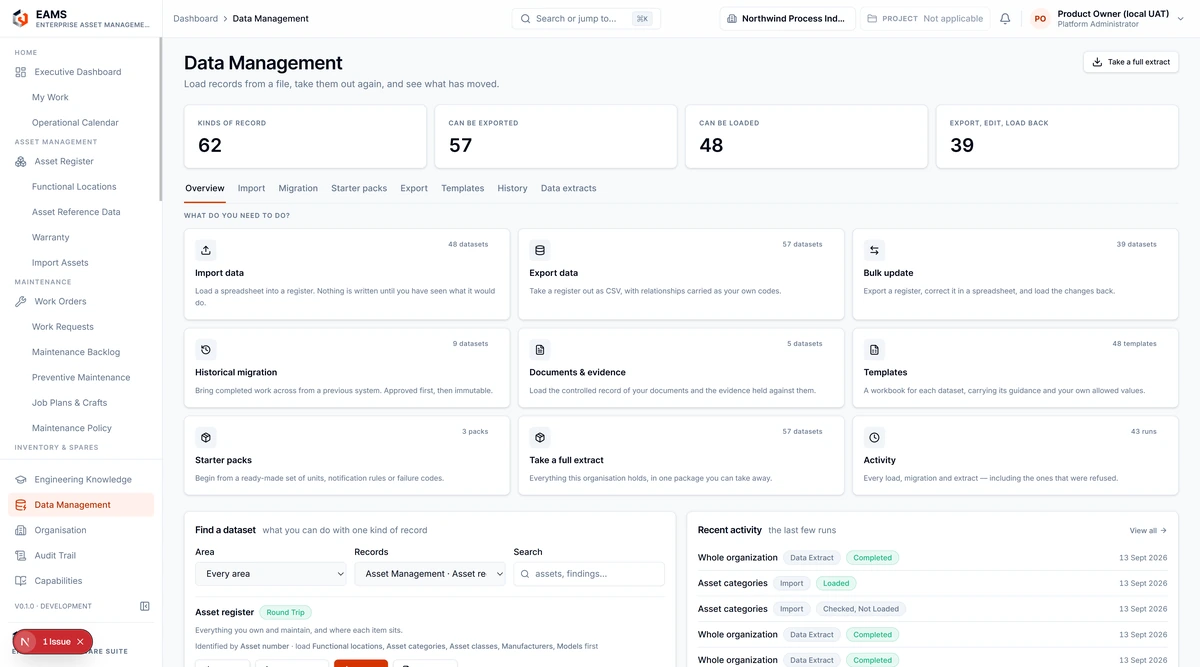
Sixty-two kinds of record, and each declares what may be done to it.
Import, export, bulk update, historical migration, documents, evidence, templates and a full organisation extract are governed through defined data-management routes. Round-trip capability is stated explicitly so users know which records can be exported, corrected and re-imported without loss of control.
Independent verification
Completing a work order and closing it are two acts by two people. The verification policy is configuration, not convention, so it cannot quietly lapse.
An immutable stock ledger
Stock movements are appended, never edited. What was issued to a work order remains attributable to it, and stocktake reconciles against the ledger rather than replacing it.
Unavailable, not zero
Where no supporting operational data exists the measure is shown as unavailable rather than as zero, so an absent reading never reads as a good one.
Blocking work ranks first
The personal queue ranks sixteen kinds of pending action by whether they stop other work, not by how recently they arrived.
More of what the application covers.
- Asset 360 with relations across every module
- Functional-location hierarchy from business unit to area
- Warranty tracked against the asset
- Meter-driven maintenance from recorded readings
- Stores and locations with replenishment
- Operational calendar across crafts and contractors
- Engineering knowledge library
- Starter packs for units, notification rules and failure codes
Maintenance execution, beside the judgement that drives it.
- AIRMSAIRMS: Asset Integrity & Reliability Management SystemIntegrity judgement, inspection and corrosion; EAMS executes the maintenance that follows from it.
- RAMSRAMS: Reliability, Availability & Maintainability Management SystemQuantitative reliability and maintainability analysis over the failure history EAMS records.
- SPIRSPIR: Spare Parts Interchangeability Record Management SystemSpares interchangeability and vendor records behind the stock EAMS issues.
- OMSOMS: Obsolescence Management SystemObsolescence and lifetime-buy decisions for equipment EAMS keeps in service.
See EAMS with one of your maintenance backlogs.
Bring one asset and its open work. We will show the queue it produces, what the verification policy would require to close it, and what the stock ledger says was used.