
Reliability, Availability & Maintainability Management System
A living reliability model, not last year’s study.
Quantitative reliability engineering maintained as a governed system of record: reliability block diagrams with deterministic analysis, failure-mode and criticality studies, fault and event trees, Weibull prediction with censoring and confidence intervals, availability and maintainability analysis, Monte Carlo simulation, production assurance and the failure data that supports each result.
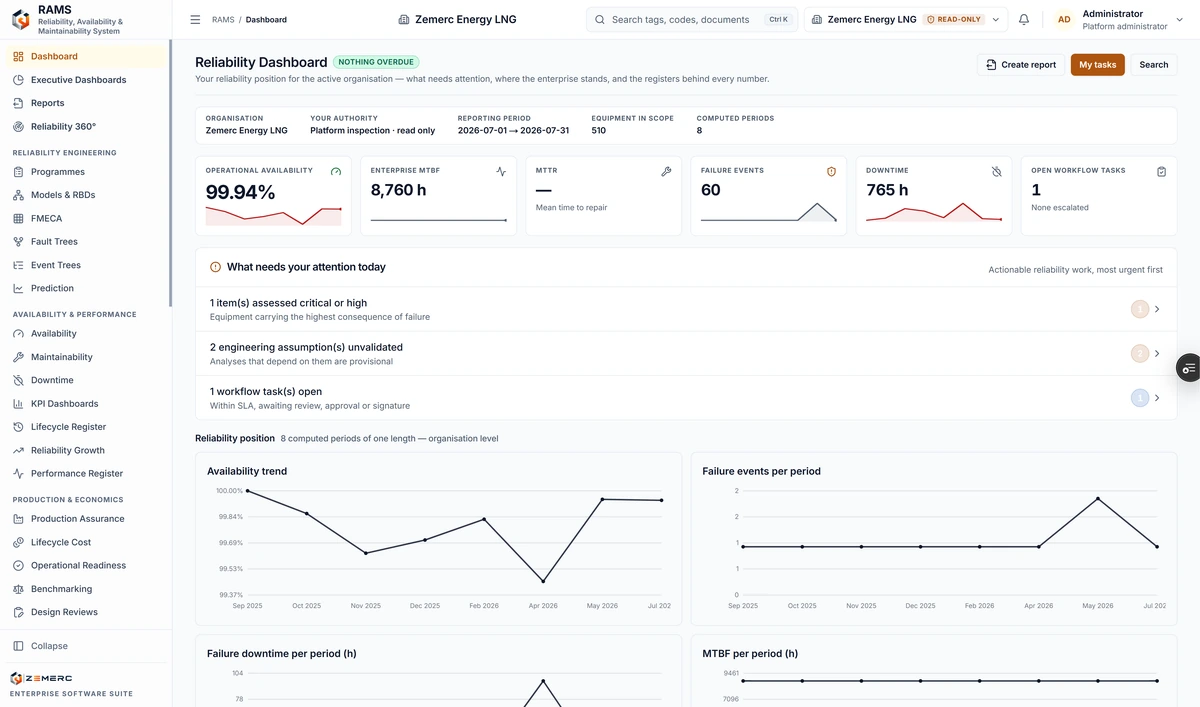
Six steps, and the result stays connected to the data.
A reliability study normally ends as a document. Six months later the failure history has moved on and nobody re-runs it, so the decisions it supported are being made against a model that is quietly out of date. RAMS keeps the model, the register and the report as one thing.
A reliability programme with its scope, its hierarchy and the assumptions it depends on; recorded in an assumption register rather than left in the analyst’s head.
Block diagrams, fault trees, Weibull analysis and Monte Carlo simulation, governed against one reliability record.
The reason RAM work fragments is that each technique usually lives in its own desktop tool with its own copy of the data. Here they share the failure register, the equipment hierarchy and the assumption register, so a change in one is a change in all of them.
Deterministic and pinned
The calculation engine is native and deterministic, pinned to worked examples. A result can be checked against a textbook case rather than taken on trust.
Uncertainty is carried
Weibull prediction handles censoring and carries confidence intervals, so a prediction from six failures does not present itself with the same authority as one from six hundred.
Simulation where closed form will not do
Monte Carlo simulation runs over the models the organisation has actually built, for the cases an analytic solution cannot reach.
The matrix is configurable because yours already exists.
Risk priority number and criticality are configured to the organisation's approved methodology rather than imposed by the application. What the system requires is consistent coding of the underlying failure data so the resulting analysis remains comparable and auditable.
Nine report families, and a controlled path to issued.
Executive reliability and performance; failure and downtime; equipment and system profiles; engineering studies; portfolio and governance; digital reliability; knowledge governance; data quality and provenance; and audit and traceability. Each report follows a controlled path from draft through review to issue.
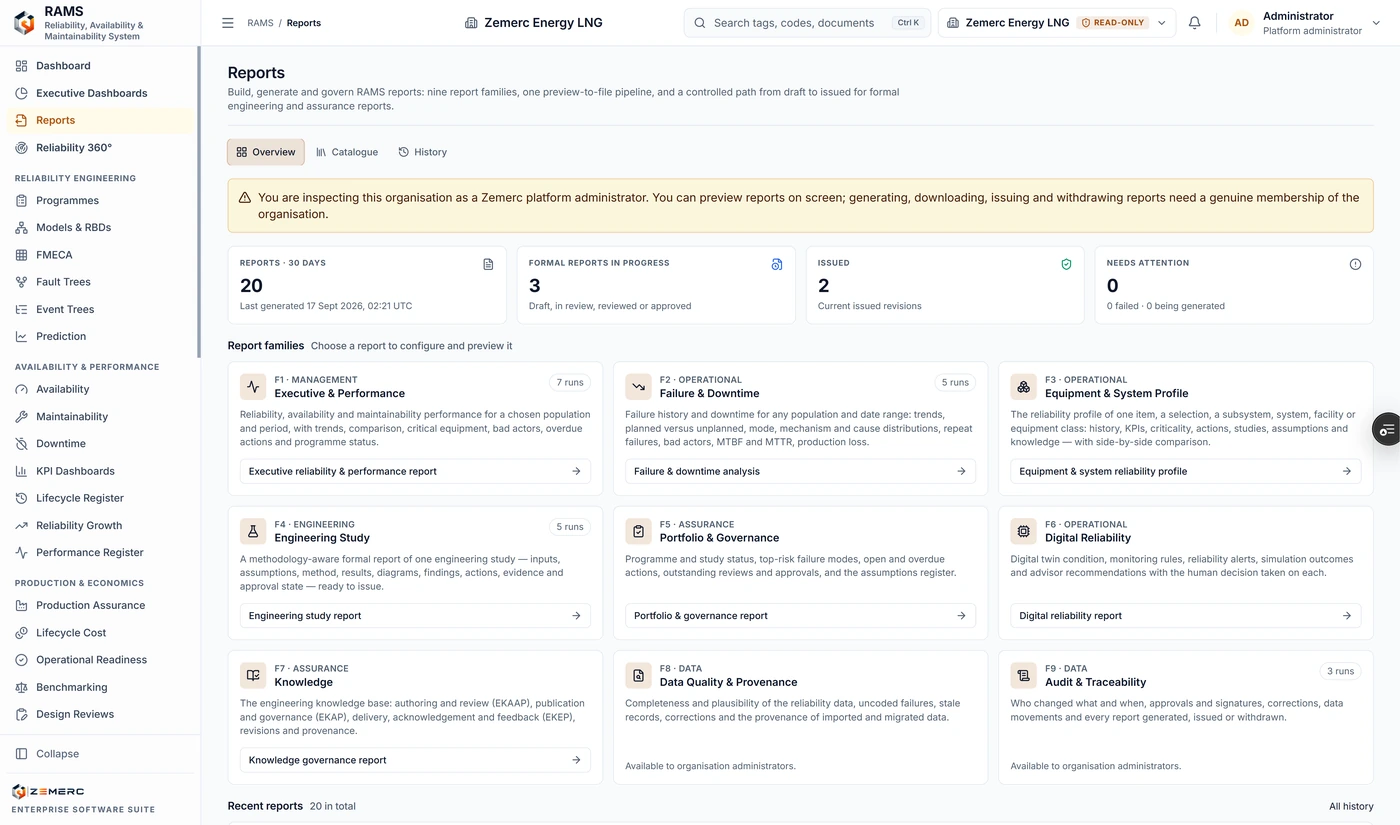
A study report is methodology-aware: it carries the inputs, assumptions, method, results, diagrams, findings, actions, evidence and approval state that make it defensible.
- Signed approvalA report is issued through workflow with a signed approval, which is what lets it be relied on outside the team that produced it.
- Provenance carriedData quality and provenance is a report family of its own, covering completeness, plausibility, stale records and where imported data came from.
- Withdrawal is possibleIssued reports can be withdrawn, and the audit and traceability family records who did what, when, and to which revision.
Eleven module groups, from the failure event to the shutdown plan.
The application's own navigation, from reliability engineering through availability and economics to failure management, digital reliability and the libraries beneath them. Every chip is a page.
Reliability engineering
Programmes and versioned models with a block-diagram editor and an analytic engine, failure mode effects and criticality analysis, fault trees with minimal cut sets, event trees, and Weibull prediction with censoring and confidence intervals.
- Programmes
- Models & RBDs
- FMECA
- Fault Trees
- Event Trees
- Prediction
Availability and performance
Inherent, achieved and operational availability, maintainability, downtime analysis with its Pareto, indicator dashboards, the lifecycle register, reliability growth and the performance register.
- Availability
- Maintainability
- Downtime
- KPI Dashboards
- Lifecycle Register
- Reliability Growth
- Performance Register
Production and economics
Production assurance, lifecycle cost, operational readiness, benchmarking, design reviews, maintenance strategy and reliability-centred maintenance, spare strategy and shutdown planning.
- Production Assurance
- Lifecycle Cost
- Operational Readiness
- Benchmarking
- Design Reviews
- RCM
- Spare Strategy
- Shutdown Planning
Failure management
An immutable failure register coded to the international standard for reliability data collection, with investigations and criticality assessment against it.
- Failure Register
- Investigations
- Criticality
Digital reliability
Digital twins, monitoring and alerts, and Monte Carlo simulation over the models the organisation has built rather than over a generic template.
- Digital Twins
- Monitoring
- Alerts
- Simulation
Libraries and governance
Standards, failure-rate libraries, failure coding and the assumption register, with workflow, controlled documents, signed approvals and the audit history behind them.
- Standards
- Failure Rates
- Failure Coding
- Assumptions
- My Tasks
- Documents
- Audit History

Reliability engineers who are tired of rebuilding the model.
Reliability engineers and analysts across oil and gas, liquefied natural gas, petrochemical, refining, mining, utilities, power and manufacturing who need current reliability models connected to governed failure data rather than isolated spreadsheets or static studies.
- Versioned models rather than a file somebody copied
- Failure data coded to a standard the next engineer will recognise
- Assumptions in a register rather than in the analyst’s head

A batch commits wholly, or it does not commit.
Engineering data is staged, previewed and reconciled before anything is written, and a commit is all or nothing. Protected fields stay protected through a bulk update, and every batch records who ran it, from which file, and exactly which rows were created or updated.
- Historical migration keeps the source, author and dates as provenance
- Templates are generated from the rules the importer actually applies
- A complete checksummed extract, including the customer exit package
An immutable failure register
Failure events are recorded once and coded to the international standard for reliability data collection. A prediction is only as good as the register beneath it, so the register is not editable after the fact.
Assumptions are recorded
An analysis that depends on an unvalidated engineering assumption is flagged as such on the dashboard, because an assumption nobody has checked is the usual reason a RAM study is wrong.
All or nothing commits
Data moves in staged previews with all-or-nothing commits, reconciliation and provenance, so a partial load never leaves a model half-updated.
Signed approvals
A study is issued through workflow with a signed approval, which is what lets it be relied on outside the team that produced it.
More of what the application covers.
- Reliability block diagram editor with an analytic engine
- Configurable risk priority number and criticality matrix
- Minimal cut sets from fault tree analysis
- Censoring and confidence intervals in prediction
- Inherent, achieved and operational availability
- Downtime Pareto by cause
- Failure-rate libraries and coding standards
- Executive dashboards with a controlled report behind each
The quantitative analysis, beside the records it runs on.
- AIRMSAIRMS: Asset Integrity & Reliability Management SystemAsset integrity records the engineering judgement; RAMS does the quantitative analysis over the failure history.
- EAMSEAMS: Enterprise Asset Management SystemMaintenance execution; RAMS decides the strategy the maintenance programme implements.
- SPIRSPIR: Spare Parts Interchangeability Record Management SystemSpares and interchangeability, informed by the spare strategy RAMS produces.
- FAMSFAMS: Flow Assurance Management SystemProduction assurance across the flow network the availability analysis is about.
See RAMS with one of your failure registers.
Bring one system and its failure history. We will show the block diagram it becomes, the prediction the data actually supports, and the assumptions the analysis is resting on.