

Keep it available. Keep it supportable.
Availability in generation and transmission assets is influenced by decisions made throughout the asset lifecycle, including how integrity is recorded, reliability is analysed and obsolescence is identified and managed.
- 0
- Applications serving this industry
- 0
- Operating areas
- 0
- Stages in the lifecycle
What this industry is actually like to run.
Generating and transmission assets kept available and supportable, with integrity, reliability and obsolescence risk managed against a single equipment record.
Availability is the commercial product
A unit that cannot run when it is called on has failed regardless of how well it was maintained. Everything upstream of that moment is an argument about probability.
Planned outages provide the principal opportunity for major intervention.
Scope that is not identified and prepared in time may be deferred to a later outage, affecting asset availability.
The supply chain ages too
Control systems, firmware, licences and spares reach end of support on their own schedule, entirely independently of how well the plant itself is running.
Every one of these is a failure a governed record prevents.
Not a list of features. Each row is something that goes wrong in this industry, and the specific control in a Zemerc application that stops it happening.
- Reliability studies trapped in spreadsheets and consultant reports that nobody re-runs
Version-controlled reliability models executed through a deterministic engine over an immutable failure register coded to an approved taxonomy.
RAMSReliability, Availability & Maintainability Management System- A critical spare discovered to be obsolete at the moment it is needed
Lifecycle position maintained as a governed state derived from verified manufacturer evidence, supporting lifetime-buy decisions while intervention remains possible.
OMSObsolescence Management System- Maintenance compliance figures that include work nobody independently checked
Work completion and independent verification are held as separate governed actions.
EAMSEnterprise Asset Management System- Integrity judgements recorded as a score whose method nobody can produce
Recorded counts and engineering judgements are reported directly, with no unsupported composite health, risk or readiness index.
AIRMSAsset Integrity & Reliability Management System
5 stages, and who owns each of them.
The sequence this industry is genuinely run along, with the applications that govern each stage. Every one of them runs on its own; none of them needs the others to be useful.
Design life
The asset register with criticality, strategy and warranty, and the functional-location hierarchy everything hangs from.
Operate
Preventive plans driven by meter readings, inspections and calibration with actual readings recorded.
Analyse
Weibull prediction with censoring and confidence intervals, fault trees, availability and simulation over the models built.
Support
Obsolescence across physical items and software alike, with exposure counted through the bill of material.
Extend or replace
Life-extension decisions made against recorded condition and recorded judgement rather than against an index.
RAMS: Reliability, Availability & Maintainability Management System
Quantitative reliability analysis for operating assets.
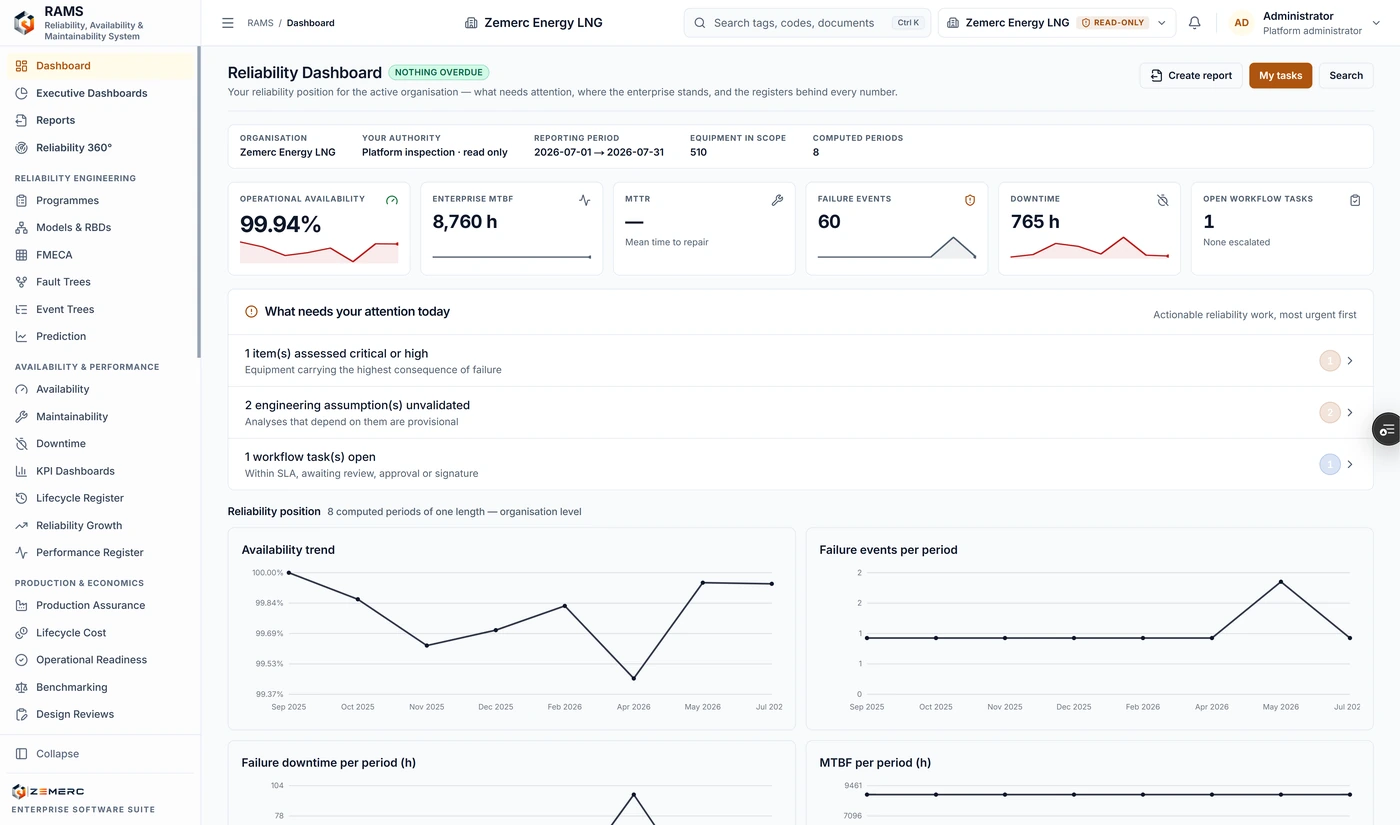
Analyses that depend on an unvalidated engineering assumption are flagged as such, because an unchecked assumption is the usual reason a study is wrong.

The work that decides availability happens long before the call.
Inspection, calibration and preventive maintenance create the evidence required for subsequent engineering analysis. The value of that evidence depends on the quality, traceability and context of the record produced.
- Failure events coded to a standard reliability taxonomy
- Meter-driven maintenance from recorded readings rather than estimates
- Exposure counted through bills of material to the installations that depend on it

Status is a conclusion drawn from verified evidence.
Only verified events determine the lifecycle position. Superseded events cease to govern, verified events take effect from their effective date, and the most severe in-force state determines the current position. Where no qualifying evidence exists, the position is reported as unknown.
- Unknown treated as a real answer, never as active
- Physical items and software, firmware and licences in one lifecycle model
- Aligned with the applicable obsolescence-management standard, with the claim stated as alignment rather than certification.
8 applications across 2 operating areas.
Adopt a single application and it works on its own. Adopt an operating area and the records line up across it.
Keep operating assets available, maintained, inspected and supportable.
- AIRMSAIRMS: Asset Integrity & Reliability Management System
- RAMSRAMS: Reliability, Availability & Maintainability Management System
- EAMSEAMS: Enterprise Asset Management System
- OMSOMS: Obsolescence Management System
Build management systems, report sustainability, control documents, retain knowledge.
- IMSIMS: Integrated Management System
- ESGESG: Environmental, Social & Governance Management System
- EDMSEDMS: Enterprise Document Management System
- LLMSLLMS: Lessons Learned Management System
The position you can defend when you are asked to.
Every control on this page exists because the underlying decision may need to be demonstrated later to a regulator, auditor, partner or board.
Assumptions in a register
The assumptions an analysis depends on are recorded and their validation state reported, rather than living in the analyst’s head.
A study that stays alive
Model, register and report are one thing, so a study does not quietly go out of date the month after it is issued.
Signed, and therefore usable
A study issued through workflow with a signed approval can be relied on outside the team that produced it.
Bring one unit and its failure history.
We will show the reliability model it becomes, the prediction the data actually supports, and whether its critical spares will outlast the exposure.