
Integrated Management System
Compliance is an outcome of a functioning management system, not the management system itself.
Build the management system around the organisation and its operating context rather than around a clause list. IMS supports organisational context, gap assessment, controlled system generation, operations, recurring activities, risk and objectives, internal audit, management review and continual improvement.
- 0
- Management-system areas
- 0
- Data domains
- 0
- Report definitions
- 0
- Governed datasets

Six stages, and it does not end at the certificate.
Understand the organisation, assess the gap, establish the management system, operate it and improve it. Improvement feeds the next assessment so the system continues to evolve after certification.
Establish what the organisation does, where it operates and which requirements apply, so the management system is built against the correct organisational context.
In the application: Understand
The generated system is already running.
IMS establishes an operational management system rather than producing a document pack that must later be translated into working controls. Processes, controls, registers and documents are editable and governable from the point the system is established.
Onboarding. Establish what the organisation does, where it operates and which requirements apply, so the management system is built against the correct organisational context.
Five steps to an issued report, and the scope is set before the first one.
Choose a report, set the management system, dates and records it covers, generate it with its own reference, review it on screen exactly as it will be issued, then download it or deliver it on a schedule. Management-system health is reported per area, as live against total, so a weak area cannot be averaged away.
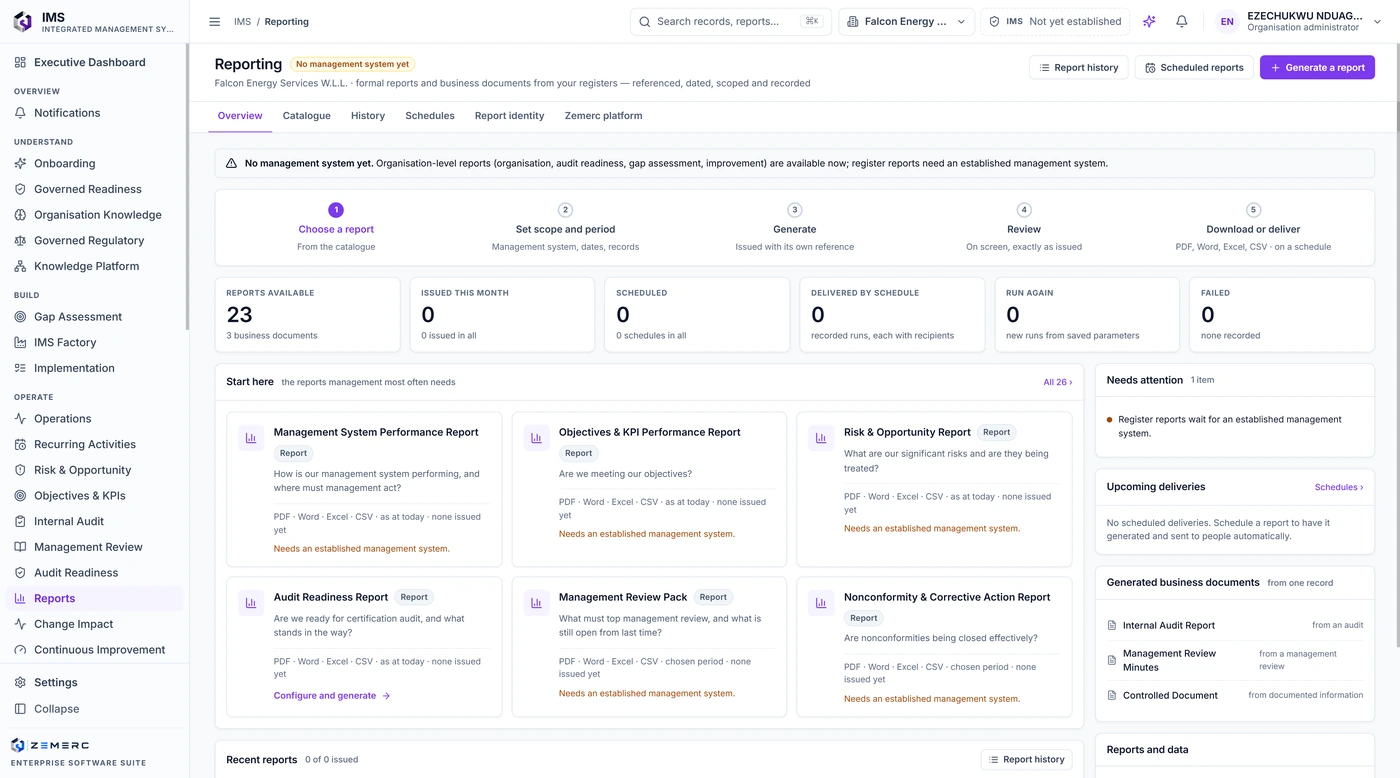
A report states the management system, dates and records it covers before it is generated, and is reviewed on screen exactly as it will be issued.
- Work, not a scoreImprovement priorities are expressed as defined actions, such as closing a gap, clearing overdue work or re-reviewing controlled documents, each with its own significance.
- Maturity carries a levelMaturity is shown with its level and its movement since last, rather than as a bare number with no direction.
- Approved is not publishedAn approved but unpublished artefact is not treated as operational evidence, and the dashboard says so.
Understand, build and operate the management system, supported by governed controls beneath it.
The application's own navigation, arranged as the journey rather than as a feature list. Every chip is a page.
Understand
Onboarding establishes what the organisation actually does, where it operates and what applies to it, with governed readiness, organisation knowledge and the regulatory position recorded before anything is built.
- Onboarding
- Governed Readiness
- Organisation Knowledge
- Governed Regulatory
- Knowledge Platform
Build
Assess the gap against what already exists, then establish an operational management system that is editable and governable from the start rather than a set of templates awaiting completion.
- Gap Assessment
- IMS Factory
- Implementation
Operate
The system running: operations, recurring activities, risk and opportunity, objectives and indicators, internal audit, management review, audit readiness, change impact and continual improvement.
- Operations
- Recurring Activities
- Risk & Opportunity
- Objectives & KPIs
- Internal Audit
- Management Review
- Audit Readiness
- Change Impact
- Continuous Improvement
The management system
Governance, processes, controls, documented information, evidence, competence and training, suppliers and customers, assets, compliance and improvement; the ten areas the health view reports against.
- Governance
- Processes
- Controls
- Documented Information
- Evidence
- Competence & Training
- Suppliers & Customers
- Assets
- Compliance
- Improvement
Reference and library
The organisation record, the governed library, the audit trail and the standards intelligence behind the system, kept as reference rather than mixed into operational registers.
- Organisation
- Governed Library
- Audit Trail
- Standards Intelligence
Data management
Datasets by domain with what is importable and exportable declared per domain, imports and updates previewed before anything is written, and migration history kept.
- Datasets
- Import & Update
- Export
- Templates
- Files
- History
- Extract & Offboarding

Organisations that need a system, not a shelf of procedures.
Operations directors at organisations too small to carry a full compliance function, and consultants running the same method across several clients. What both need is a management system that reflects how the organisation actually works and stays current when it changes.
- Jurisdiction inheritance across sites and business units
- Change impact assessed when the organisation changes
- Multi-standard integration in one system rather than parallel ones
Twenty-one domains, each with its own rules.
An organisation-level management system holds a great deal of data that belongs to different owners. IMS keeps it in domains rather than in one undifferentiated store, and states per domain what may be brought in and taken out.
Every domain declares what it holds and what it accepts.
Organisation, standards and governance, processes, risk and opportunity, objectives, controls, evidence, documented information, internal audit and improvement each hold their own datasets, with importable and exportable stated per domain and last activity carried alongside.

Built around the organisation
The system is organised by what the organisation does, not by clause number. A clause is something the system answers to, not the way it is arranged.
Operational from generation
A generated management system is live rather than a document pack. Nothing has to be transcribed into another tool before it can be used.
Editable everywhere
Every generated process, control, document and register can be changed. Generation is a starting position, not a constraint.
Management-system health is reported by area
Such as documents, processes, controls, objectives, registers, audits and management review, so weakness in one area cannot be hidden within a composite score.
More of what the application covers.
- Jurisdiction inheritance across sites and business units
- Multi-standard integration in one management system
- Recurring activities with due dates and owners
- Internal audit programme and audit readiness
- Management review pack assembled from the registers
- Change impact assessment when the organisation changes
- Competence and training held with the people it applies to
- Governed import, export, templates and offboarding extract
The management system, and the operations that run inside it.
- QMSQMS: Quality Management SystemQuality operations, inspection and non-conformance; IMS holds the management system those sit inside.
- HSEHSE: Health, Safety & Environment Management SystemOccupational health, safety and environment operations; IMS holds the clauses its audits reference.
- RMSRMS: Risk Management SystemEnterprise risk; IMS carries risk and opportunity at management-system level.
- ESGESG: Environmental, Social & Governance Management SystemSustainability disclosure built on the same governed evidence.
See IMS build a system for your organisation.
Bring a small set of existing procedures, a register or a previous audit finding. The working session will show how IMS assesses the gap and how those records become part of the operating management system.