
Health, Safety & Environment Management System
Report promptly and control actions through verified closure.
A governed HSE system covering frontline and offline reporting, permit to work, job safety analysis, investigations, corrective actions, occupational health, environment, emergency response, audits and obligations, with reported positions derived from recorded data.
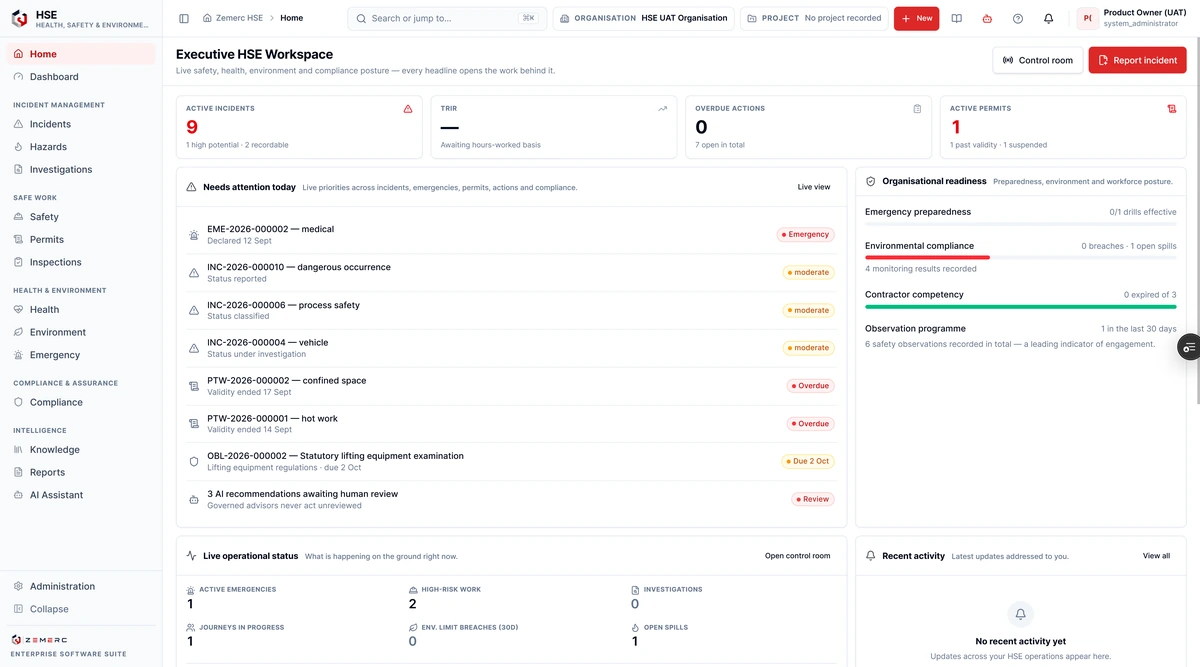
Observe, assess, control, act, verify and retain evidence
HSE workflows move through observation, assessment, control, action, verification and retained evidence. The loop closes because verified controls and evidence become part of the basis for subsequent observations and assurance.
Field and offline reporting support hazards, observations, near misses and incidents, each with a permanent document number.
In the application: Incidents · Hazards · Observations
Five functional groups supported by one governed record
HSE navigation is organised around principal operational functions, with each area linked to governed records and workflows.
Incident management
Incidents, near misses, hazards and observations receive permanent identifiers, follow defined classification and investigation workflows, and progress to corrective or preventive action through valid next states.
- Incidents
- Hazards
- Investigations
- Actions
- Observations
Safe work
Permit-to-work workflows support suspension and return, mandatory job safety analysis where configured, Life Saving Rules, stop-work controls, behavioural safety, safety walks, toolbox talks, PPE, fatigue, visitors, contractors and inspection activities.
- Safety
- Permits
- JSAs
- Inspections
- Toolbox talks
- Contractors
Health and environment
Occupational-health surveillance and exposure records are separated from environmental aspects, monitoring, spills, waste and emergency-response records, with medical data restricted to authorised medical roles.
- Health
- Environment
- Emergency
- Spills
- Monitoring
Compliance and assurance
Audits, statutory obligations, improvements and management-of-change records retain owners, dates and approval evidence required by their governing workflows.
- Compliance
- Audits
- Obligations
- Management of change
Analysis and reporting
Twelve governed report definitions support executive, operational, assurance, environment, health and board reporting, alongside a knowledge library and permission-aware search across fourteen record types.
- Reports
- Knowledge
- Search
- Advisors

Every authorised site user can report, and every report becomes a governed record
Workers, supervisors and contractors can report hazards, observations, near misses and incidents from mobile devices, including offline use where supported. Reports receive permanent identifiers and synchronise into the governed record without duplicate creation.
- Offline capture with duplicate-controlled synchronisation
- Permanent document numbers across fifty schemes
- Life Saving Rules and stop-work authority available across authorised site roles
- Toolbox talks, safety walks and behavioural observations in the same registers
Every reported figure derived through a governed calculation
Recordable and lost-time rates are calculated from recorded hours worked. Incident classification, leading and lagging indicators, exceptions, health, environment, permit and action positions are reported from governed source records.
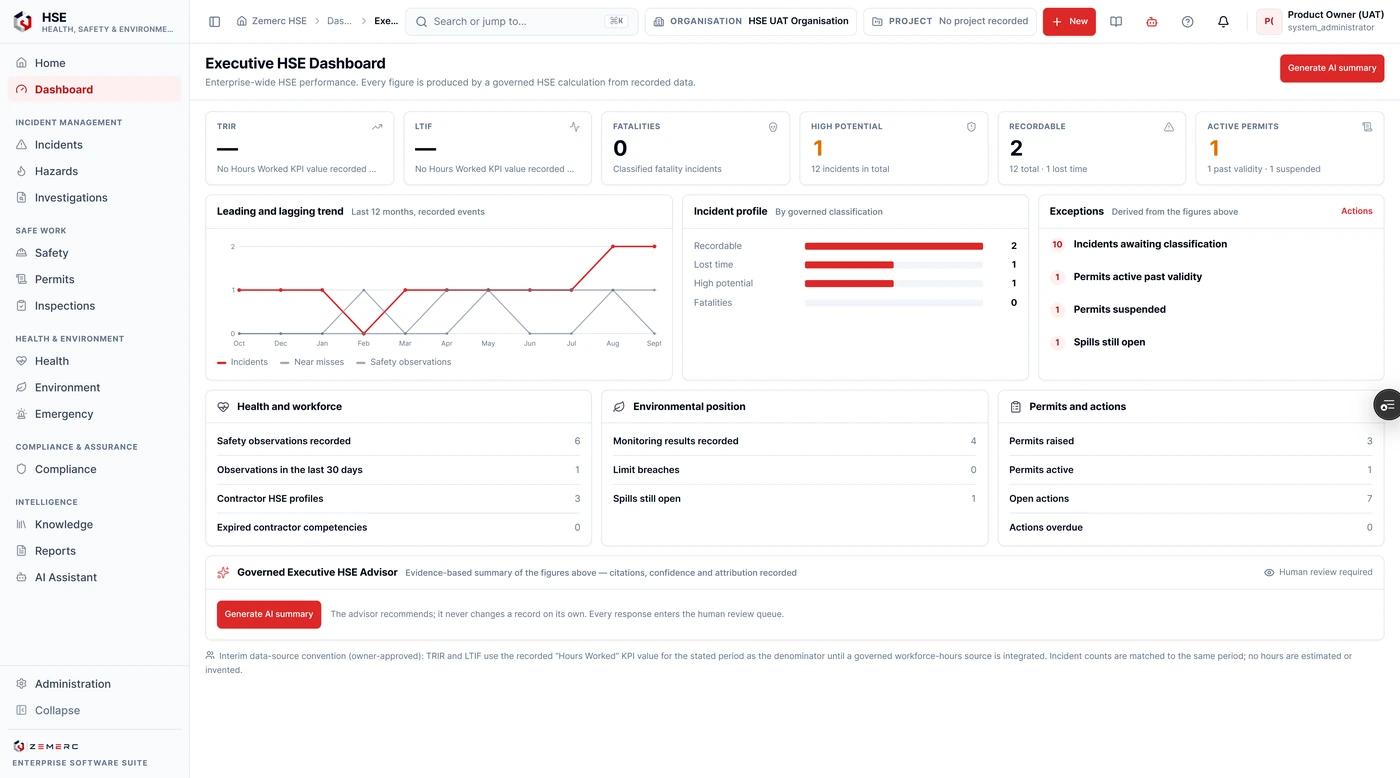
Where a figure lacks a recorded basis, the application reports it as unavailable rather than presenting an unsupported value.
- Advisors recommend onlyAdvisory responses do not alter governed records and are routed for human review with citations and confidence retained.
- Status is not communicated by colour aloneEach state includes a text label, and keyboard navigation is supported throughout the application.
- Operational status showingActive emergencies, high-risk work, journeys in progress, limit breaches and open spills
Only valid next workflow actions are available
Incidents move through reporting, classification, investigation, action and closure. Permits move through draft, approval, active use, suspension, return and close-out.
Twelve governed reports derived from organisation records
Executive, operational, assurance, environment, health and board reporting use governed report definitions with identity, schedule and generated artefacts derived from recorded data.

Reproducible approvals
Approvals and digital signatures retain who approved each action and when. Management-of-change records require a named approver and signature reference.
Evidence with integrity verification
Uploads are authorised against owning records, listed, downloadable and retireable, with integrity verification and no public access link.
Governed data movement
Data management covers import, export, templates, bulk update, historical migration and organisation extract, with imported records subject to the same domain validation and control rules as records entered through the application.
Roles, access control and audit
Twenty-three system roles, permission-aware search, text-labelled statuses and append-only audit history support controlled HSE access and traceability.
More of what the application covers
- Offline field capture with duplicate-controlled synchronisation
- Permanent document numbers across fifty numbering schemes
- Control room and live operations view
- Contractor HSE profiles and competencies
- Visitors, PPE and fatigue management
- Safety walks, toolbox talks and behavioural observations
- Statutory obligations register with due dates
- Notifications and scheduled processing
One governed HSE record across every work front

Safety walks, toolbox talks and behavioural observations are recorded at the point of work and retained in the same governed HSE record set as incidents, permits and actions.

Lifting, diving and marine activities can be governed through permits, mandatory job safety analyses, Life Saving Rules and stop-work controls, with a common operational status visible to authorised teams.
Occupational HSE connected to process safety and enterprise risk
- RMSRMS: Risk Management SystemRMS governs enterprise risk, bow-ties and control effectiveness, while HSE incidents and job safety analyses can reference relevant controls.
- PSMPSM: Process Safety Management SystemPSM governs process-safety events and loss-of-containment records, while HSE governs occupational and operational HSE records.
- LLMSLLMS: Lessons Learned Management SystemHSE investigations can contribute governed lessons to LLMS.
- IMSIMS: Integrated Management SystemThe management system itself; HSE audits reference its clauses.
Review HSE using one of your incident records
Bring one incident, one permit and one audit finding. The demonstration will follow them from initial record through action, verification and reporting.