
Process Safety Management System
Manage barriers and process-safety risk without unsupported composite scores.
Process safety treated as an engineering discipline: process hazard analysis and facilitated studies; barrier management and safety-critical elements; safety instrumented functions and requirements; operating envelopes; management of change and simultaneous operations; proof testing; and the process safety event and loss-of-containment records these controls are intended to prevent.
Everything in process safety is a barrier or a consequence.
Causes are held back by preventive barriers. When they are not, recovery barriers decide how far it goes. PSM is arranged around that model, which is why barrier impairment is a first-class state rather than a note on an action.
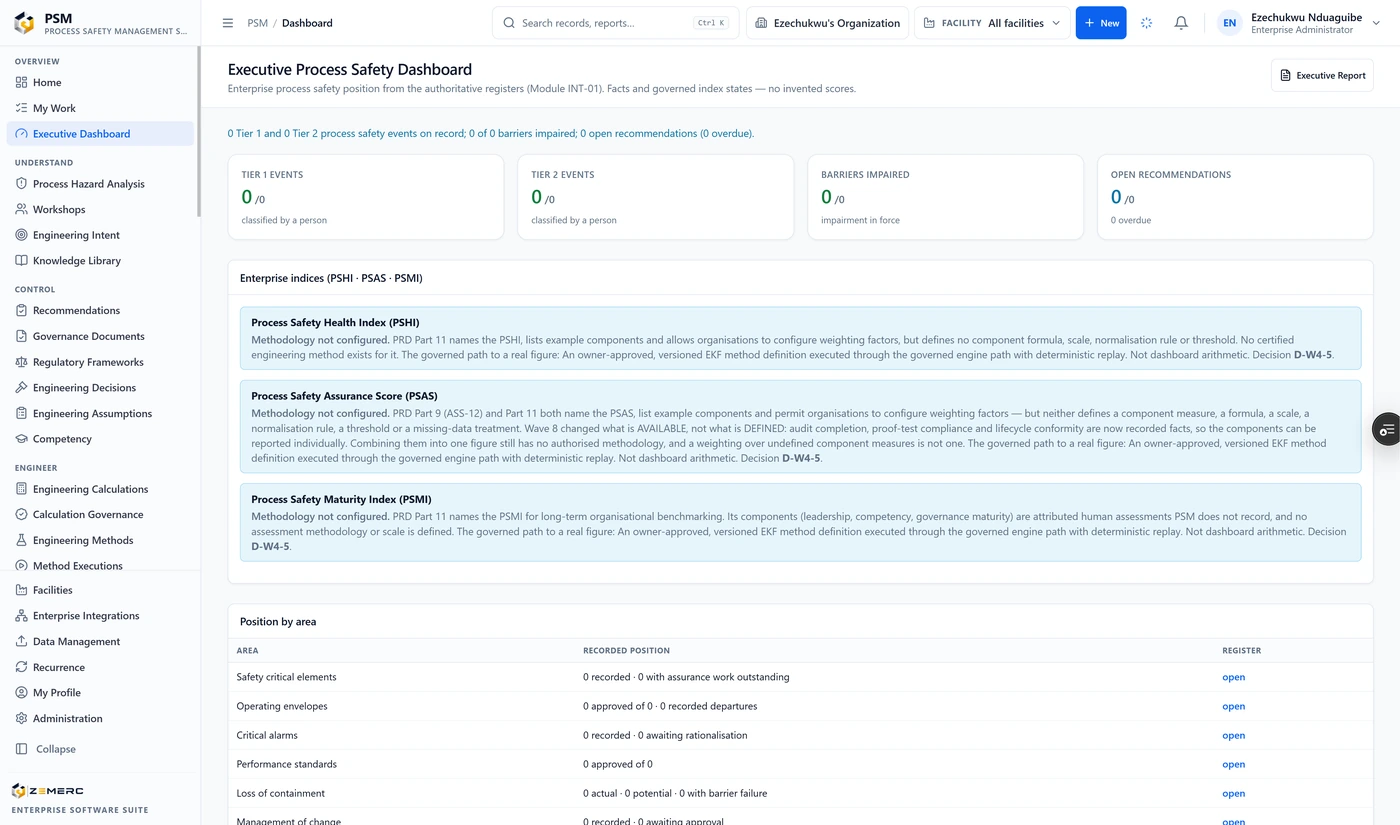
No certified method, no number.
Where no approved methodology or certified engineering method exists for a process-safety index, PSM states that limitation and does not generate the number. The underlying component measures remain available individually so the recorded position can still be reviewed.
An index needs a method
A health or assurance index requires defined component measures, formulae, scales, normalisation rules and thresholds. Where the organisation has not approved that methodology, combining the components into a single score would not constitute an authorised engineering result.
Components are reported individually
Instead of an unsupported aggregate, the application reports the recorded position by area, including safety-critical elements, operating envelopes, critical alarms, performance standards, loss of containment and management of change, with each position linked to its governing register.
The route to a real figure exists
An index becomes valid only when its method is owner-approved, version-controlled and executed through a governed deterministic calculation path that can reproduce the result. Until that method exists, the application reports that no valid index is available.
Analyse, define requirements, design safeguards, operate, verify and feed learning back into the analysis.
The lifecycle is a cycle, which is why an event feeds hazard analysis rather than closing a file. Rest on the ring to hold a stage.
Hazard and operability, hazard identification and what-if studies run as workshops, with every recommendation becoming a tracked item rather than a line in a report.
In the application: Process Hazard Analysis
Fourteen documents issued from the authoritative registers.
Executive and management, hazard analysis and workshops, risk, functional safety, barriers and safety-critical elements, operational process safety, management of change, events and learning, assurance and audit, engineering calculations, and governance and regulatory; each marked with its state and classification and recorded every time it is issued.
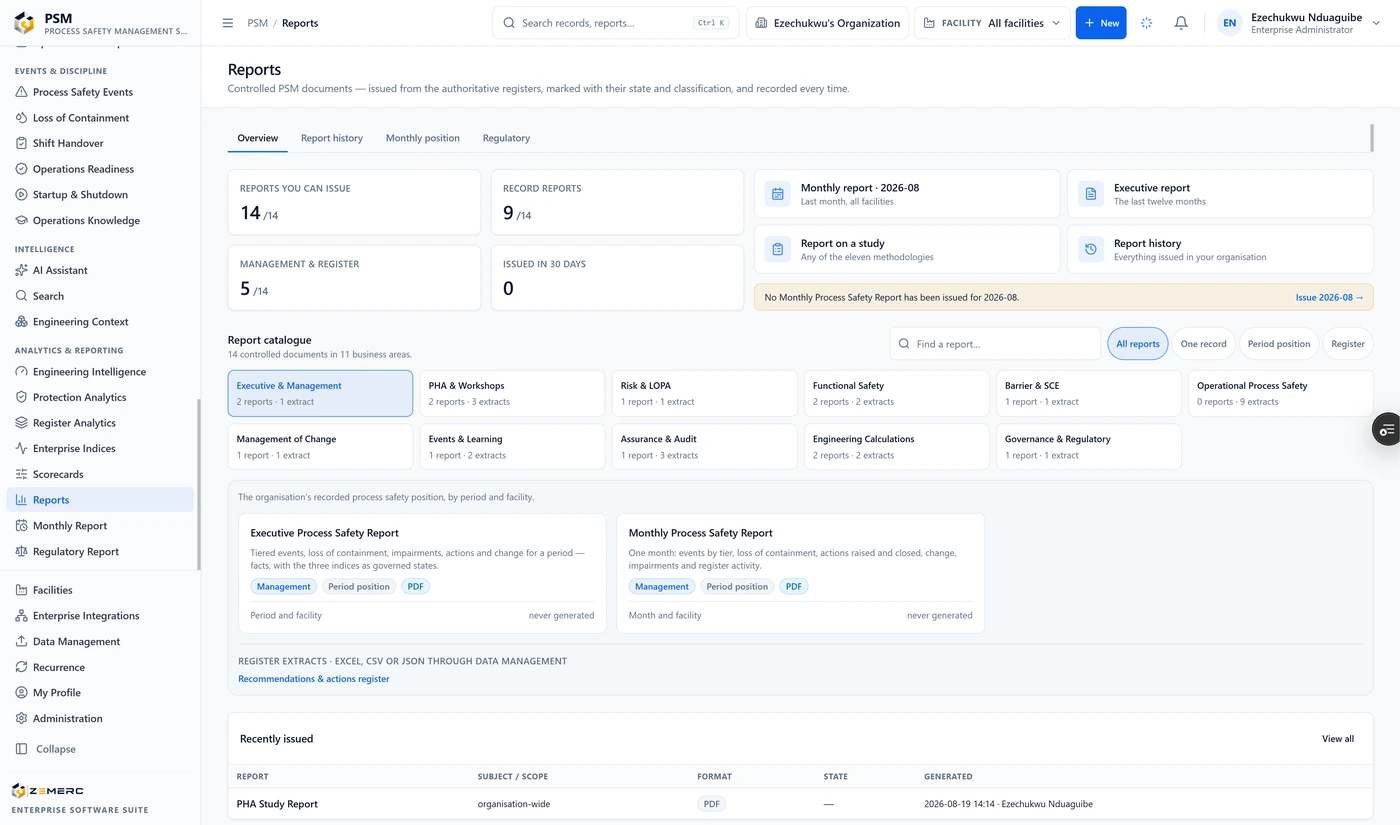
A report states the period and facility it covers and is issued from the registers, not assembled alongside them.
- Issued, not exportedIssuing a controlled document is a recorded act with a state and a classification, distinct from taking an extract.
- Register extracts stay separateSpreadsheet and data extracts come through data management, so a working file is never mistaken for a controlled document.
- Eleven methodologiesA study report can be produced for any of the methodologies the organisation actually runs.
Understand, protect, assure, operate; and engineer beneath all of it.
The application's own navigation, arranged as the discipline works rather than as a feature list. Every chip is a page.
Understand
Process hazard analysis across HAZOP, HAZID, environmental identification, what-if and structured what-if studies, with workshop recommendations converted into governed actions.
- Process Hazard Analysis
- Workshops
- Engineering Intent
- Knowledge Library
Protect
Manage barriers and safety-critical elements, safety instrumented functions, safety requirements and alarm management as defined layers of protection against escalation.
- Barriers
- Safety-critical elements
- SIF register
- Safety requirements
- Alarm management
Assure
Govern process safety audits, proof testing, functional safety lifecycle activities and assurance evidence through to the executive assurance position.
- Audits
- Proof tests
- Lifecycle
- Assurance programme
- Executive assurance
Operate
Control operating envelopes and critical parameters, recorded deviations, management of change, temporary instructions, simultaneous operations, shift handover, operational readiness, start-up and shutdown.
- Operating envelopes
- Critical parameters
- Deviations
- Management of Change
- Temporary instructions
- SIMOPS
- Shift handover
- Startup & Shutdown
Engineer
Govern engineering calculations, approved methods, method definitions, recorded executions and traceable results.
- Engineering Calculations
- Calculation Governance
- Engineering Methods
- Method Executions
Events and governance
Maintain process safety event and loss-of-containment records together with regulatory frameworks, engineering decisions, assumptions, competency records and recommendation tracking.
- Process Safety Events
- Loss of Containment
- Regulatory Frameworks
- Engineering Decisions
- Engineering Assumptions
- Competency
- Recommendations

TSM defines the barrier. PSM keeps it credible.
Technical safety in design owns the definitions; barriers, safety-critical elements, safety instrumented functions and their performance standards; and publishes them. PSM is the system of record once the plant is running: management of change, simultaneous operations, operating envelopes, proof-test execution, barrier health, events and loss of containment.
- Design definitions published into operation rather than re-entered
- Proof-test execution and operational barrier health held in PSM
- Regulatory frameworks recorded against the facility they apply to
Setup completeness is derived from your records, not declared.
How much of the organisation is actually configured is computed from what has been recorded. Roles come from an engineering role library with what each one permits; canonical engineering concepts are mapped to the organisation's own terminology; recurrence and revalidation intervals are configuration rather than convention.
- Engineering role library with explicit permissions
- Facility structure reconciled against references already in use
- Immutable audit trail behind every change

A refusal is the application working
Where no certified engineering method and no approved methodology exist, the application states that rather than producing an index. There is no dashboard arithmetic standing in for engineering.
Classified by a person
Event tiers are classifications a person made against a governed scheme, not a severity the system inferred from a description.
Segregation on identity
Separation of duties is enforced against identity, so the engineer who performed the work is not the one who verifies it; and the system refuses to close work that is not evidenced.
Your terminology, mapped
The canonical engineering concepts the application reads are mapped to the organisation’s own terminology, so nobody has to rename their plant to fit a vendor’s vocabulary.
More of what the application covers.
- Workshops with recorded participants and recommendations
- Impairment of a barrier held with its compensating measures
- Temporary instructions with an expiry that is enforced
- Simultaneous operations assessed before the work runs
- Shift handover as a governed record
- Operations readiness before start-up
- Recurrence and revalidation intervals as configuration
- Immutable audit trail of who changed what and when
Major hazard in operation, beside design and enterprise risk.
- TSMTSM: Technical Safety Management SystemTechnical safety in design owns the barrier, element and performance-standard definitions and publishes them; PSM is the system of record in operation.
- HSEHSE: Health, Safety & Environment Management SystemOccupational and operational safety; PSM covers the major-hazard discipline beside it.
- RMSRMS: Risk Management SystemEnterprise risk and control effectiveness, referencing the same barrier model.
- AIRMSAIRMS: Asset Integrity & Reliability Management SystemAsset integrity of the equipment the protection layers depend on.
See PSM with one of your hazard studies.
Bring one hazard study and its recommendations. We will show the barriers and safety-critical elements they produce, the proof tests that keep them credible, and what the application refuses to compute for you.