
Manage barriers and process-safety risk Evidence before assurance.
A process plant relies on an engineering demonstration that safeguards reduce risk to an approved tolerability basis. Maintaining that demonstration through change, simultaneous operations, proof testing and operating experience is a continuing process-safety obligation.
- 0
- Applications serving this industry
- 0
- Operating areas
- 0
- Stages in the lifecycle

What this industry is actually like to run.
Process safety in live operation: hazard and barrier management, management of change, permits to work and incident investigation, alongside the operating quality system.
The design assumption decays
Every safeguard was specified against an operating assumption. Management of change, temporary instructions and simultaneous operations are the mechanisms by which that assumption quietly stops being true.
A barrier is only as good as its last test
Proof tests, audits and inspections exist to demonstrate that a protection layer still performs. A test not performed is not a test, and treating it as one is how major accidents are prepared.
Quality does not stop at handover
Material traceability, weld records and non-conformance dispositions are as relevant in year twelve as they were during construction, because that is when somebody asks about them.
Every one of these is a failure a governed record prevents.
Not a list of features. Each row is something that goes wrong in this industry, and the specific control in a Zemerc application that stops it happening.
- A process safety index produced without an approved methodology behind it
Where no certified engineering method exists, the application does not produce the figure and instead reports the underlying component measures individually.
PSMProcess Safety Management System- Design definitions re-entered by hand once the plant is operating
Barriers, safety-critical elements and performance standards are defined in design and published as governed requirements for operation.
TSMTechnical Safety Management System- Occupational incidents and process safety events held in one undifferentiated register
Occupational safety remains a separate governed record from process-safety events and loss-of-containment records.
HSEHealth, Safety & Environment Management System- A non-conformance closed by the person who raised it
Disposition is made by the authorised technical role, with corrective action subject to effectiveness review and controlled closure.
QMSQuality Management System
PSM: Process Safety Management System
Process safety in operation: hazards, barriers, change and proof tests.
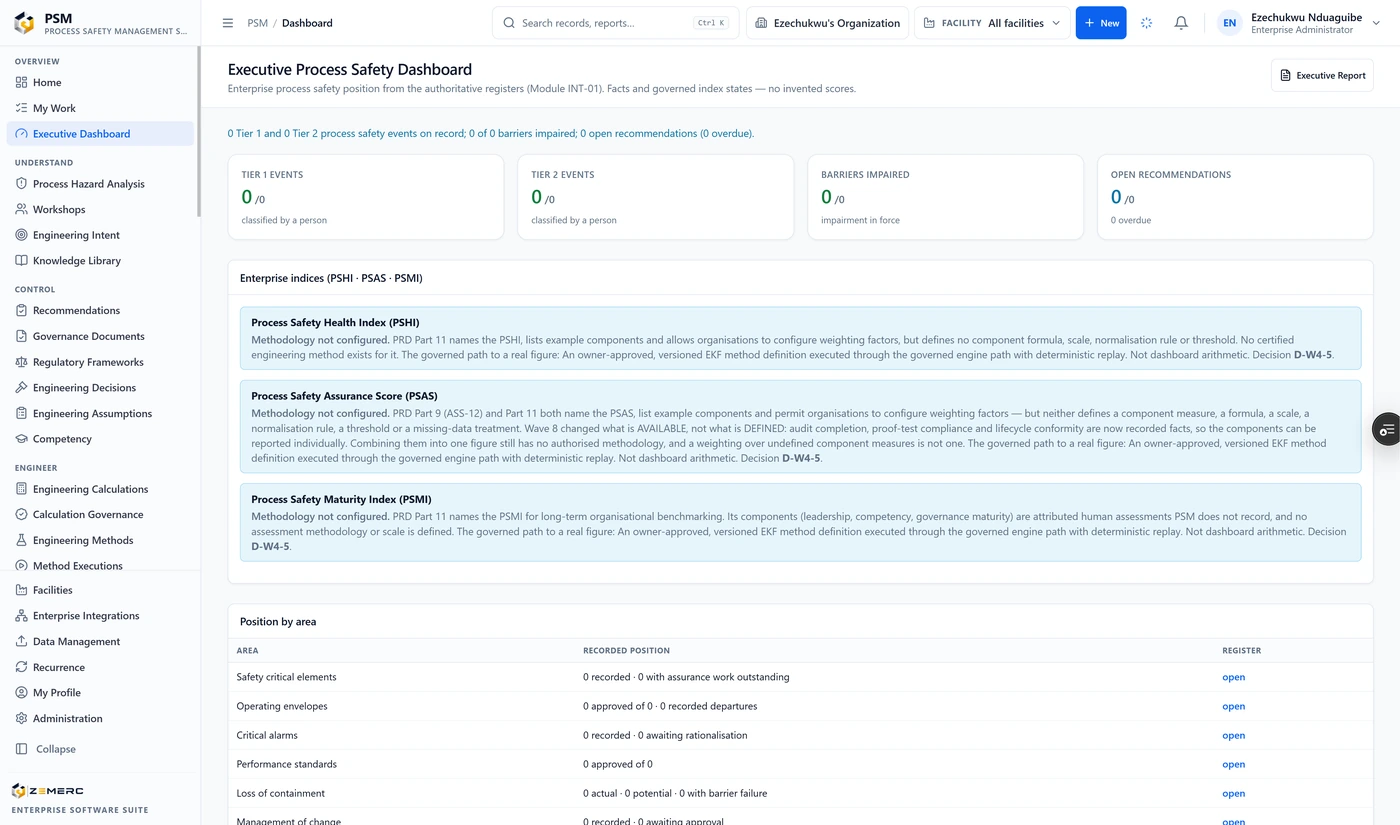
The enterprise indices state where no methodology is configured and no certified engineering method exists. In those cases, the components are reported individually rather than combined into an unsupported score.
5 stages, and who owns each of them.
The sequence this industry is genuinely run along, with the applications that govern each stage. Every one of them runs on its own; none of them needs the others to be useful.
Identify
Hazard and operability, hazard identification and what-if studies run as workshops, with recommendations that become tracked work.
Design
Safety instrumented functions, safety-critical elements and performance standards defined and published.
Operate
Operating envelopes, critical parameters, management of change and simultaneous operations keeping the assumption true.
Prove
Proof tests, audits and inspections demonstrating the protection still performs.
Learn
Process safety events and loss of containment feeding back into the next hazard analysis.
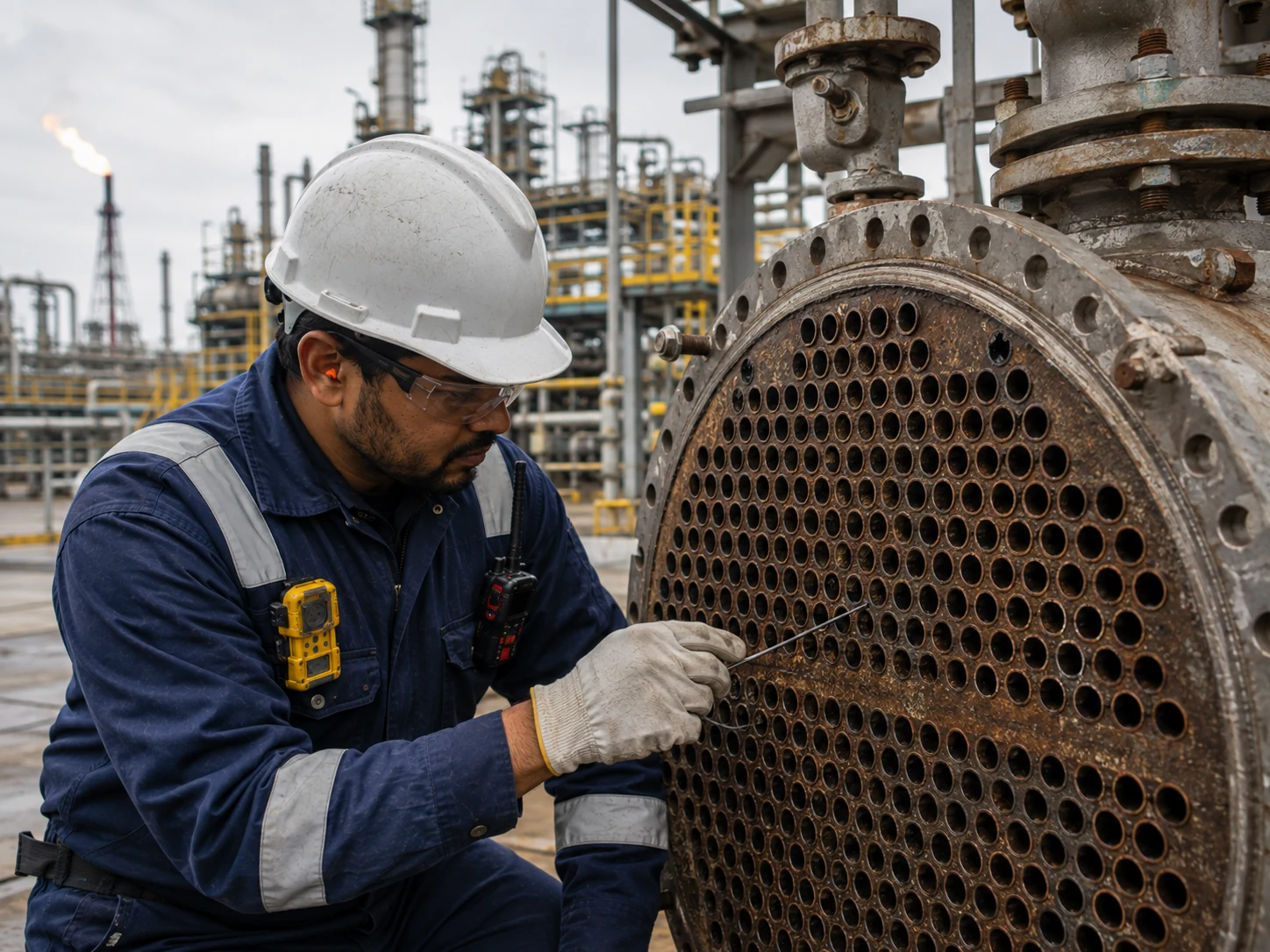
The inspection that becomes next year’s argument.
Findings identified during a turnaround may determine the integrity basis for the next operating period. Their future value depends on being recorded against the correct asset, revision, inspection context and accountable person.
- Inspection and test records executed against approved template revisions
- Material traced from heat number through lot to the equipment it became
- Immutable corrosion readings with their provenance kept

Every figure produced by a governed calculation from recorded data.
Recordable and lost-time rates are calculated from recorded hours worked. Where the required basis is absent, the application reports that the rate cannot be determined rather than substituting an estimated value.
- Anyone reports in seconds, from the field and offline, with a permanent document number
- Only the valid next step is ever offered on an incident or a permit
- Management of change needs a named approver and a signature reference
6 applications across 2 operating areas.
Adopt a single application and it works on its own. Adopt an operating area and the records line up across it.
Prevent harm and major accidents, and govern enterprise risk.
- HSEHSE: Health, Safety & Environment Management System
- PSMPSM: Process Safety Management System
- TSMTSM: Technical Safety Management System
- RMSRMS: Risk Management System
Engineer production flow and account for every measured hydrocarbon.
The position you can defend when you are asked to.
Every control on this page exists because the underlying decision may need to be demonstrated later to a regulator, auditor, partner or board.
Refusals as a control
Where the evidence will not support a figure, the application says so. On a major-hazard site that refusal is worth more than the number would have been.
Design and operation kept apart
Technical safety owns the definitions and publishes them; process safety is the system of record in operation. Actions and evidence are never merged.
Approved records are superseded
An approved engineering record is never edited. Supersession requires the dependent records to be reassessed rather than silently cascading.
Bring one hazard study and its safeguards.
We will show the barriers and safety-critical elements it produces, the proof tests that keep them credible, and exactly what the applications refuse to compute for you.