
Lessons Learned Management System
A lesson nobody reviewed is not a lesson.
Capture experience while it is still fresh, take it through a governed review, publish it as a versioned record with a periodic review date, and make it findable by the people who will need it; with the standards and procedures it cites held as their own cited, revisioned sources.
- 0
- Roles
- 0
- Governed domains
- 0
- Lifecycle states
- 0
- Loadable registers

Capture is the easy part. Review is the part that gets skipped.
Lessons captured at close-out have little value if they are never reviewed or reused. LLMS measures the lifecycle beyond capture, including items in review, overdue reviews, unscheduled reviews and records without an accountable owner.
Somebody records what was learned while the project still remembers it, rather than at close-out when the people have moved on.
A citation identifies a specific revision of its source.
Standards, procedures, drawings and reports cited by a lesson remain governed records in their own right. A change to title, authority or validity creates a new revision and returns the source to draft for controlled re-registration.
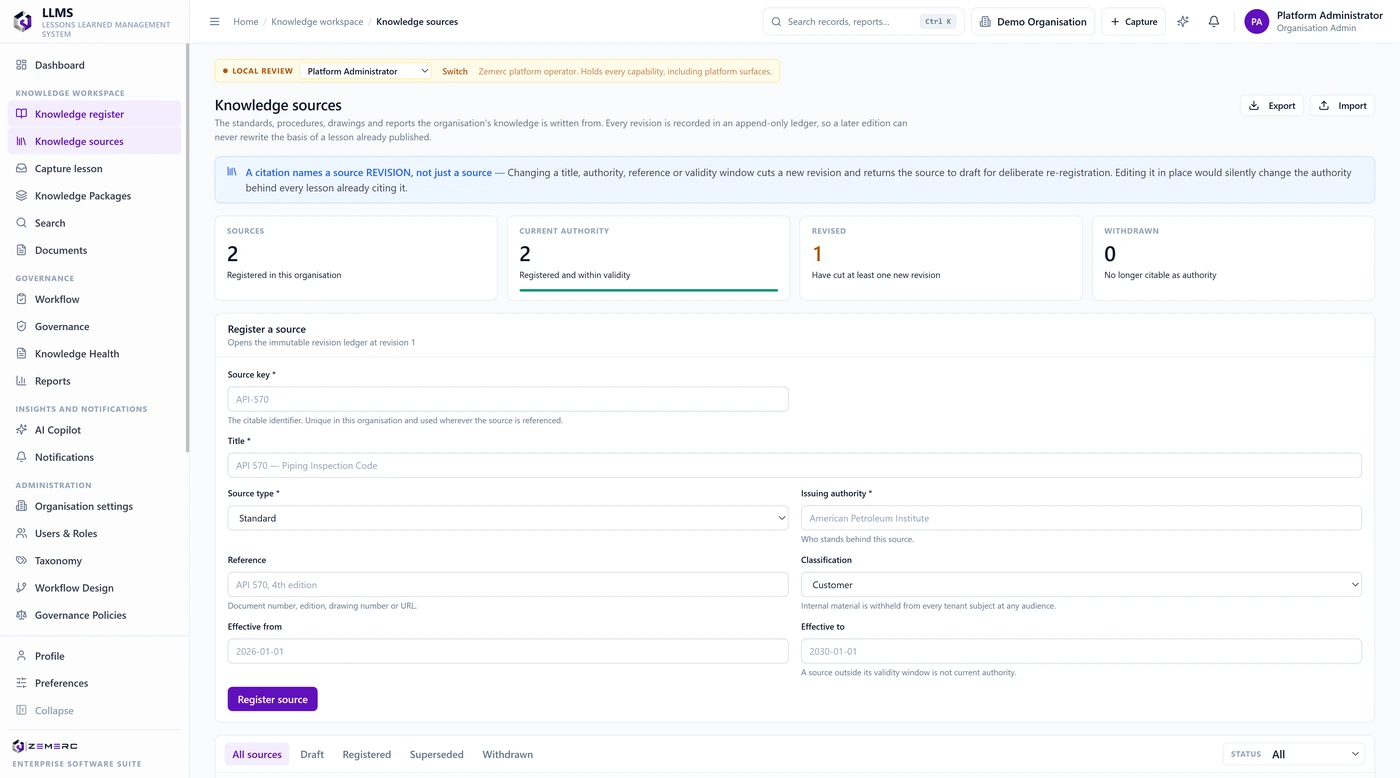
Editing a source in place would silently change the authority behind every lesson already citing it, so it is not permitted.
- Validity has a windowA source carries effective-from and effective-to dates, so a lesson written under an earlier edition can still be read against it.
- Authority is namedWho stands behind a source is recorded on the source, rather than implied by where the file was stored.
- Withdrawn is a stateA source no longer citable as authority is withdrawn rather than deleted, and the lessons citing it remain readable.
Published, and then due again.
Publication is not the end of a lesson's lifecycle. Each lesson carries a periodic review date and is subsequently confirmed, revised or retired. Technical review and periodic review remain separate because they answer different governance questions.
A workspace, a governance layer and a way to design both.
The application's own navigation. The taxonomy and the review stages are the organisation's own, designed rather than accepted. Every chip is a page.
The knowledge workspace
The register of governed lessons, practices and failure records; the sources they cite; capture; knowledge packages; search; and the documents that sit behind them.
- Knowledge register
- Knowledge sources
- Capture lesson
- Knowledge Packages
- Search
- Documents
Governance
Workflow, review boards, governance policies, knowledge-health reporting and controlled reports ensure lessons progress from capture through review, publication and reuse.
- Workflow
- Governance
- Knowledge Health
- Reports
- Governance Policies
Taxonomy and workflow design
The organisation’s own taxonomy and its own review stages, designed rather than accepted, so a discipline lead reviews what they should and nobody else does.
- Taxonomy
- Workflow Design
- Users & Roles
- Organisation settings
Reuse
Search across the register, knowledge packages assembled for a project or a discipline, notifications when something relevant is published, and report branding for what is issued.
- Search
- Knowledge Packages
- Notifications
- Report branding
Data management
Guided journeys for loading registers in the right order, export, extracts, templates carrying the organisation’s own codes, and an audit log that records refused operations as well as successful ones.
- Data Management
- Workflows
- Import
- Export
- Extracts
- Templates
- History
- Audit Log

The same mistake, on the next project.
Project, engineering, construction, commissioning, safety, quality and integrity teams all generate operational learning. LLMS provides the governed route from one team's experience to the teams that need to apply it next.
- Seven roles including an external reviewer
- Discipline leads review what belongs to their discipline
- Knowledge packages assembled for a project or a discipline

Registers load in the order their dependencies require.
Where one register depends on another, guided data journeys load records in the required sequence and validate each dependency before import is committed.
- Templates carry the organisation’s own codes rather than generic ones
- Every load and export recorded, including refusals
- An organisation extract in one verifiable package
A citation identifies a revision.
Each lesson cites the specific revision of its source. Changes to title, authority or validity create a new revision and return the source to draft for controlled re-registration.
Append-only sources
The source ledger is append-only. Editing a source in place would silently change the authority behind every lesson already citing it, so the application does not allow it.
Review compliance is measured
What is in review, due for review, without a review schedule and without an owner are all reported. A register nobody maintains is visible as such.
Refusals are recorded
The activity log keeps every load and export including the ones that were refused, so a failed import is part of the record rather than an absence.
More of what the application covers.
- Lesson capture with triage before review
- Workflow board across review stages
- Best practices, failures and success stories held distinctly
- Knowledge packages assembled per project or discipline
- Periodic and technical review states
- Knowledge health with owner and schedule coverage
- Guided migration journeys for loading registers in order
- Organisation extract in one verifiable package
Organisational memory, beside the systems that generate the experience.
- HSEHSE: Health, Safety & Environment Management SystemIncident investigations that produce a lesson worth keeping.
- QMSQMS: Quality Management SystemNon-conformance and corrective action, where recurrence is the thing being prevented.
- IMSIMS: Integrated Management SystemThe management system whose improvement process the lessons feed.
- PDMSPDMS: Project Delivery Management SystemProject delivery, where a lesson is most useful before the next gate rather than after it.
See LLMS with one of your close-out reports.
Bring one project close-out and the standards it referenced. We will show the lessons it produces, the review each one would go through and the register entry that comes out.