
Flow Assurance Management System
Flow assurance governed from the engineering record.
One engineering environment for flow assurance across the production network, covering fluids and PVT, production chemistry, operating envelopes, hydraulic and thermal analysis, and wax, hydrate, scale and asphaltene studies used to define safe and reliable operating conditions.
- 0
- Licensed modules
- 0
- Governed registers
- 0
- Engineering datasets
- 0
- Solids threats covered
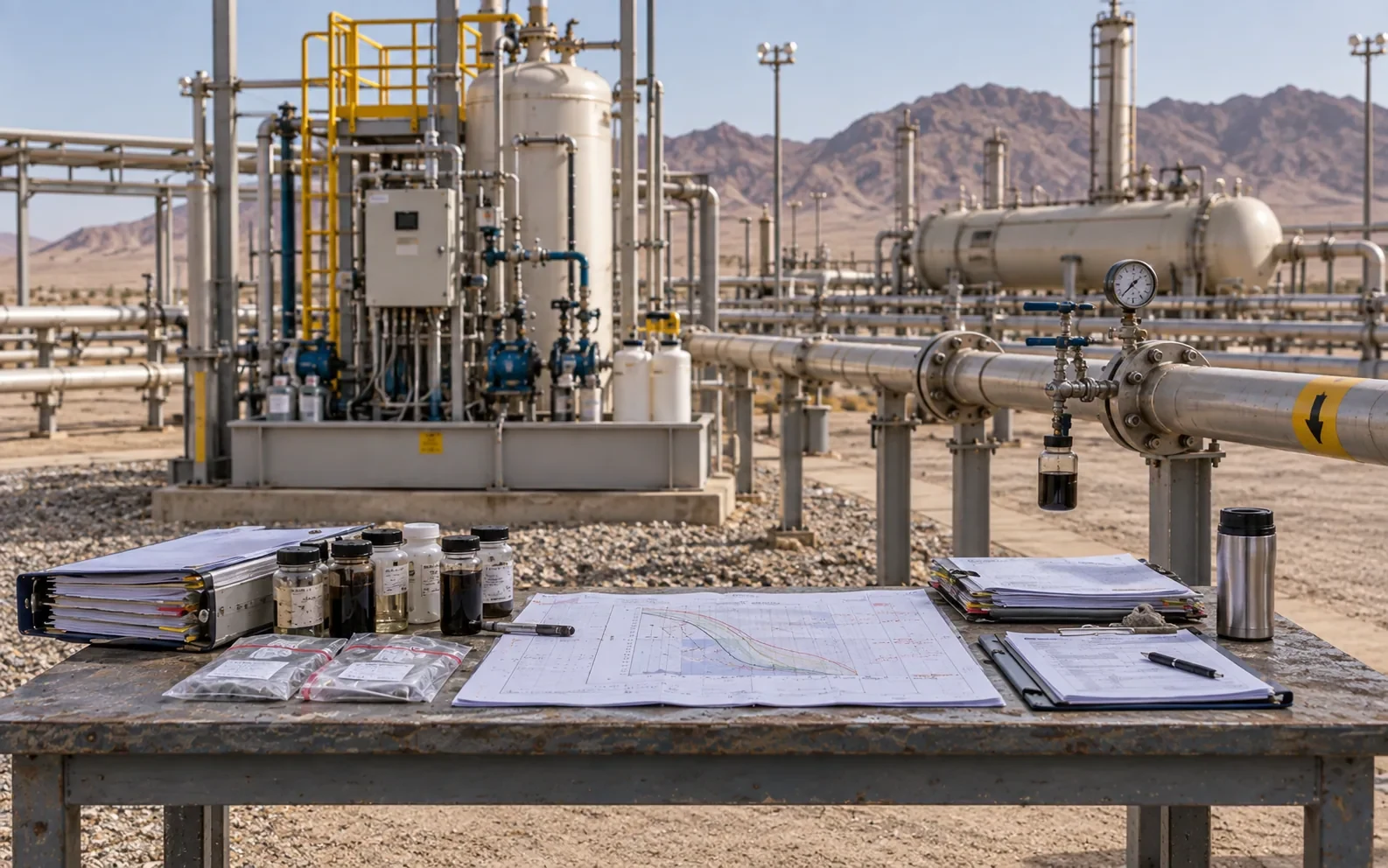
Only approved engineering records may be used downstream.
Until an engineering record is approved, downstream modules cannot rely on it. A hydraulic study cannot be based on an unapproved fluid definition, and preparation and approval remain separated by role.
The workspace distinguishes records that exist from records approved for downstream use, making outstanding engineering assurance work visible rather than allowing unapproved information to be treated as authoritative.
From business unit to the individual well.
The production network is a single hierarchy, not a diagram redrawn per study. Every node carries its record number and its approval state, so the structure a study was made against can be reconstructed later.
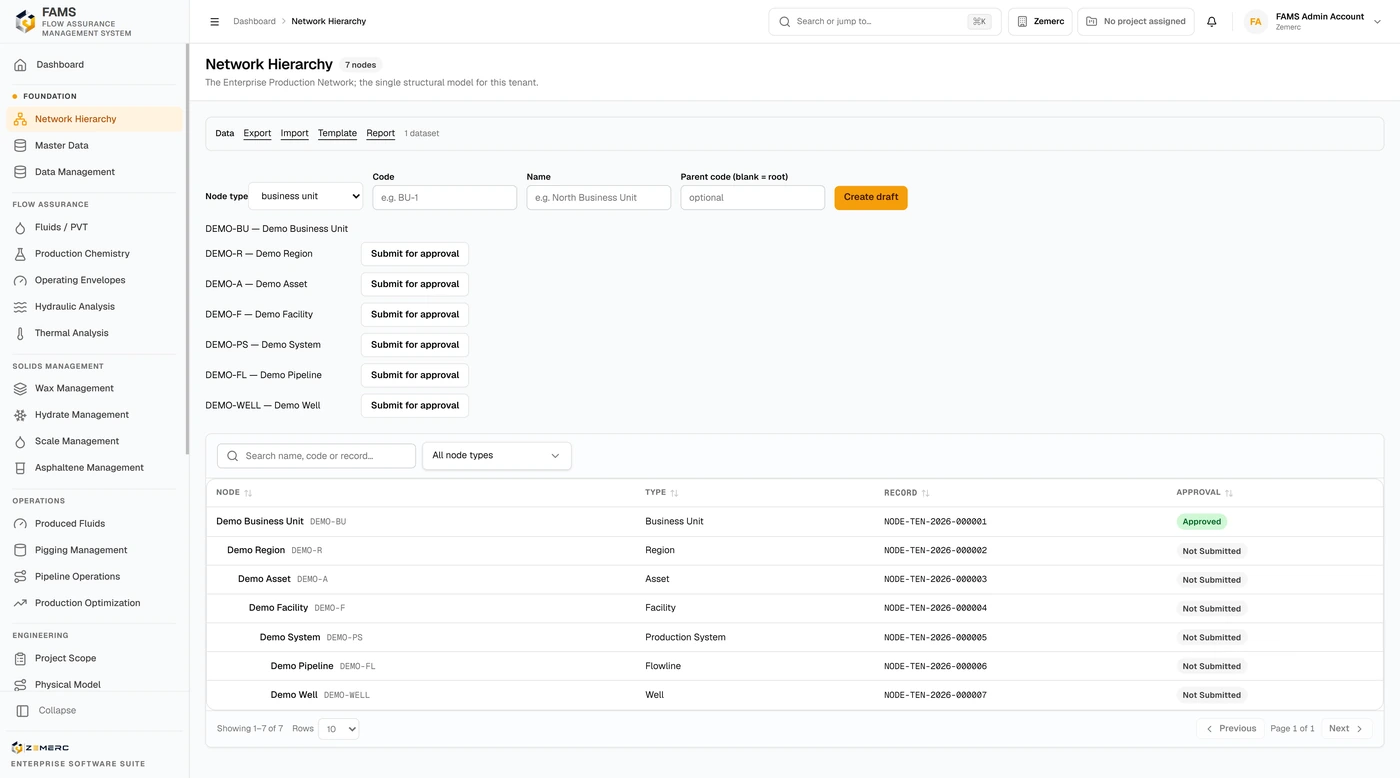
Node types run business unit, region, asset, facility, production system, flowline and well.
- One model, many studiesHydraulic, thermal and solids studies all reference the same network rather than each carrying a private copy of it.
- Revisions on the geometryLine geometry is revisioned, so a study remains readable against the physical model that was current when it was made.
- Approval state on the nodeA node that has not been approved is visible to its author and to nothing else.
Four threats that shut a line in, each with its own studies.
Wax, hydrate, scale and asphaltene behave differently, are measured differently and are mitigated differently. FAMS keeps them apart rather than folding them into one generic risk assessment.
Wax
Deposition studies against the thermal profile of the line, with the pigging programme that answers them.
Hydrate
Formation risk across the operating envelope, with the inhibition strategy recorded as an engineering decision.
Scale
Scaling tendency from the water analysis register rather than from an assumed brine composition.
Asphaltene
Precipitation and deposition studies held with the fluid definition they were made against.
Twenty-seven licensed modules, from the network to the export point.
The application's own navigation, grouped from foundation through flow assurance and solids to operations, engineering and insight. Every chip is a page.
The network foundation
One structural model of the production network from business unit down to the individual well, with the master data and governed data movement that every other module reads from.
- Network Hierarchy
- Master Data
- Data Management
Flow assurance
Fluids and PVT, production chemistry with its own registers, operating envelopes, and hydraulic and thermal analysis studies including the network solve.
- Fluids / PVT
- Production Chemistry
- Operating Envelopes
- Hydraulic Analysis
- Thermal Analysis
Solids management
The four threats that actually shut a line in; wax, hydrate, scale and asphaltene; each with its own studies rather than being folded into one generic risk assessment.
- Wax Management
- Hydrate Management
- Scale Management
- Asphaltene Management
Operations
Produced fluids, pigging programmes, pipeline operations and production optimisation: the operating decisions the engineering records are made to support.
- Produced Fluids
- Pigging Management
- Pipeline Operations
- Production Optimization
Engineering
Project scope, the physical model, wells and equipment, the visual model, flow assurance studies and screening, simulation management with a provider registry, governed calculation engines and method governance.
- Project Scope
- Physical Model
- Wells
- Equipment
- Visual Model
- Flow Assurance Studies
- Simulation Management
- Calculation Engines
- Method Governance
Insight and coordination
Production intelligence, reports, engineering knowledge and integrity coordination, with notifications and administration beneath them.
- Production Intelligence
- Reports
- Engineering Knowledge
- Integrity Coordination
- Notifications
- Administration

FAMS governs the methods. It does not replace them.
Organisations already own simulators and calculation methods, and they are not interchangeable. FAMS registers which provider and which method produced a result, governs how methods may be used, and keeps the engineering record that ties a decision to the run behind it.
- Simulation provider registry with method governance
- Calculation engines held as governed, referenceable records
- Values stored canonically in SI and shown in each engineer’s own units
Some registers are deliberately not importable.
Security records, workflow acts, engine output and platform-owned state are loaded by the application rather than from a file, and each one carries the reason it is held that way. A dataset catalogue states what every business dataset supports.
- Fifty-four business datasets across every engineering domain
- What round-trips is distinguished from what is export-only
- Specialist workflows for onboarding, bulk revision and historical migration


Modules are licensed, and the tenant can see which.
Edition, deployment mode, seat position and expiry are shown to the organisation rather than held by the vendor. FAMS runs as a hosted service, in the customer's own cloud, or on premises.
No self-approval
The author of an engineering record cannot approve it. Approval segregation is enforced by the application rather than left to a working practice.
Invisible until approved
A draft cannot be referenced downstream. A hydraulic study cannot quietly be built on a fluid definition that nobody has agreed to.
Orchestration, not simulation
FAMS registers and governs the simulators and calculation methods an organisation uses; it does not replace them or claim their physics as its own.
Stored in SI, shown in yours
Values are held canonically in SI units and presented in the units each user works in, so a unit preference can never change what was recorded.
More of what the application covers.
- Network solve across the physical model
- Operating-envelope limits and evaluation runs
- Water-analysis and production-chemistry registers
- Pigging programmes with their own schedule
- Simulation provider registry and method governance
- Licence-gated modules with an explicit seat position
- Append-only audit behind every governed record
- Governed import, export, templates and data extracts
One network, read the same way by every module.
Flow assurance, beside accounting and integrity.
- HAMSHAMS: Hydrocarbon Accounting Management SystemHydrocarbon accounting: FAMS decides how the network is operated, HAMS accounts for what it produced.
- AIRMSAIRMS: Asset Integrity & Reliability Management SystemPipeline and structural integrity; FAMS coordinates with it on the lines it operates.
- RAMSRAMS: Reliability, Availability & Maintainability Management SystemProduction availability and assurance analysis over the same network.
- EAMSEAMS: Enterprise Asset Management SystemMaintenance execution on the equipment the production network depends on.
See FAMS with one of your production networks.
Bring one flowline and its fluid definition. We will show the network record it becomes, the envelope it is evaluated against and the approval that has to happen before anything downstream can use it.