
Risk you can point at. Barriers you can read.
Hazards, barriers, controls and effectiveness in one governed view, in design and in operation.
- 4
- Applications
- 5
- Stages in the flow

Effectiveness is computed
Hazards, barriers, controls and effectiveness in one governed view, in design and in operation.
Effectiveness is computed
Barrier effectiveness comes from the control findings, such as survey intervals exceeded without an intervention.
Design and operation, kept distinct
Technical safety in design (TSM) and process safety in operation (PSM) are separate applications with their own records.
Field safety on the same record
Permits, incidents and observations from the field sit beside the enterprise risk register.
5 stages, each owned by an application.
Every stage is a working part of a Zemerc application today, and each application runs on its own. An operating area is how they are bought, not a bundle they have to be bought in.
Identified and registered.
Four disciplines, one control model.
Occupational safety, process safety in operation, technical safety in design and enterprise risk are distinct disciplines. Their common concern is the effectiveness of barriers between causes and consequences, supported by evidence that those barriers have been verified.
- Technical safetyProcess safety
Design definitions; barriers, safety-critical elements, performance standards; are published into operation
- Process safetyOccupational safety
Operating envelopes and permits govern the work the frontline actually does
- All threeEnterprise risk
Control effectiveness rolls up without the technical registers being duplicated
RMS: Risk Management System
One enterprise risk register with workshops, BowTies and control effectiveness.
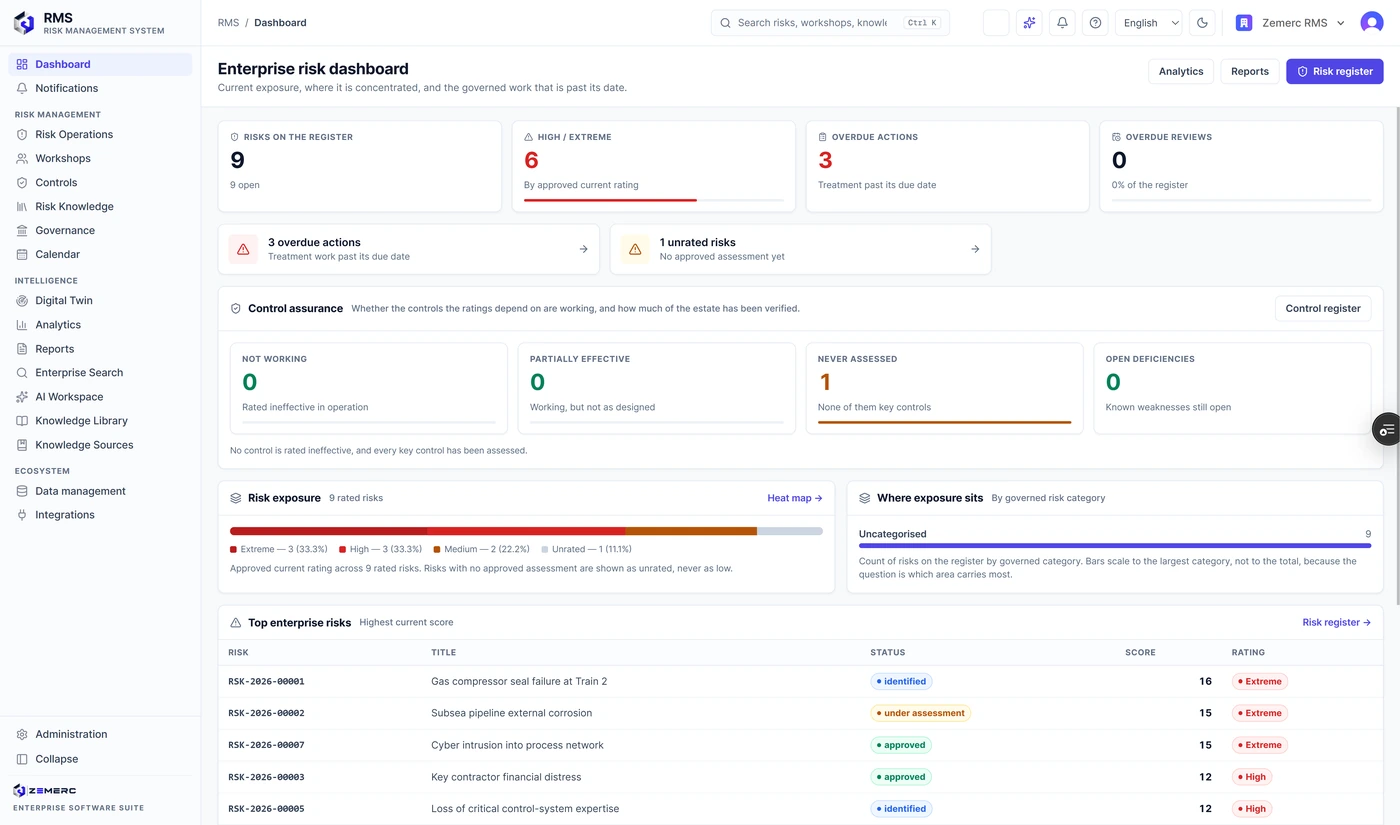
Unrated risks are drawn in the exposure bar rather than left out of it, because a chart of only the rated ones describes a smaller register than the real one.
- Unrated is not lowA risk with no approved assessment is shown as unrated, never defaulted to low, and it still counts on the register.
- Design apart from operationA control can be well designed and not working, or working but not as designed. Collapsing the two is how a register comes to say everything is effective.
- A refusal rather than a scoreWhere no certified engineering method exists, the process safety application states that instead of producing an index.

Bring one risk and its barriers.
The question is never whether a control exists on paper. It is whether anything has tested it, and whether the person who tested it was the person who installed it.
- BowTie on the register; RMS draws threats, barriers and consequences from the enterprise risk register.
- Computed findings; Control findings are derived from the governed control record rather than entered as unsupported conclusions.
- Safety case in design; TSM holds the hazard register, ALARP and safety-critical element assurance.
Every figure produced by a governed calculation from recorded data.
Recordable and lost-time rates are calculated from recorded hours worked. Where the required basis is absent, the application reports that the rate cannot be determined rather than substituting an estimated value.
- Anyone reports in seconds, from the field and offline, with a permanent document number
- Only the valid next step is offered on an incident or a permit
- Status never carried by colour alone

4 applications, each operable on its own.
Adopt one and it works. Adopt the area and the records line up. No application here depends on another to run.
- HSE
HSE: Health, Safety & Environment Management System
Occupational and operational safety, field reporting, permits and emergencies.
See the interface - PSM
PSM: Process Safety Management System
Process safety in operation: hazards, barriers, change and proof tests.
See the interface - TSM
TSM: Technical Safety Management System
Technical safety in design: safety case, hazard register and safety-critical elements.
See the interface - RMS
RMS: Risk Management System
One enterprise risk register with workshops, BowTies and control effectiveness.
See the interface

Where this area is actually worked.
A barrier that is degraded carries its compensating measures and its restoration position, so nothing sits impaired without a route back.
- Mobile incident reporting; HSE captures field reports and incidents on the phone.
Before the first working session.
Which applications belong here?
RMS, TSM, PSM and HSE.
Does TSM compute SIL or QRA?
No. TSM records hazards, ALARP and SCE assurance; no computed SIL or QRA is claimed.
Where do I start?
RMS where the enterprise register is the need; HSE where field reporting is.
BowTie on the register
RMS draws threats, barriers and consequences from the enterprise risk register.
Computed findings
Control findings are derived from the governed control record rather than entered as unsupported conclusions.
Safety case in design
TSM holds the hazard register, ALARP and safety-critical element assurance.
Mobile incident reporting
HSE captures field reports and incidents on the phone.
Bring one risk and its barriers
We will draw the BowTie from your register.