
Enterprise Document Management System
A copy is not a document. A revision is.
The controlled lifecycle for engineering and operational information: registration and numbering, review and approval, revision and supersession, transmittals and correspondence, controlled copies and document packages, then records, retention, archive and disposal; with access, distribution and reporting all governed by role, project and classification rather than by where a file happens to sit.
- 0
- Governed reports
- 0
- Role-aware dashboards
- 0
- Governed datasets
- 0
- Governed KPIs

Eight states, and a document is only ever in one of them.
A document is registered before a file is attached, reviewed by named people at named stages, published as a revision that supersedes rather than replaces, distributed with acceptance recorded, and eventually declared a record with a retention clock running against it.
Requested. Somebody asks for a document to exist, against a project and a type.
The question is never what it is. It is who is holding it.
Every review and approval moving through the organisation, on one screen: the stage it is at, the person it is waiting on, the date it was due and how many days it has been open. A queue is a fact, not a feeling.
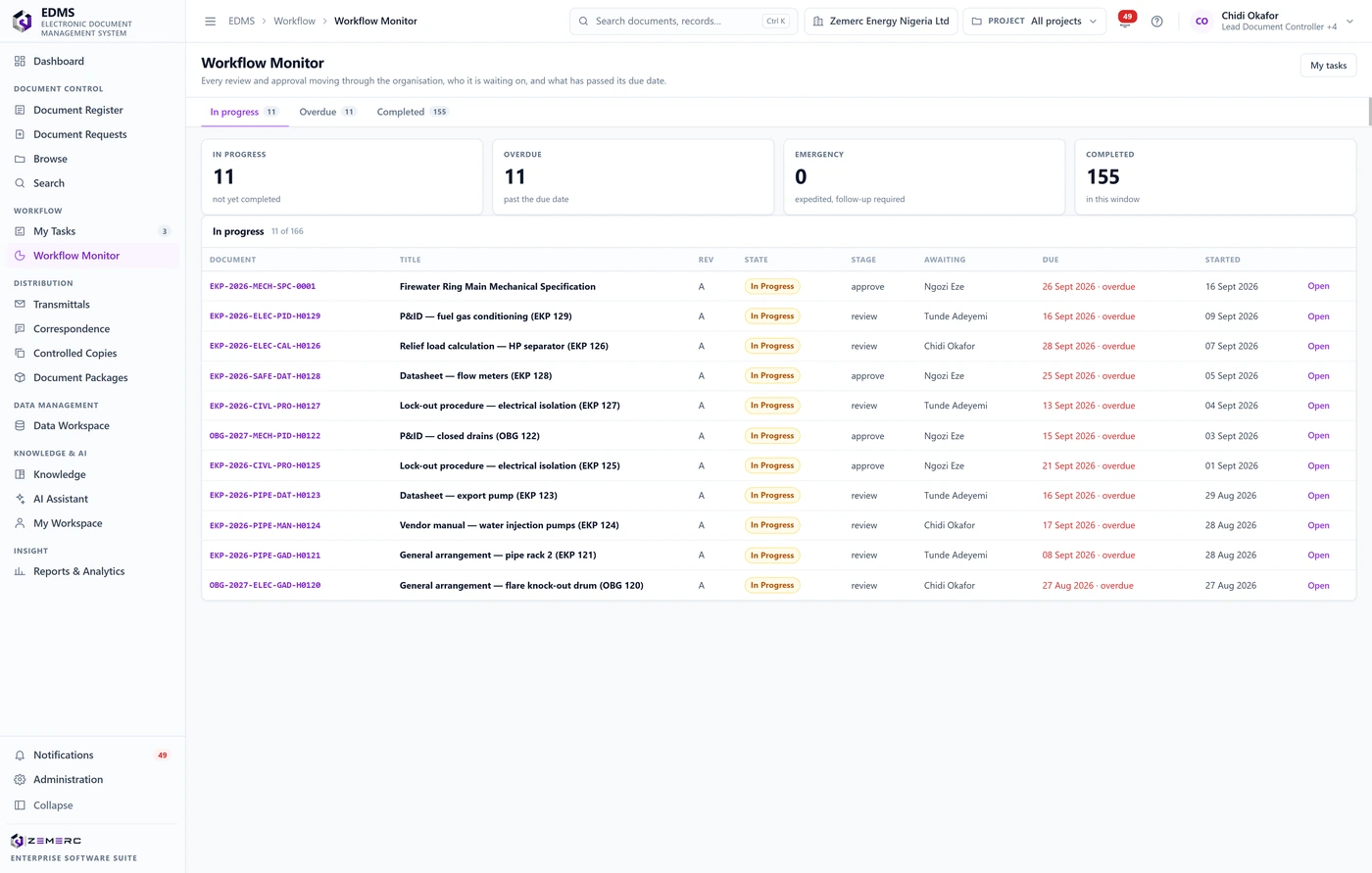
Overdue is measured against the due date the workflow carried, not against when somebody remembered to chase it.
- In progress, overdue, completedThree views of the same queue, so a backlog cannot hide inside a total.
- Waiting on a personEach row names who it sits with, which is the only detail that moves it along.
- Cycle time is measuredReview and approval turnaround is computed over the period rather than estimated from memory.
Superseded, never overwritten.
Publishing a new revision does not replace the one before it. The earlier revision stays readable and stays addressable, because a transmittal sent last year pointed at that one, and the people who received it are entitled to see what they were sent.
Sent is not received.
A transmittal is not finished when it leaves. The external portal records who accepted it and when, so distribution becomes evidence rather than an assumption; and an outstanding acknowledgement is a number on a dashboard rather than a memory.
- Document registerTransmittal
The controlled revision, named rather than attached loosely
- TransmittalExternal portal
The recipient opens it without an account inside the organisation
- External portalAcceptance record
Who accepted, and when; held against the transmittal
- Acceptance recordReports
Acknowledgements outstanding, measured against its own target
Six groups, and every chip is a page.
This is the application's own navigation rather than a feature list. EDMS is not a file share and not an authoring tool; it is the control layer around documents that are authored somewhere else.
Document control
Registration and numbering, the requests that ask for a document to exist, and the register everything is found in. Not a file share: a document is registered, typed, classified and numbered before it is anything.
- Dashboard
- Document Register
- Document Requests
- Browse
- Search
Review and approval
Who is holding the document up, at which stage, and for how long. Reviews and approvals run as workflow rather than as an email thread, and the monitor shows the queue across the whole organisation.
- My Tasks
- Workflow Monitor
Distribution
Getting a controlled document to somebody outside and proving they received it. Transmittals carry an acceptance step through an external portal; correspondence and meeting records are governed the same way.
- Transmittals
- Correspondence
- Controlled Copies
- Document Packages
Records and retention
The point at which a document becomes a record: declared, held where a hold applies, archived on schedule, and disposed of as a decision somebody made rather than as a deletion somebody performed.
- Records & Retention
- Audit & History
Data workspace
Twenty-six datasets that move in and out under the same checks the screens apply; import with a preview, bulk update with a before-and-after, historical migration that is rehearsed and approved, and a whole-organisation extract with a manifest and checksums.
- Data Workspace
- Import
- Export
- Bulk Update
- Historical Migration
- Templates
- Data Extracts
Knowledge and insight
Twenty-five governed reports across eight domains, eight role-aware dashboards, scheduled distribution, and an assistant that helps you find and understand a document without ever acting on one.
- Knowledge
- AI Assistant
- My Workspace
- Reports & Analytics
Against a target, or it is a number.
Overdue workflows, outstanding acknowledgements and overdue correspondence responses each carry their own target and alert threshold, so the dashboard states breach or off target rather than leaving a reader to judge. Twenty-five governed reports sit behind them across eight domains.
- Every figure calculated from the records the reader is authorised to see
- Each generated file carries its parameters and a checksum
- Report schedules distribute without anybody running them

Superseded, never overwritten
Publishing a new revision supersedes the one before it. The earlier revision stays readable, because a transmittal sent last year pointed at that one.
Classification governs reach
What a person can see, search and receive follows their role, their projects and the document’s security classification; applied in the data layer, not in the interface.
Acceptance is recorded
A transmittal is not finished when it is sent. The external portal records who accepted it and when, so distribution is evidence rather than an assumption.
History with an integrity check
The audit history is append-only and carries its own integrity check, so the record of what happened can itself be verified.

Document control is a role, not a folder.
Lead, project, engineering and vendor document controllers; engineers across every discipline; project managers and executives; contractors and vendors submitting from outside; operations, maintenance, quality and HSE reading what was handed over; and auditors who need to look without changing anything.
- Auditor access is read-only by design
- Contractors and vendors submit through a governed route rather than by email
- What a person can see follows role, project and classification
More of what the application covers.
- Document packages that assemble a set of controlled documents as one issued thing
- Controlled copies tracked as physical issues, with holders recorded
- Correspondence and meeting records governed on the same lifecycle as documents
- Numbering schemes configured per organisation rather than fixed by the application
- Bounded semantic re-ranking in search, on top of ordinary metadata search rather than instead of it
- Report schedules that distribute a governed report without anybody running it
- Least-squares forecasts on registration and publication trends
- Legal holds that suspend disposal without altering the retention schedule
- An organisation extract with manifest and checksums, for portability and for audit
The controlled record, beside the systems that produce what it controls.
- QMSQMS: Quality Management SystemQuality owns inspection and non-conformance; EDMS holds the controlled documents and dossiers the evidence is filed as.
- CCMSCCMS: Completion, Commissioning & Handover Management SystemCompletions proves the asset is built right; EDMS carries the turnover documentation it hands over.
- IMSIMS: Integrated Management SystemThe management system defines which documents must exist; EDMS is where they are controlled.
Bring one document that went out at the wrong revision.
We will register it, run it through review, publish a revision and transmit it; and show you exactly where the old one is, who holds it, and what the audit history says.