
Prove it is built right. Hand it over on evidence.
Inspection records, punch lists, certificates, quality dossiers and engineering information move together toward handover.
- 3
- Applications
- 5
- Stages in the flow

Readiness is read, not declared
Inspection records, punch lists, certificates, quality dossiers and engineering information move together toward handover.
Readiness is read, not declared
A certificate stage is reached when the inspection and test records say so.
Quality travels with the asset
ITPs, NCRs and traceability compile into a dossier that follows the system into operation.
Nothing lost at handover
Spares, interchangeability records and vendor data are delivered digitally, not in boxes.
5 stages, each owned by an application.
Every stage is a working part of a Zemerc application today, and each application runs on its own. An operating area is how they are bought, not a bundle they have to be bought in.
Inspection and test records per tag.
A certificate is a gate, and a gate reads records.
Completion, quality and engineering information converge at handover. The handover remains defensible because each discipline retains its underlying evidence rather than reducing it to an unsupported summary.
- CompletionsQuality
An inspection and test record is executed against an approved template revision
- QualityCompletions
A non-conformance blocks the gate it was raised against until it is dispositioned
- Engineering informationHandover
Vendor deliverables, spares and transmittals complete the package the operator receives
CCMS: Completion, Commissioning & Handover Management System
ITRs, punch lists, certificate sequence and turnover packages.
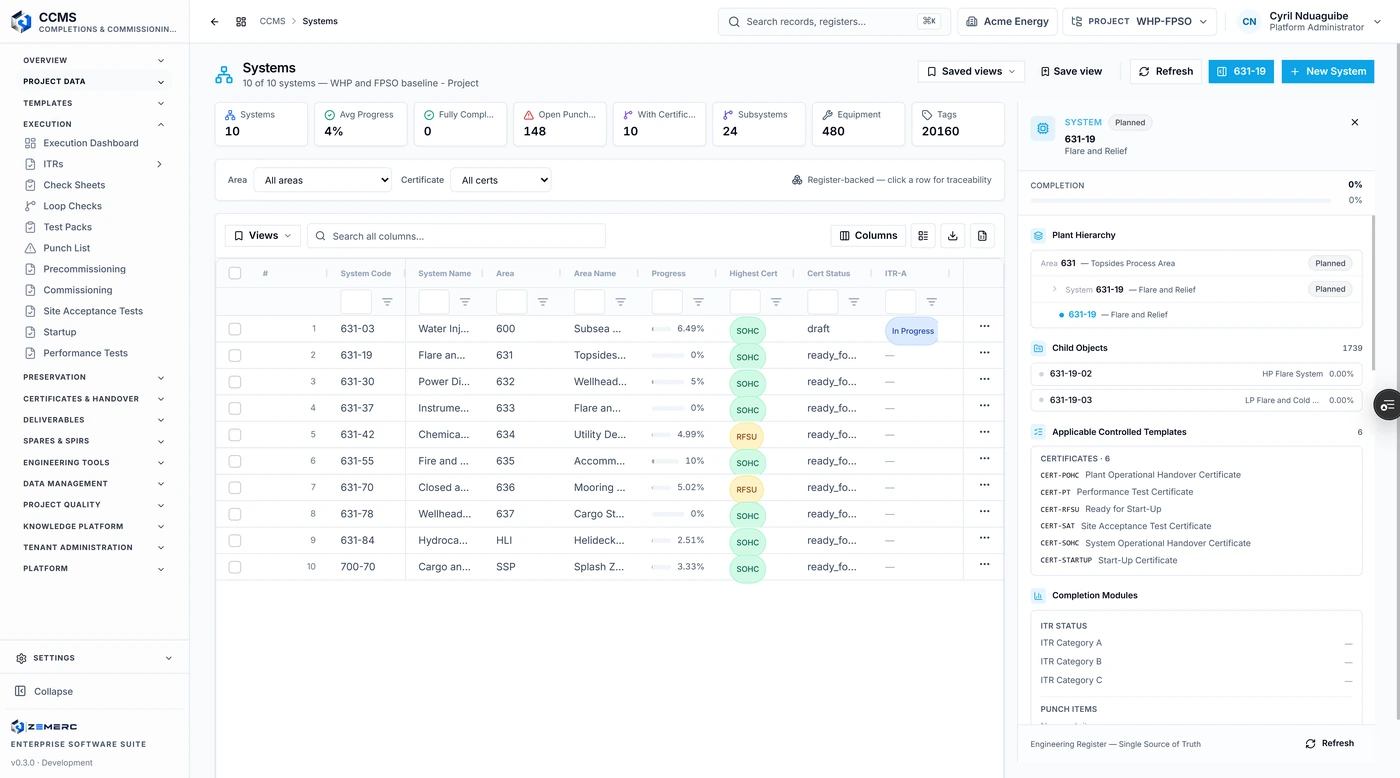
Open a system and the application shows its place in the plant hierarchy, the controlled certificate templates that apply, and what stands between it and its next gate.
- Completion as records reachedProgress is shown as records reached against records required, so the figure can always be taken apart.
- Punch that blocks by categoryCategory A punch is counted against the system it belongs to rather than aggregated into one cleared percentage.
- Acknowledged, not merely sent.A transmittal that has been issued but not acknowledged remains an open control point and is reported as such.

Bring one system's punch list.
The walkdown produces the records the certificate will be issued against. Nothing further down the chain can be stronger than what was written here.
- Certificate chain; CCMS holds the MC, RFC, RFSU and handover sequence per system.
- Traceability; QMS keeps material and weld traceability with the quality dossier.
- Digital handover; SPIR delivers vendor data, transmittals and spares records as one handover centre.

Disposition is an engineering decision, not an administrative one.
Use as is, repair, rework, reject and return have different consequences for the asset. Disposition is therefore made by the authorised technical role rather than by the originator of the non-conformance or by schedule pressure.
- Classification, severity and source held as three separate questions
- Cancelled held apart from closed, so closure rate cannot be improved by cancelling
- Material traced from heat number through lot to the equipment it became
3 applications, each operable on its own.
Adopt one and it works. Adopt the area and the records line up. No application here depends on another to run.
- CCMS
CCMS: Completion, Commissioning & Handover Management System
ITRs, punch lists, certificate sequence and turnover packages.
See the interface - QMS
QMS: Quality Management System
ITPs, inspections, NCR and CAPA, traceability and quality dossiers.
See the interface - SPIR
SPIR: Spare Parts Interchangeability Record Management System
Spares, transmittals, vendor portal and digital handover records.
See the interface

Where this area is actually worked.
The person who signs is the person who checked, and the record carries their name against the template revision that was in force on the day.
- Gates from records; Readiness is computed from the ITR and punch records, as the OPEP gate view shows.
Before the first working session.
Which applications belong here?
CCMS (completions and commissioning), QMS (quality), SPIR (spares and engineering information).
How is readiness decided?
From the records: OPEP's readiness gates read inspection, test and certificate records and report ready, not ready or cannot be determined, never a declared status.
Can I start with quality only?
Yes. QMS runs on its own and pairs with CCMS when completions are added.
Certificate chain
CCMS holds the MC, RFC, RFSU and handover sequence per system.
Traceability
QMS keeps material and weld traceability with the quality dossier.
Digital handover
SPIR delivers vendor data, transmittals and spares records as one handover centre.
Gates from records
Readiness is computed from the ITR and punch records, as the OPEP gate view shows.
Bring one system's punch list
We will show how readiness is read from it.