
Govern the project. See delivery clearly.
Cost, interfaces and delivery governance held on one project record, from portfolio view to stage gate.
- 3
- Applications
- 5
- Stages in the flow

One version of project truth
Cost, interfaces and delivery governance held on one project record, from portfolio view to stage gate.
One version of project truth
Estimate, budget, commitment, actual and forecast sit in one financial chain rather than in reconciled spreadsheets.
Gates read the record
Stage gates and delivery health are read from the workspaces that hold the work, not declared in a status report.
Interfaces owed, not assumed
What one party owes another on a capital project is registered, agreed and closed on evidence.
5 stages, each owned by an application.
Every stage is a working part of a Zemerc application today, and each application runs on its own. An operating area is how they are bought, not a bundle they have to be bought in.
Every project in one governed view.
PDMS: Project Delivery Management System
Integrated delivery governance: portfolio, project workspaces and stage gates.
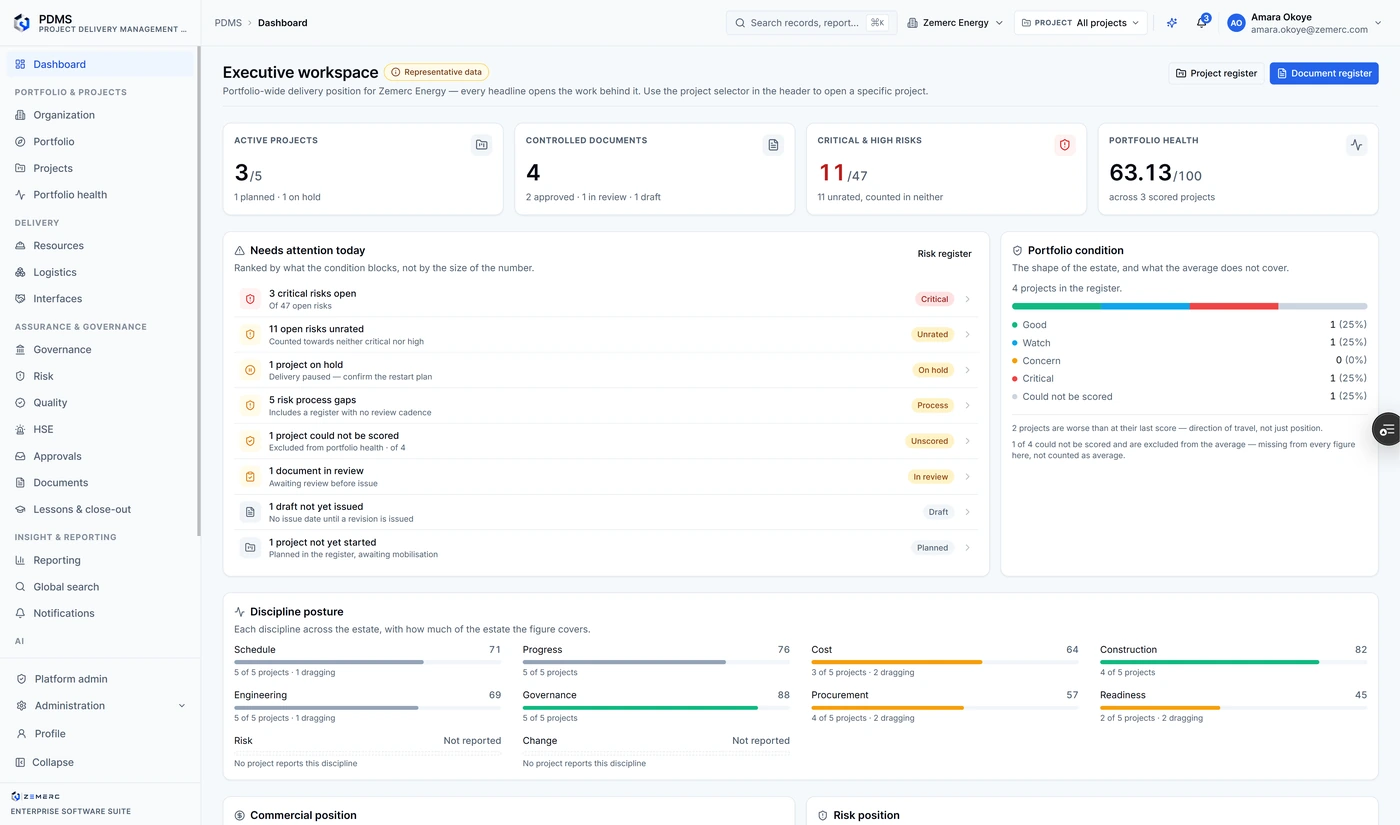
Portfolio health is scored across the estate, and a project that cannot be scored is named as unscoreable rather than dropped from the average.
- Health that names its exclusionsPortfolio health is scored across projects, and the ones that cannot be scored are listed rather than quietly left out of the average.
- Forecast, or an honest refusalA completion forecast is projected from observed run-rate with a countable spread, and refused where the history will not support one.
- Registers reported on their upkeepRisk registers with no review cadence, reviews past their date and escalations unacknowledged are reported as their own figures.
One delivery record, read by three applications.
Delivery governance, cost control and interface management are separate disciplines with separate owners. They fail together when each keeps its own copy of the project.
- Delivery governanceCost
A stage gate reads the cost position rather than a reported summary of it
- InterfacesDelivery governance
An unresolved interface surfaces as a constraint on the gate it blocks
- CostContracts
A commitment becomes a contractual obligation with certification behind it

Bring one project. We will show its delivery record.
A stage gate is taken by people standing in front of the work, against the evidence the workspaces hold rather than a status somebody typed the night before.
- Governed cost record; BCMS keeps the whole financial chain in one place, with earned value derived from it.
- Standalone applications; PDMS, BCMS and IFMS each run on their own; a project can start with one.
- Traceable decisions; Interface decisions and their supersession are kept, so the history is auditable.
Capital projects fail at the boundary, not inside a company.
Engineering and contractual interface failures commonly arise where accountability is assumed rather than defined. IFMS numbers each interface, identifies accountable parties on both sides and measures closure against the agreed required-by date.
- Technical, organisational, contractual and stakeholder interfaces in one register
- Under review held apart from open, so waiting on somebody is visible
- Performance reported per responsible organisation, not only per project

3 applications, each operable on its own.
Adopt one and it works. Adopt the area and the records line up. No application here depends on another to run.
- PDMS
PDMS: Project Delivery Management System
Integrated delivery governance: portfolio, project workspaces and stage gates.
See the interface - BCMS
BCMS: Budget & Cost Management System
Estimate, budget, commitment, actual and forecast in one financial chain.
See the interface - IFMS
IFMS: Interface Management System
Governed interfaces between parties on capital projects.
See the interface

Where this area is actually worked.
The portfolio review reads the same record the project team updates, which is what makes a recovery conversation about the work rather than about whose spreadsheet is right.
- Office and site; operate from the same governed project record, so the position reviewed by the project office is derived from the records updated by the delivery team.
Before the first working session.
Which applications belong here?
PDMS for delivery governance, BCMS for budget and cost, IFMS for interfaces. Contracts (CMS) sit in supply chain but pair closely.
Can they be deployed independently?
Yes. Each is a standalone application. BCMS is a common first step for cost control.
Do they work together?
Where records genuinely relate: commitments and payment certification connect BCMS and CMS; PDMS gates read the workspace records.
Governed cost record
BCMS keeps the whole financial chain in one place, with earned value derived from it.
Standalone applications
PDMS, BCMS and IFMS each run on their own; a project can start with one.
Traceable decisions
Interface decisions and their supersession are kept, so the history is auditable.
Office and site
operate from the same governed project record, so the position reviewed by the project office is derived from the records updated by the delivery team.
Bring one project. We will show its delivery record
A working session on your portfolio, a live project or a cost baseline.