
Vessel Management Tracker
The spread runs on a day. So does the record.
One governed system for a marine spread, covering the vessel register and fleet lifecycle, campaigns and spreads, daily operational records, downtime classification, planning, assurance and commercial rating.
- 0
- Governed datasets
- 0
- Reports in the catalogue
- 0
- Data domains
- 0
- Exportable datasets

The record is made offshore. The argument happens onshore.
Every figure the commercial position is built from starts as somebody on a vessel writing down what happened that day. VMT is organised around that hand-off rather than around the month-end it eventually produces.
Records the day: hours, activity, people aboard, consumption and what stopped.
Hands onOne operational record for the date
Everything downstream depends on what the register says a vessel is.
Vessel category, type, class, declared capability, contractor and lifecycle state are retained as governed attributes and can be filtered or assessed as at a specified date. A vessel without an assigned lifecycle state is reported explicitly as unclassified.
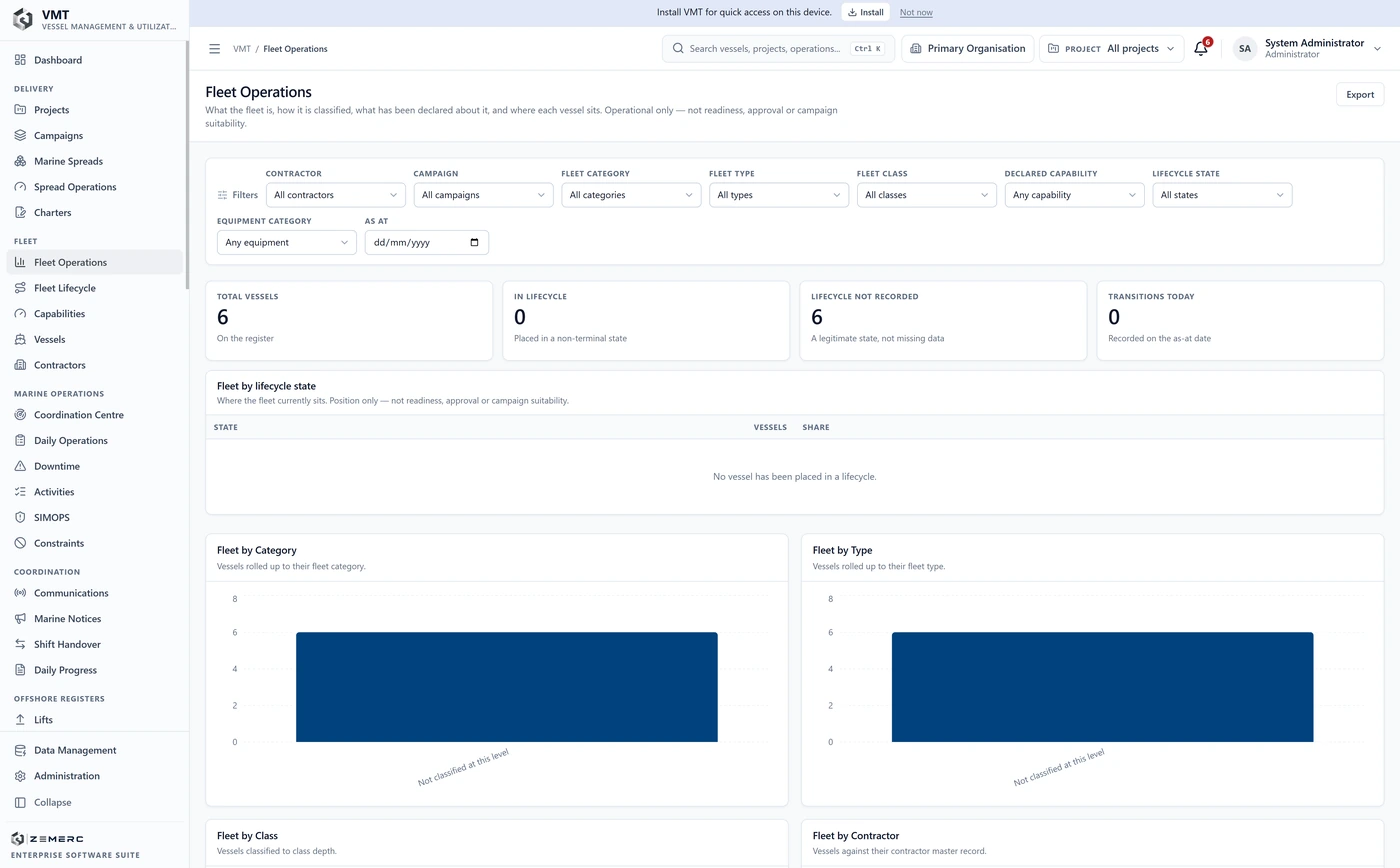
Operational only. This screen states what the fleet is; it does not assert readiness, approval or campaign suitability, which are decided elsewhere.
- As at a dateThe fleet can be read as it stood on a chosen day rather than only as it stands now.
- Declared, not assumedA capability is something recorded against a vessel, so what it was hired to do can be checked against what it was said to be able to do.
- Contractor is a master recordVessels roll up to the contractor that owns them, which is what makes a scorecard meaningful.
A blank that means something is not a zero.
The failure mode of a vessel workbook is not arithmetic. It is a gap that gets filled with a nought, travels into a claim, and is discovered six weeks later by the other side. VMT refuses to do that.
- 0
- Governed datasets
- 0
- Reports in the catalogue
- 0
- Data domains
- 0
- Exportable datasets
Operate. Each day produces one operational record: hours, activity, people aboard and consumption.
Verification is not payment.
The rating engine calculates the governed commercial position for a period from the underlying operational records and records the engine version and calculation time. Supplier claims can then be compared with the system-derived position.
Six groups, one vessel day underneath all of them.
Safety, assurance, commercial and coordination functions operate over the same governed vessel and campaign record rather than as disconnected modules.
Fleet
What the fleet is, before anything is asked of it: the vessel register, declared capabilities, the contractor each vessel belongs to, and the lifecycle state it currently sits in.
- Fleet Operations
- Fleet Lifecycle
- Capabilities
- Vessels
- Contractors
Delivery
The work the fleet is there for. Projects, campaigns and the marine spreads assembled for them, the operations run against each spread, and the charters underneath.
- Projects
- Campaigns
- Marine Spreads
- Spread Operations
- Charters
Marine operations
The daily record. Hours, consumption and activity for each vessel on each day, the downtime classified against it, simultaneous operations and the constraints in force.
- Coordination Centre
- Daily Operations
- Downtime
- Activities
- SIMOPS
- Constraints
Coordination and registers
What moves between the shore and the spread: communications, marine notices, shift handover, daily progress, and the offshore registers for lifts and conveyance.
- Communications
- Marine Notices
- Shift Handover
- Daily Progress
- Lifts
Commercial
What the operational record is worth. Rating produces the commercial position for a period, off-hire is a governed determination, and invoices are verified against the rated figure rather than paid against a claim.
- Commercial
- Off-hire
- Invoices
- Back Charges
- Contractor Scorecards
Assurance, safety and environment
Functions establish whether the spread is fit to sail and fit to work, covering marine assurance, findings and decisions, mobilisation, contractor assurance, inspections and the environmental and safety records associated with the campaign.
- Marine Assurance
- Assurance Findings
- Assurance Decisions
- Mobilisation
- Contractor Assurance
- Inspections
- Certificates
- Safety Centre
- Events
- Risk Assessments
- Toolbox Talks
- Permits
- Waste
- Emissions

Configure the application without touching code.
The states a vessel may occupy and the moves permitted between them. The SIMOPS matrix and what a shift handover must cover. Which finding severities prevent a readiness decision. The emission factors the environmental figures derive from. Each is administration, and each is versioned.
- The vessel lifecycle is an organisation decision, not a release
- Assurance severities that block readiness are configured, not hard-coded
- An immutable audit and change history across the organisation
Unresolved is not zero
Where the engine could not price a period it says which configuration was missing, and shows the period as unresolved. A gap never arrives as a zero that somebody later treats as a fact.
Not classified is a state
A vessel that has not been placed in a lifecycle, or a fleet not classified to a level, is reported as exactly that. The application distinguishes a legitimate blank from missing data.
Traceable to the day
Every commercial amount traces to the operational records behind it, and each rated period records the engine version that produced it and when.
Configured, not coded
The vessel lifecycle and its permitted moves, the SIMOPS matrix, the safety event lifecycle, emission factors and the assurance severities that block readiness are all administration, not a release.
Sixty-nine datasets, and sixty-five of them come back out.
Ten domains, twenty-nine of them accepting a file, and a historical migration that carries the provenance of every record brought in from the system before this one. The operating record is portable by design, because an operator who cannot export is an operator who is trapped.
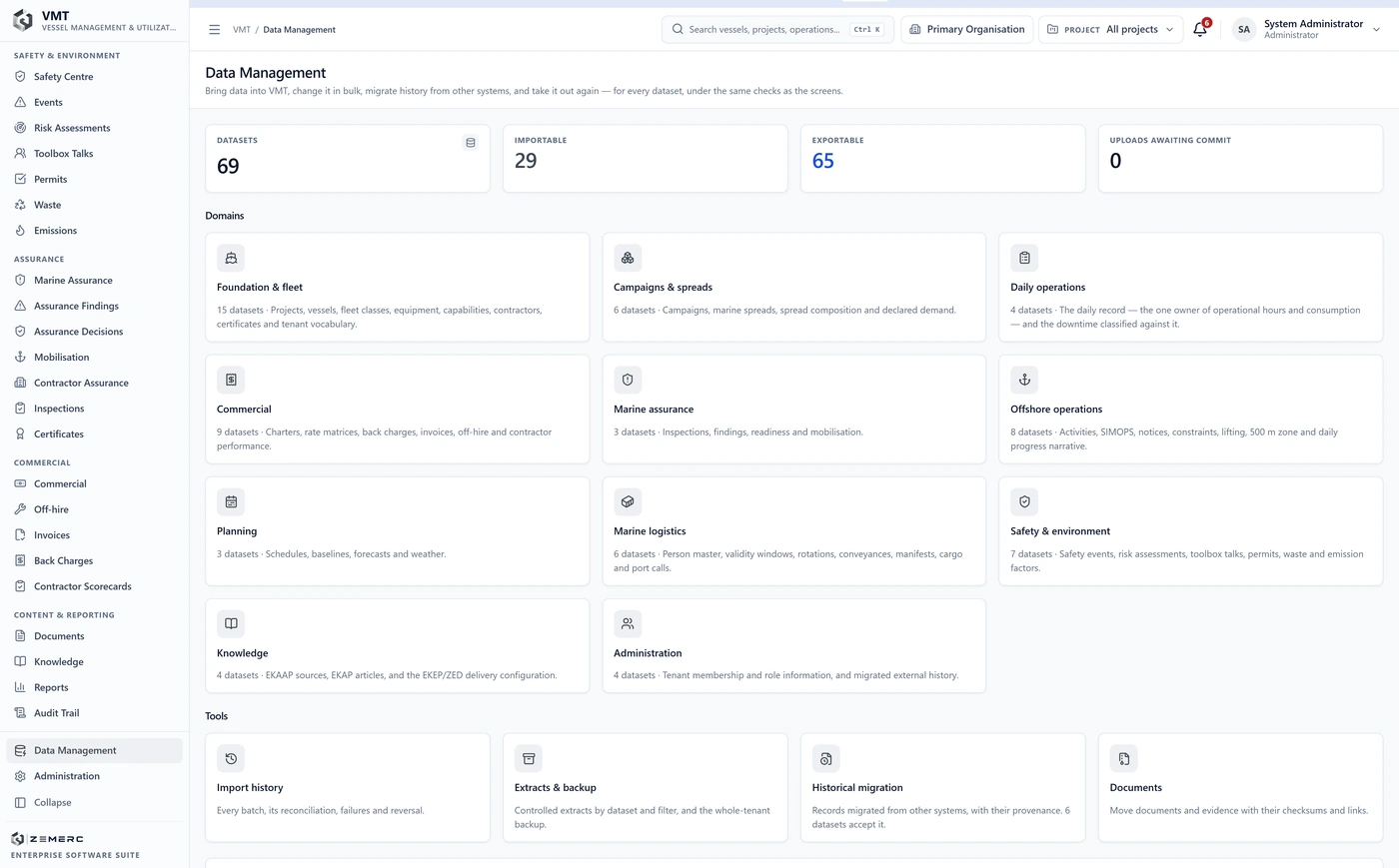
Import, bulk update, migration and extract run under the same checks the screens apply, rather than through a back door that bypasses them.

The people who lose the argument when the record is thin.
Logistics and marine coordinators, logistics managers, project engineers and project managers, and the operations management who are asked at month end why utilisation looks like that and why the off-hire claim was refused.
- Role and permission based, per organisation membership
- Certificate and inspection expiry on a thirty, fourteen, seven and zero-day ladder
- Shift handover recorded rather than messaged
More of what the application covers.
- A forward schedule with baselines, forecasts and weather held against it
- Certificate and inspection expiry reminders on a thirty, fourteen, seven and zero-day ladder
- Contractor scorecards built from the same records the commercial position is rated from
- Back charges raised against the responsible party and tracked to recovery
- Shift handover as a governed record rather than a message
- People-on-board position derived from recorded movements, beside the reported figure and stated capacity
- Historical migration that carries the provenance of every record brought in from an earlier system
- An immutable audit and change history across the whole organisation
- Sixty-five of sixty-nine datasets exportable, so the operating record can always be taken back out
The marine spread, beside the projects and logistics it serves.
- OPEPOPEP: Offshore Projects Execution PlatformOPEP governs offshore project execution; VMT governs the marine spread and vessel record supporting that project.
- LGMSLGMS: Logistics Management SystemLGMS governs logistics planning and movement; VMT governs the vessel, daily operational record and associated commercial rating.
- HSEHSE: Health, Safety & Environment Management SystemHSE governs the organisation-wide HSE lifecycle; VMT retains the vessel and campaign safety, permit and emissions records generated offshore.
Bring one month of vessel days and the off-hire argument it caused.
Using a daily vessel record, the application can classify downtime, rate the period and trace the resulting commercial position back to the operational evidence, including any conditions that prevent the engine from producing a valid result.