
Offshore Projects Execution Platform
A number is counted, not typed.
One governed system for executing an offshore project from fabrication and load-out through installation, commissioning and final handover, with reported positions derived from the underlying operational records.
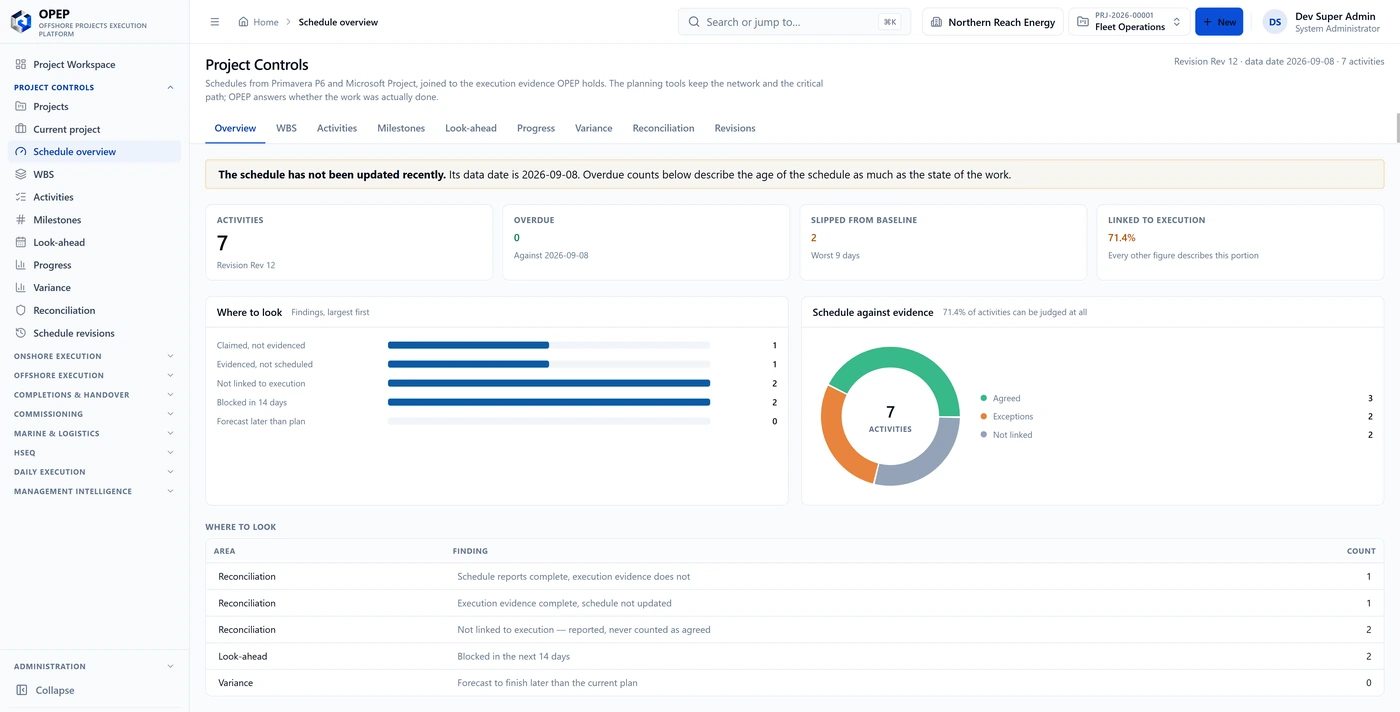
One project, three zones, one record.
Offshore projects usually run on one system in the fabrication yard, another offshore and a third for completions. OPEP holds the whole lifecycle in one place, which is what makes a schedule reconcilable against the evidence beneath it.
Fabrication in the yard: work packs, work fronts, materials and labour, with manufacturing and vendor scope tracked against the project.
Every figure here exists because a record exists.
Offshore reporting has a well-known failure mode: the number in the management report and the number the site would recognise are not the same number. OPEP derives every figure from the registers, and refuses to invent the ones it cannot.
Claimed against evidenced
The schedule is reconciled against execution evidence, so claimed-but-not-evidenced and evidenced-but-not-scheduled are both positions you can open and work through.
Not measurable is shown
Where a figure cannot be derived, the application says so. An absent measurement is never presented as zero, and never as a satisfactory result.
One register per thing
Equipment, personnel, companies, vessels and portfolios each exist once and are shared across every module, so the same vessel is the same vessel in logistics and in installation.
A non-conformance blocks the scope it was raised against, and nothing else.
Blocking readiness, overdue work, failed inspections and items awaiting verification are separate governed states. A blocking record prevents the affected scope from progressing until the required condition is resolved.
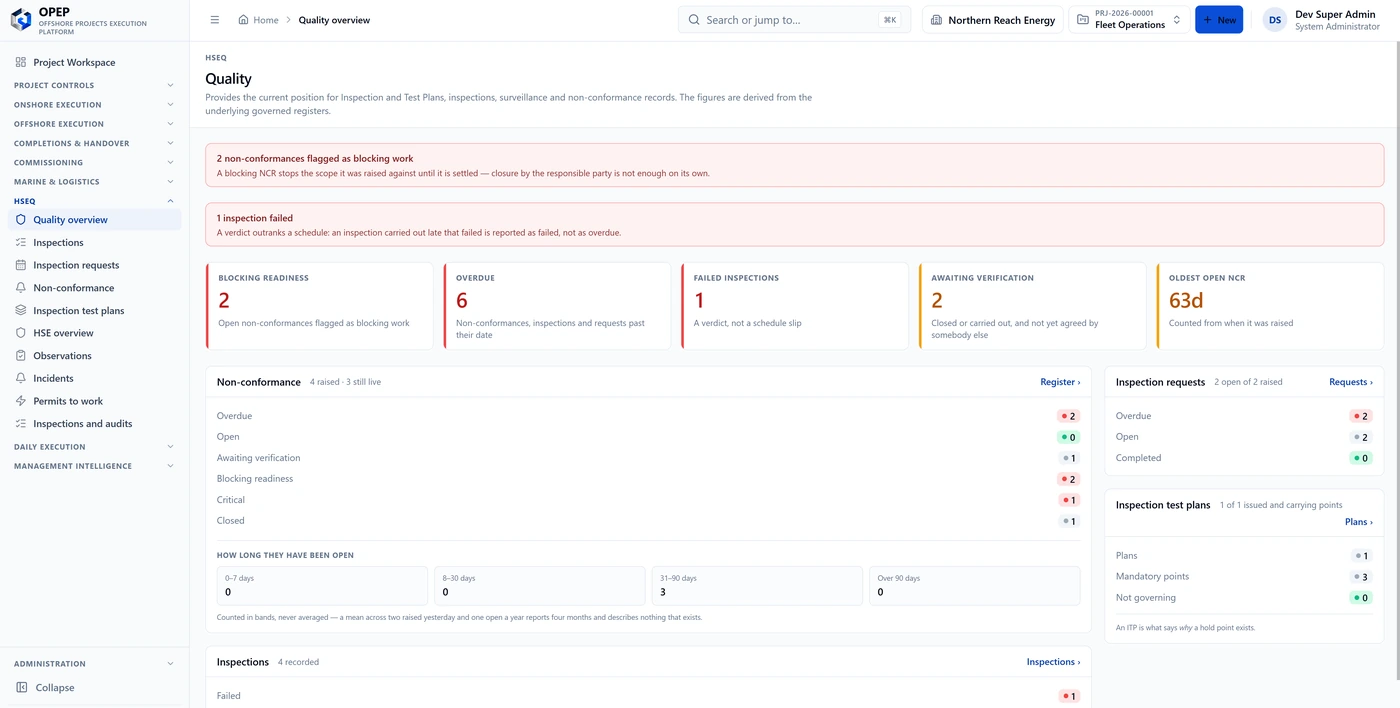
Open non-conformances are counted in age bands rather than averaged, because a mean across two years hides what matters.
- A verdict, not a slipA failed inspection is a verdict. An inspection carried out late is a schedule slip. The two are counted separately.
- A blocking non-conformance remains open until the responsible party resolves the underlying issue and the required verification is completed.Closure by the originator alone is not sufficient.
- Oldest open, namedThe oldest open non-conformance is reported by age from when it was raised, so nothing quietly ages out of view.
Cannot be determined is its own answer.
Most readiness reporting has two states, and that is the problem: a criterion nobody has evidence for gets reported as not ready, which is indistinguishable from a criterion that genuinely failed. OPEP keeps the third state.
It matters most at load-out, where the difference between “we checked and it is not ready” and “nobody checked” is the difference between a delayed sailing and an expensive one.
- Load-out readiness
- Work packs complete
- Cargo manifested
- Certificates issued
A criterion with no supporting record is reported as cannot be determined, which is held apart from not ready.
- Campaign readiness
- Vessel available
- Weather window
- Lift plan approved
Readiness is read from the registers involved rather than declared at the morning meeting.
- Mechanical completion
- Check sheets
- Punch by category
- Inspection test plans
Completion share is derived from the check sheets, so it can always be taken apart.
- Ready for start-up
- Commissioning tests
- Non-conformances cleared
- Turnover package
A blocking non-conformance stops the scope it was raised against, and nothing else.
Nine modules, arranged as the project runs.
The application's own sidebar is organised by lifecycle stage rather than by function, which is how an offshore project is actually staffed. Every chip is a page.
Project controls
Work breakdown, activities, milestones, progress and variance with look-ahead and schedule revisions, reconciled against the execution evidence rather than reported alongside it.
- Projects
- WBS
- Activities
- Milestones
- Progress
- Variance
- Look-ahead
- Reconciliation
- Schedule revisions
Onshore execution
Work packs and work fronts, materials, labour and areas through the fabrication yard, with manufacturing and vendor scope tracked against the same project record.
- Work packs
- Work fronts
- Materials
- Labour
- Areas
- Manufacturing
- Vendors
Marine and logistics
Records cover cargo, load lists, manifests, warehouse movements and persons on board, providing the operational position required to determine whether the offshore campaign can proceed as planned.
- Cargo
- Load lists
- Manifests
- Warehouse
- POB
- Marine spreads
- Vessels
Offshore installation
Campaigns, lifts and the installation sequence, with subsea scope held in the same record so a weather window and a lift plan are read against each other.
- Campaigns
- Lifts
- Sequence
- Subsea
Completions and commissioning
Records govern systems, subsystems, tags, check sheets, punch items, certificates, turnover and readiness, followed by commissioning tests, packs, activities and start-up.
- Systems
- Subsystems
- Tags
- Check sheets
- Punch
- Certificates
- Turnover
- Readiness
- Tests
- Start-up
Daily execution and assurance
Daily reports, diary, weather, constraints, actions and shift handover, with incidents, observations, permits, inspections, investigations and environmental records beside them.
- Daily reports
- Diary
- Weather
- Constraints
- Actions
- Handover
- Incidents
- Permits
- Investigations

The yard, the vessel and the platform.
Offshore oil and gas, liquefied natural gas, offshore wind and power, subsea infrastructure, marine construction, offshore utilities and carbon capture. What they share is a project where the expensive decisions are made against weather, vessel availability and whether the load-out was actually complete.
- Persons on board and crew rotation held with the campaign
- Weather windows read against the lift plan
- Daily reports, diary and shift handover as governed records
Six organisation registers, each with its own key.
Companies, equipment, personnel, portfolios, reference values and vessels. Each states the key it is identified by, the fields it requires and the limits it enforces; and reference values are the organisation's own vocabulary, never shipped with the application.

Nothing changes until an import is reviewed, approved and committed.
A controlled workbook is uploaded, the application shows exactly what it would change, and the change is applied only once it is approved. A complete portable extract of everything is available in the other direction.
Counted, not typed
Every figure is derived from the records beneath it. A progress number exists because the check sheets exist, not because somebody entered it into a report.
Not measurable, not zero
Where a figure cannot be derived the application says it is not measurable. An absent measurement never reads as a good one.
One register per thing
Equipment, personnel, companies, vessels and portfolios each live in one register shared across every module, so the same vessel is the same vessel everywhere.
Claimed against evidenced
The schedule is reconciled against execution evidence, so claimed-but-not-evidenced and evidenced-but-not-scheduled are both reportable positions.
More of what the application covers.
- Schedule reconciliation against execution evidence
- Look-ahead with blocked work in the next fourteen days
- Weather windows held against the campaign
- Persons on board and crew rotation
- Shift handover as a governed record
- Execution intelligence: attention, bottlenecks and readiness
- Signed certificates among the controlled documents
- Portable data extract of the whole organisation
One project end to end, beside the portfolio and the fleet.
- OPMSOPMS: Offshore Projects Management SystemPortfolio management and reporting across an offshore department; OPEP executes one project end to end.
- VMTVMT: Vessel Management TrackerFleet, charters and vessel performance; OPEP uses the marine spread supporting the campaign.
- CCMSCCMS: Completion, Commissioning & Handover Management SystemCompletion and commissioning depth, where a project needs the full certificate library.
- SPIRSPIR: Spare Parts Interchangeability Record Management SystemSpares and the digital handover record the operator receives.
See OPEP with one of your offshore campaigns.
Bring one campaign with its work packs, its load list and its check sheets. We will show the schedule reconciled against the evidence, and the readiness the records actually support.